Department of Nephrology and Dialysis, Institute of Nephrology of the National Academy of Medical Sciences of Ukraine, Kyiv, Ukraine.
Korean J Intern Med. 2022 Jan;37(1):167-178. doi: 10.3904/kjim.2020.561. Epub 2021 Jun 25.
BACKGROUND/AIMS: It was hypothesized that oxalate might be strongly involved in atherogenesis and the inflammatory pathway that could result in an increased risk of cardiovascular disease (CVD) in end-stage renal disease (ESRD) patients. Therefore, this study aimed to address two primary research questions: to characterize the lipid profile and the pattern of pro-inflammatory cytokines according to plasma oxalic acid (POx) concentration in ESRD patients; to evaluate the potential role of elevated POx concentration in the development of CVD risk.
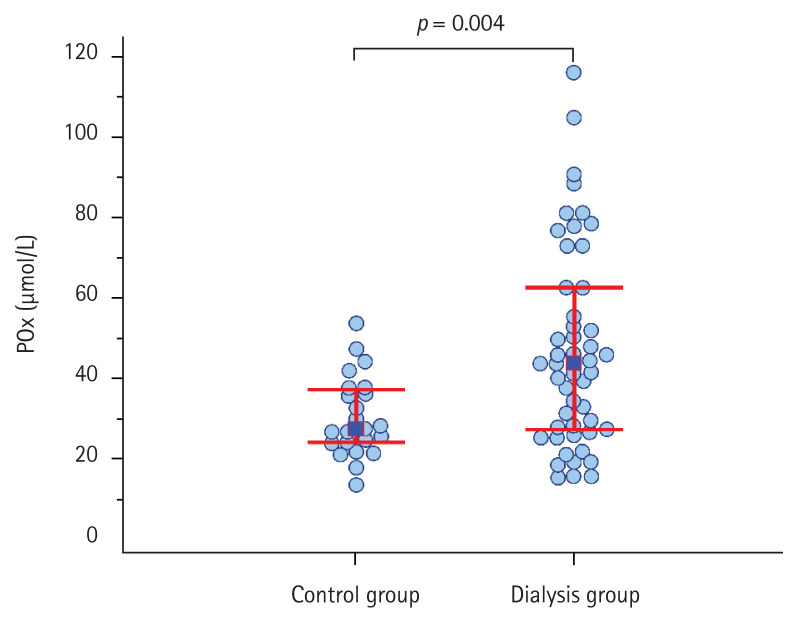
A total of 73 participants were enrolled in this prospective, observational cohort pilot study. Among them, there were 50 ESRD patients and 23 healthy volunteers. The lipid profile and the pro-inflammatory cytokines were analyzed according to the distribution of POx concentration into tertiles. After the clinical examination, 29 hemodialysis patients and 21 peritoneal dialysis patients without prevalent CVD were observed for CVD events for 2 years. The Cox regression analysis and a set of different types of sensitivity analyses were used to determine whether elevated POx was associated with an increased risk of CVD.
An increasing trend in the atherogenic lipoprotein fractions and the pro-inflammatory markers as well as a linear decrease in high-density lipoprotein was significantly associated with elevated POx. POx concentration ≥ 62.9 μmol/L was significantly associated with CVD events independently of other examined CVD risk factors.
This pilot study firstly demonstrated a potential contribution of POx to atherogenesis, inflammation and CVD risk in ESRD patients.
背景/目的:据推测,草酸盐可能在动脉粥样硬化和炎症途径中起重要作用,从而导致终末期肾病(ESRD)患者心血管疾病(CVD)风险增加。因此,本研究旨在解决两个主要研究问题:根据 ESRD 患者血浆草酸盐(POx)浓度,描述血脂谱和促炎细胞因子的模式;评估 POx 浓度升高在 CVD 风险发展中的潜在作用。
本前瞻性观察队列研究共纳入 73 名参与者,其中包括 50 名 ESRD 患者和 23 名健康志愿者。根据 POx 浓度的分布将血脂谱和促炎细胞因子分为三分位。临床检查后,观察 29 名无 CVD 且未接受过治疗的血液透析患者和 21 名腹膜透析患者 2 年内发生 CVD 事件。使用 Cox 回归分析和一系列不同类型的敏感性分析来确定 POx 是否与 CVD 风险增加相关。
随着 POx 水平的升高,致动脉粥样硬化脂蛋白片段和促炎标志物呈上升趋势,高密度脂蛋白呈线性下降。POx 浓度≥62.9 μmol/L 与 CVD 事件显著相关,独立于其他检查的 CVD 危险因素。
本研究首次证明了 POx 在 ESRD 患者的动脉粥样硬化形成、炎症和 CVD 风险中的潜在作用。