Izquierdo Elisa, Proszek Paula, Pericoli Giulia, Temelso Sara, Clarke Matthew, Carvalho Diana M, Mackay Alan, Marshall Lynley V, Carceller Fernando, Hargrave Darren, Lannering Birgitta, Pavelka Zdenek, Bailey Simon, Entz-Werle Natacha, Grill Jacques, Vassal Gilles, Rodriguez Daniel, Morgan Paul S, Jaspan Tim, Mastronuzzi Angela, Vinci Mara, Hubank Michael, Jones Chris
Division of Molecular Pathology, Institute of Cancer Research, London, UK.
Molecular Diagnostics, Royal Marsden Hospital NHS Trust, Sutton, UK.
Neurooncol Adv. 2021 Jan 27;3(1):vdab013. doi: 10.1093/noajnl/vdab013. eCollection 2021 Jan-Dec.
The use of liquid biopsy is of potential high importance for children with high grade (HGG) and diffuse midline gliomas (DMG), particularly where surgical procedures are limited, and invasive biopsy sampling not without risk. To date, however, the evidence that detection of cell-free DNA (cfDNA) or circulating tumor DNA (ctDNA) could provide useful information for these patients has been limited, or contradictory.
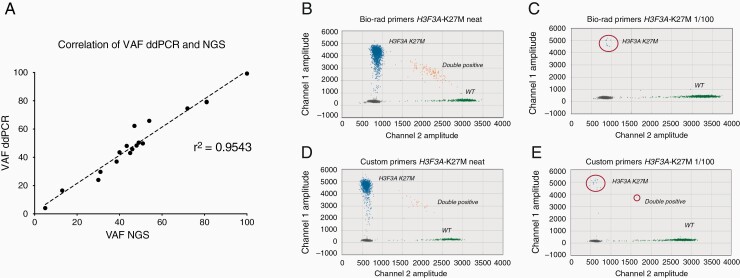
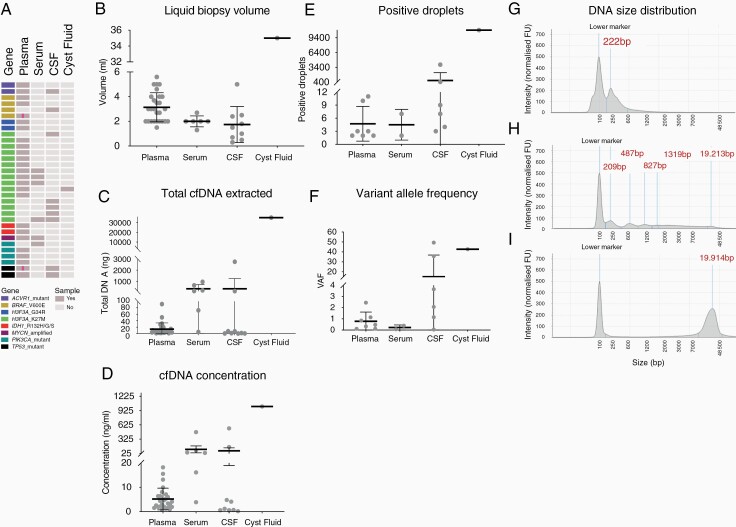
We optimized droplet digital PCR (ddPCR) assays for the detection of common somatic mutations observed in pediatric HGG/DMG, and applied them to liquid biopsies from plasma, serum, cerebrospinal fluid (CSF), and cystic fluid collected from 32 patients.
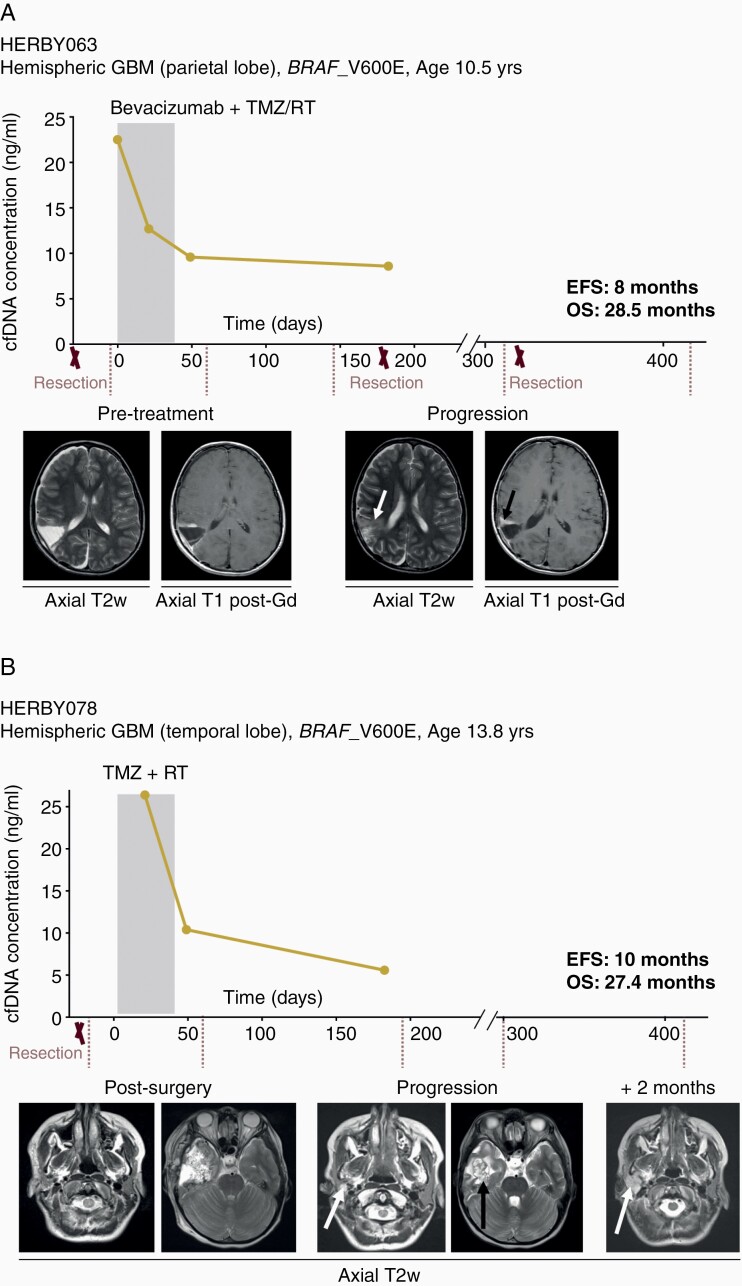
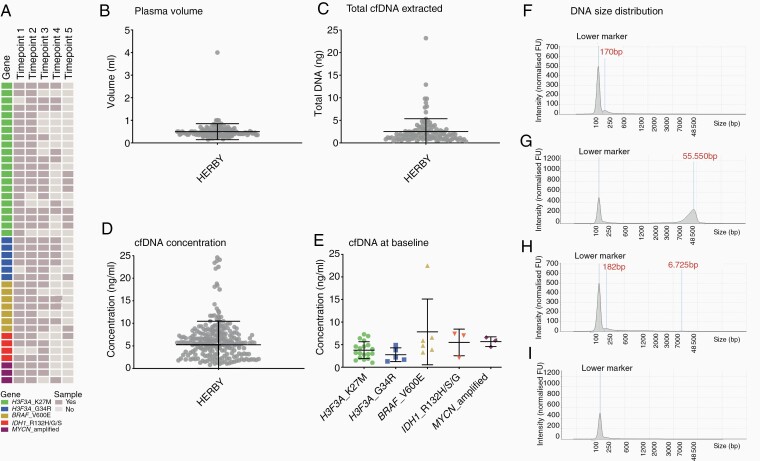
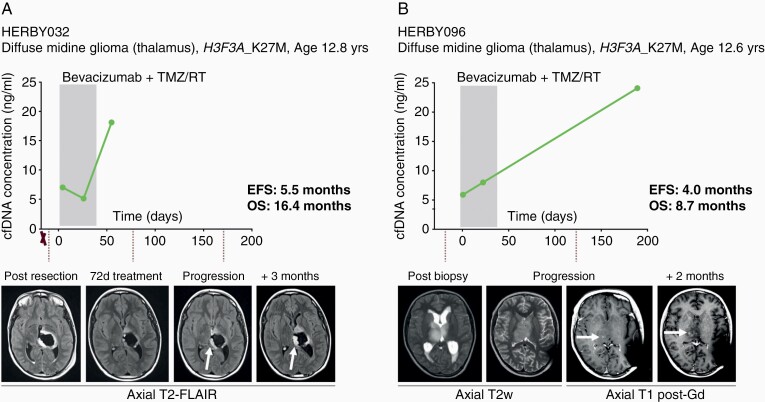
Although detectable in all biomaterial types, ctDNA presented at significantly higher levels in CSF compared to plasma and/or serum. When applied to a cohort of 127 plasma specimens from 41 patients collected from 2011 to 2018 as part of a randomized clinical trial in pediatric non-brainstem HGG/DMG, ctDNA profiling by ddPCR was of limited use due to the small volumes (mean = 0.49 mL) available. In anecdotal cases where sufficient material was available, cfDNA concentration correlated with disease progression in two examples each of poor response in _K27M-mutant DMG, and longer survival times in hemispheric _V600E-mutant cases.
Tumor-specific DNA alterations are more readily detected in CSF than plasma. Although we demonstrate the potential of the approach to assessing tumor burden, our results highlight the necessity for adequate sample collection and approach to improve detection if plasma samples are to be used.
对于患有高级别胶质瘤(HGG)和弥漫性中线胶质瘤(DMG)的儿童,液体活检可能具有高度重要性,特别是在手术操作受限且侵入性活检采样存在风险的情况下。然而,迄今为止,无细胞DNA(cfDNA)或循环肿瘤DNA(ctDNA)检测可为这些患者提供有用信息的证据有限或相互矛盾。
我们优化了液滴数字PCR(ddPCR)检测方法,以检测儿科HGG/DMG中常见的体细胞突变,并将其应用于从32例患者收集的血浆、血清、脑脊液(CSF)和囊液的液体活检样本。
尽管在所有生物材料类型中均可检测到,但与血浆和/或血清相比,CSF中的ctDNA水平明显更高。在一项2011年至2018年收集的41例患者的127份血浆样本队列中,作为儿科非脑干HGG/DMG随机临床试验的一部分,由于可用体积较小(平均 = 0.49 mL),通过ddPCR进行的ctDNA分析用途有限。在有足够材料的个别案例中,在_K27M突变型DMG反应不佳的两个例子以及半球_V600E突变型病例中生存期较长的两个例子中,cfDNA浓度与疾病进展相关。
与血浆相比,在CSF中更容易检测到肿瘤特异性DNA改变。尽管我们证明了该方法评估肿瘤负荷的潜力,但我们的结果强调了如果要使用血浆样本,进行充分样本采集和改进检测方法的必要性。