Department of Radiation Oncology, Imaging Division, University Medical Center Utrecht, Utrecht University, Utrecht, The Netherlands.
Department of Otolaryngology-Head and Neck Surgery and Cancer Center Amsterdam, Amsterdam UMC, Vrije Universiteit Amsterdam, Amsterdam, The Netherlands.
Support Care Cancer. 2021 Dec;29(12):7793-7803. doi: 10.1007/s00520-021-06368-6. Epub 2021 Jun 25.
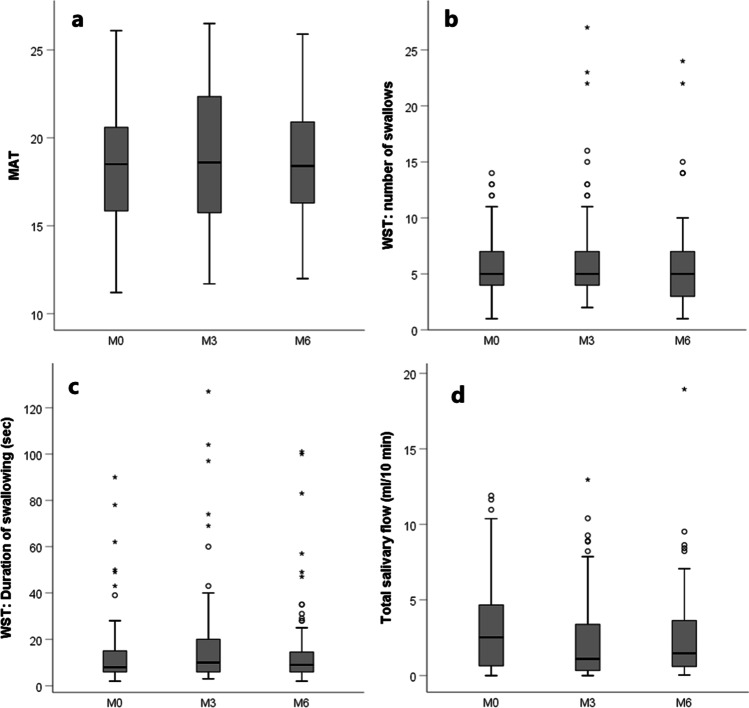
Before and after treatment for head and neck cancer (HNC), many patients have problems with mastication, swallowing, and salivary flow. The aim of this study was to investigate the association between objective test outcomes of mastication, swallowing, and salivary flow versus patient-reported outcomes (PROs) measuring mastication-, swallowing-, and salivary flow-related quality of life.
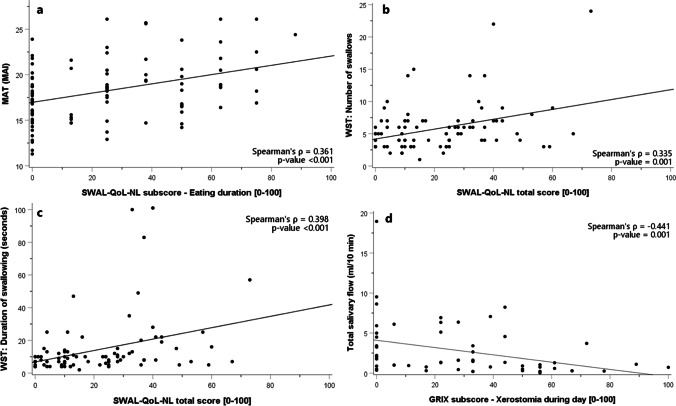
Data of the prospective cohort "Netherlands Quality of Life and Biomedical Cohort Study" was used as collected before treatment, and 3 and 6 months after treatment. Spearman's rho was used to test the association between objective test outcomes of the mixing ability test (MAT) for masticatory performance, the water-swallowing test (WST) for swallowing performance, and the salivary flow test versus PROs (subscales of the EORTC QLQ-H&N35, Swallow Quality of Life questionnaire (SWAL-QoL-NL) and Groningen Radiation-Induced Xerostomia (GRIX)).
Data of 142 patients were used, and in total, 285 measurements were performed. No significant correlations were found between the MAT or WST and subscales of the EORTC QLQ-H&N35. Significant but weak correlations were found between the MAT or WST and 4 subscales of the SWAL-QoL-NL. Weak to moderate correlations were found between the salivary flow test and GRIX at 3 and 6 months after treatment, with the highest correlation between salivary flow and xerostomia during the day (Spearman's rho = - 0.441, p = 0.001).
The association between objective test outcomes and PROs is weak, indicating that these outcome measures provide different information about masticatory performance, swallowing, and salivary flow in patients with HNC.
头颈部癌症(HNC)患者在治疗前后可能会出现咀嚼、吞咽和唾液流等问题。本研究旨在调查咀嚼、吞咽和唾液流的客观测试结果与测量与咀嚼、吞咽和唾液流相关的生活质量的患者报告结果(PRO)之间的相关性。
使用前瞻性队列“荷兰生活质量和生物医学队列研究”的数据,这些数据是在治疗前、治疗后 3 个月和 6 个月收集的。使用 Spearman 秩相关检验来检验咀嚼混合能力测试(MAT)的咀嚼性能、吞咽性能的水吞咽测试(WST)和唾液流测试与 PRO(EORTC QLQ-H&N35 的子量表、吞咽生活质量问卷(SWAL-QoL-NL)和格罗宁根辐射诱导的口干症(GRIX))之间的关联。
使用了 142 名患者的数据,共进行了 285 次测量。MAT 或 WST 与 EORTC QLQ-H&N35 的子量表之间没有发现显著相关性。MAT 或 WST 与 SWAL-QoL-NL 的 4 个子量表之间存在显著但较弱的相关性。在治疗后 3 个月和 6 个月时,唾液流测试与 GRIX 之间存在弱至中度相关性,唾液流与白天口干症之间的相关性最高(Spearman 秩相关系数为-0.441,p=0.001)。
客观测试结果与 PRO 之间的相关性较弱,表明这些结果测量方法提供了关于 HNC 患者咀嚼、吞咽和唾液流的不同信息。