HRB Centre for Health and Diet Research, School of Public Health, University College Cork, Cork, Ireland.
PLoS One. 2021 Jun 25;16(6):e0253537. doi: 10.1371/journal.pone.0253537. eCollection 2021.
Type 2 diabetes is a leading cause of death and disability worldwide and pre-diabetes is a strong predictor of diabetes development. To date, studies estimating the prevalence of pre-diabetes in the Irish population are sparse and conflicting. Monitoring the prevalence of pre-diabetes and a knowledge of associated factors is required to inform policies and to prevent development of type 2 diabetes. Therefore, this research examined the prevalence and correlates of pre-diabetes in a sample of middle- to older-aged Irish adults using three different methods for diagnosis.
The Mitchelstown Cohort Rescreen (2016/17) was a follow-up, cross-sectional study of the Mitchelstown Cohort Study (2010/11). 1,378 participants were recruited from a random sample of patients attending a single primary care centre. Pre-diabetes was defined using three diagnostic criteria: American Diabetes Association (ADA) glycated haemoglobin A1c (HbA1c) cut-offs between 5.7%-6.4% (39-46 mmol/mol), World Health Organization International Expert Committee (WHO-IEC) HbA1c cut-offs between 6.0%-6.4% (42-46 mmol/mol) and ADA fasting plasma glucose (FPG) cut-offs between 5.6-6.9 mmol/l. Univariate and multivariable logistic regression analyses were used to determine factors associated with pre-diabetes.
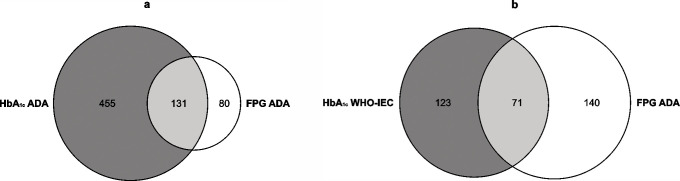
The prevalence of pre-diabetes was found to be 43.9% (95% CI: 41.2%─46.5%), 14.5% (95% CI: 12.7%─16.5%) and 15.8% (95% CI: 13.9%─17.8%) according to HbA1c ADA, HbA1c WHO-IEC and FPG ADA definitions, respectively. Depending on diagnostic method, factors associated with pre-diabetes in univariate analyses included sex, age, marital status, health rating, education and poor diet quality. In multivariable analysis, subjects classified by the FPG ADA pre-diabetes criterion displayed the least optimal metabolic profile defined by overweight and obesity (OR = 2.88, 95% CI: 1.53-5.43), hypertension (OR = 2.27, 95% CI: 1.51-3.40) and low high-density lipoprotein cholesterol concentrations (OR = 1.75, 95% CI: 1.07-2.87).
The discordance between prevalence estimates according to method of diagnosis is concerning. A National Diabetes Prevention Programme is currently being developed in Ireland. Monitoring the prevalence of pre-diabetes over time will be important to assess the effectiveness of this programme. This study will inform national decision-makers on which definition of pre-diabetes to use for monitoring purposes.
2 型糖尿病是全球范围内导致死亡和残疾的主要原因,而糖尿病前期是糖尿病发展的强有力预测指标。迄今为止,估计爱尔兰人群中糖尿病前期患病率的研究很少且相互矛盾。监测糖尿病前期的患病率和相关因素的知识对于制定政策和预防 2 型糖尿病的发生是必要的。因此,本研究使用三种不同的诊断方法,检查了中年至老年爱尔兰成年人样本中糖尿病前期的患病率和相关因素。
米切尔斯顿队列再筛查(2016/17 年)是米切尔斯顿队列研究(2010/11 年)的随访、横断面研究。从单一初级保健中心就诊的患者随机样本中招募了 1378 名参与者。糖尿病前期采用三种诊断标准定义:美国糖尿病协会(ADA)糖化血红蛋白 A1c(HbA1c)5.7%-6.4%(39-46mmol/mol)、世界卫生组织国际专家委员会(WHO-IEC)HbA1c 6.0%-6.4%(42-46mmol/mol)和 ADA 空腹血糖(FPG)5.6-6.9mmol/l。采用单变量和多变量逻辑回归分析确定与糖尿病前期相关的因素。
根据 HbA1c ADA、HbA1c WHO-IEC 和 FPG ADA 定义,糖尿病前期的患病率分别为 43.9%(95%CI:41.2%-46.5%)、14.5%(95%CI:12.7%-16.5%)和 15.8%(95%CI:13.9%-17.8%)。在单变量分析中,与糖尿病前期相关的因素包括性别、年龄、婚姻状况、健康状况评分、教育程度和不良饮食质量。在多变量分析中,根据 FPG ADA 糖尿病前期标准分类的受试者表现出最不理想的代谢特征,包括超重和肥胖(OR=2.88,95%CI:1.53-5.43)、高血压(OR=2.27,95%CI:1.51-3.40)和低高密度脂蛋白胆固醇浓度(OR=1.75,95%CI:1.07-2.87)。
根据诊断方法的不同,患病率估计值之间存在差异令人担忧。爱尔兰目前正在制定国家糖尿病预防计划。随着时间的推移监测糖尿病前期的患病率对于评估该计划的有效性非常重要。本研究将为国家决策者提供有关用于监测目的的糖尿病前期定义的信息。