Gutierrez-Quiceno Laura, Dammer Eric B, Johnson Ashlyn Grace, Webster James A, Shah Rhythm, Duong Duc, Yin Luming, Seyfried Nicholas T, Alvarez Victor E, Stein Thor D, McKee Ann C, Hales Chadwick M
Center for Neurodegenerative Disease, Emory University School of Medicine, 615 Michael Street, Office 505H, Atlanta, GA, 30322, USA.
Department of Neurology, Emory University School of Medicine, Atlanta, GA, 30329, USA.
Mol Neurodegener. 2021 Jun 25;16(1):40. doi: 10.1186/s13024-021-00462-3.
There is an association between repetitive head injury (RHI) and a pathologic diagnosis of chronic traumatic encephalopathy (CTE) characterized by the aggregation of proteins including tau. The underlying molecular events that cause these abnormal protein accumulations remain unclear. Here, we hypothesized that identifying the human brain proteome from serial CTE stages (CTE I-IV) would provide critical new insights into CTE pathogenesis. Brain samples from frontotemporal lobar degeneration due to microtubule associated protein tau (FTLD-MAPT) mutations were also included as a distinct tauopathy phenotype for comparison.
Isobaric tandem mass tagged labeling and mass spectrometry (TMT-MS) followed by integrated differential and co-expression analysis (i.e., weighted gene co-expression network analysis (WGCNA)) was used to define modules of highly correlated proteins associated with clinical and pathological phenotypes in control (n = 23), CTE (n = 43), and FTLD-MAPT (n = 12) post-mortem cortical tissues. We also compared these findings to network analysis of AD brain.
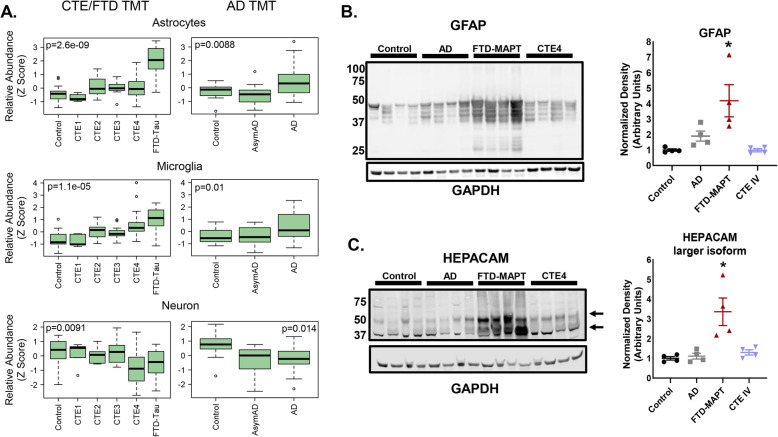
We identified over 6000 unique proteins across all four CTE stages which sorted into 28 WGCNA modules. Consistent with Alzheimer's disease, specific modules demonstrated reduced neuronal protein levels, suggesting a neurodegeneration phenotype, while other modules were increased, including proteins associated with inflammation and glial cell proliferation. Notably, unique CTE-specific modules demonstrated prominent enrichment of immunoglobulins, including IGHM and IGLL5, and extracellular matrix (ECM) proteins as well as progressive protein changes with increasing CTE pathologic stage. Finally, aggregate cell subtype (i.e., neurons, microglia, astrocytes) protein abundance levels in CTE cases were similar in expression to AD, but at intermediate levels between controls and the more exaggerated phenotype of FTLD-MAPT, especially in astrocytes.
Overall, we identified thousands of protein changes in CTE postmortem brain and demonstrated that CTE has a pattern of neurodegeneration in neuronal-synaptic and inflammation modules similar to AD. We also identified unique CTE progressive changes, including the enrichment of immunoglobulins and ECM proteins even in early CTE stages. Early and sustained changes in astrocyte modules were also observed. Overall, the prominent overlap with FTLD-MAPT cases confirmed that CTE is on the tauopathy continuum and identified CTE stage specific molecular phenotypes that provide novel insights into disease pathogenesis.
重复性头部损伤(RHI)与慢性创伤性脑病(CTE)的病理诊断之间存在关联,CTE的特征是包括tau蛋白在内的蛋白质聚集。导致这些异常蛋白质积累的潜在分子事件仍不清楚。在此,我们假设从CTE连续阶段(CTE I-IV)鉴定人脑蛋白质组将为CTE发病机制提供关键的新见解。因微管相关蛋白tau(FTLD-MAPT)突变导致的额颞叶痴呆(FTLD-MAPT)的脑样本也作为一种独特的tau蛋白病表型纳入比较。
采用等压串联质谱标记和质谱分析(TMT-MS),随后进行综合差异和共表达分析(即加权基因共表达网络分析(WGCNA)),以确定对照(n = 23)、CTE(n = 43)和FTLD-MAPT(n = 12)死后皮质组织中与临床和病理表型相关的高度相关蛋白质模块。我们还将这些发现与AD脑的网络分析进行了比较。
我们在所有四个CTE阶段鉴定出6000多种独特蛋白质,这些蛋白质被分类为28个WGCNA模块。与阿尔茨海默病一致,特定模块显示神经元蛋白水平降低,提示神经退行性变表型,而其他模块增加,包括与炎症和胶质细胞增殖相关的蛋白质。值得注意的是,独特的CTE特异性模块显示免疫球蛋白显著富集,包括IGHM和IGLL5,以及细胞外基质(ECM)蛋白,并且随着CTE病理阶段的增加蛋白质发生渐进性变化。最后,CTE病例中的聚集细胞亚型(即神经元、小胶质细胞、星形胶质细胞)蛋白质丰度水平在表达上与AD相似,但处于对照和FTLD-MAPT更夸张表型之间的中间水平,尤其是在星形胶质细胞中。
总体而言,我们在CTE死后大脑中鉴定出数千种蛋白质变化,并证明CTE在神经元-突触和炎症模块中具有与AD相似的神经退行性变模式。我们还发现了CTE的独特渐进性变化,包括即使在CTE早期阶段免疫球蛋白和ECM蛋白也会富集。还观察到星形胶质细胞模块的早期和持续变化。总体而言,与FTLD-MAPT病例的显著重叠证实CTE处于tau蛋白病连续谱上,并鉴定出CTE阶段特异性分子表型,为疾病发病机制提供了新见解。