Omran Maryam, Belcher Elizabeth K, Mohile Nimish A, Kesler Shelli R, Janelsins Michelle C, Hohmann Andrea G, Kleckner Ian R
University of Rochester Medical Center, Rochester, NY, United States.
The University of Texas at Austin, Austin, TX, United States.
Front Mol Biosci. 2021 Jun 11;8:693133. doi: 10.3389/fmolb.2021.693133. eCollection 2021.
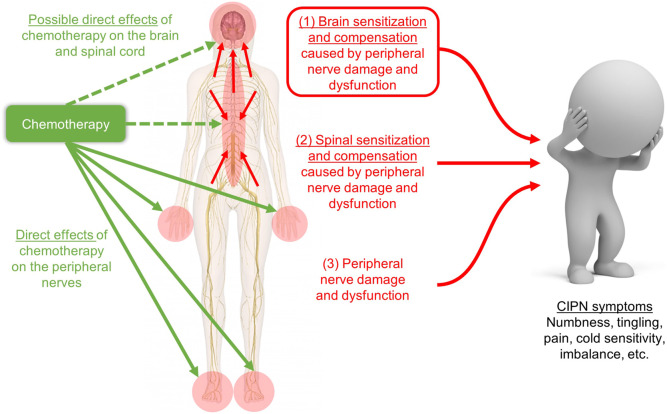
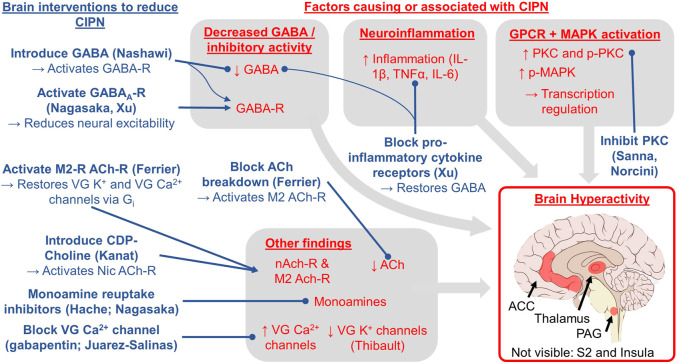
Chemotherapy-induced peripheral neuropathy (CIPN) is a common, debilitating, and dose-limiting side effect of many chemotherapy regimens yet has limited treatments due to incomplete knowledge of its pathophysiology. Research on the pathophysiology of CIPN has focused on peripheral nerves because CIPN symptoms are felt in the hands and feet. However, better understanding the role of the brain in CIPN may accelerate understanding, diagnosing, and treating CIPN. The goals of this review are to (1) investigate the role of the brain in CIPN, and (2) use this knowledge to inform future research and treatment of CIPN. We identified 16 papers using brain interventions in animal models of CIPN and five papers using brain imaging in humans or monkeys with CIPN. These studies suggest that CIPN is partly caused by (1) brain hyperactivity, (2) reduced GABAergic inhibition, (3) neuroinflammation, and (4) overactivation of GPCR/MAPK pathways. These four features were observed in several brain regions including the thalamus, periaqueductal gray, anterior cingulate cortex, somatosensory cortex, and insula. We discuss how to leverage this knowledge for future preclinical research, clinical research, and brain-based treatments for CIPN.
化疗引起的周围神经病变(CIPN)是许多化疗方案常见、使人衰弱且限制剂量的副作用,但由于对其病理生理学了解不全面,治疗方法有限。CIPN的病理生理学研究主要集中在周围神经,因为CIPN症状出现在手部和足部。然而,更好地理解大脑在CIPN中的作用可能会加快对CIPN的理解、诊断和治疗。本综述的目的是:(1)研究大脑在CIPN中的作用;(2)利用这些知识为CIPN的未来研究和治疗提供信息。我们在CIPN动物模型中鉴定出16篇使用大脑干预的论文,在患有CIPN的人类或猴子中鉴定出5篇使用脑成像的论文。这些研究表明,CIPN部分是由以下原因引起的:(1)大脑活动亢进;(2)γ-氨基丁酸能抑制作用减弱;(3)神经炎症;(4)G蛋白偶联受体/丝裂原活化蛋白激酶(GPCR/MAPK)通路过度激活。在包括丘脑、导水管周围灰质、前扣带回皮质、体感皮质和脑岛在内的几个脑区观察到了这四个特征。我们讨论了如何利用这些知识进行未来的临床前研究、临床研究以及针对CIPN的基于大脑的治疗。