Hu Weiming, DiGennaro Peter M
Department of Entomology and Nematology, University of Florida, Gainesville FL, 32611.
J Nematol. 2019 Sep 20;51. doi: 10.21307/jofnem-2019-055. eCollection 2019.
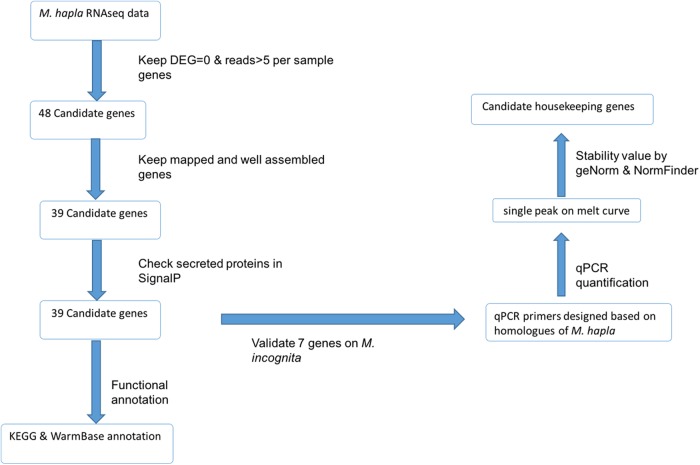
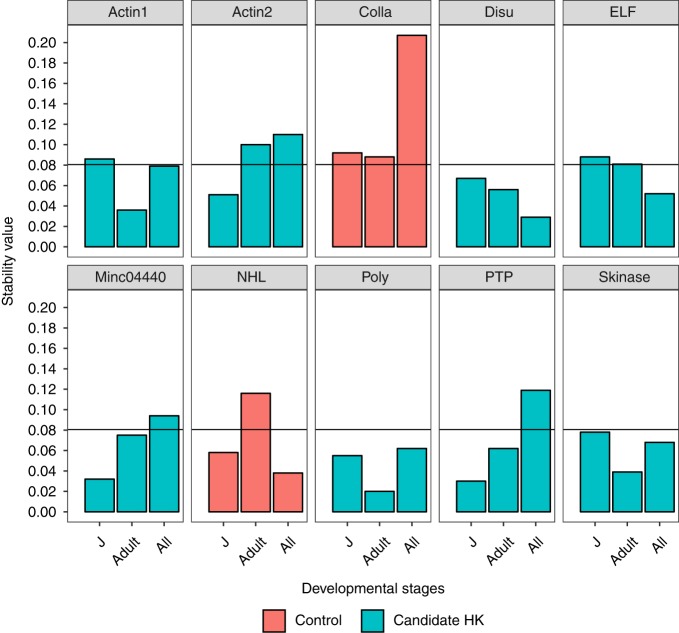
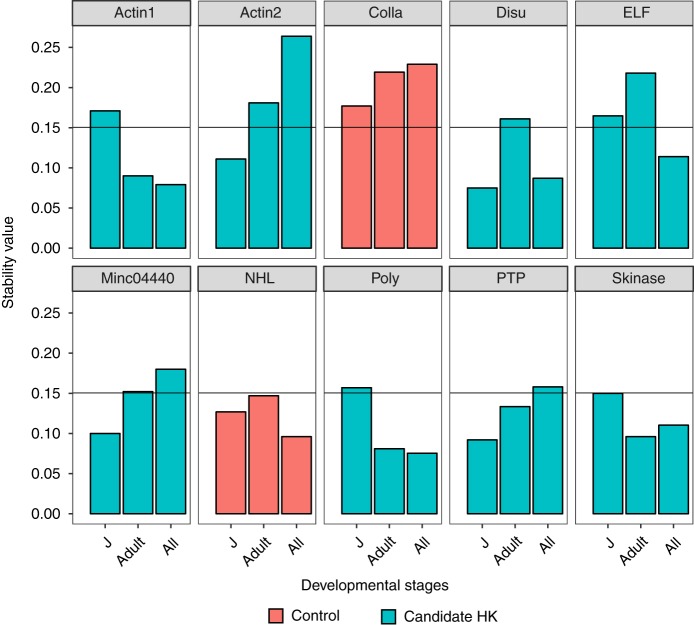
Gene expression studies often require reliable housekeeping (HK) genes to accurately capture gene expression levels under given conditions. This is especially true for root-knot nematodes (RKN, spp.), whose drastic developmental changes are strongly dependent upon their environment. Here we utilized a publicly available RNAseq database to identify putative HK genes throughout the nematode lifecycle. We then validated these candidate HK genes on in order to develop a small library of suitable HK genes for RKN. Seven putative HK genes were selected for validation based on high expression level and ease of primer design. The expression of these genes was quantified by qPCR at different developmental stages to capture the entire life cycle of which included eggs and naive infective juveniles through 3-wk post inoculation. Two algorithms, geNorm and Normfinder, identified three genes (, , and ) constitutively and uniformly expressed throughout the entire life cycle of RKN. We believe these genes are superior HK genes suitable to be used as internal reference genes at all stages of RKN. Importantly, while we identified , a commonly used HK gene, as a candidate gene within our RNAseq analyses, our qPCR results did not demonstrate stable expression throughout the nematode life cycle of this gene. This study successfully validated suitable HK genes utilizing both RNAseq data and standard qPCR methods across two species of RKN; suitable HK genes are likely applicable to other species of RKN, or even plant-parasitic nematodes. Additional lists of potential HK genes are also provided if the nematode of interest does not have homologues of the three superior reference genes described here. Gene expression studies on RKN should use validated HK genes to ensure accurate representation of transcript abundance.
基因表达研究通常需要可靠的管家(HK)基因,以准确捕捉给定条件下的基因表达水平。对于根结线虫(RKN,种)来说尤其如此,其剧烈的发育变化强烈依赖于环境。在这里,我们利用一个公开可用的RNAseq数据库来识别线虫整个生命周期中的假定HK基因。然后我们对这些候选HK基因进行了验证,以便为RKN开发一个合适的HK基因小文库。基于高表达水平和引物设计的便利性,选择了7个假定的HK基因进行验证。通过qPCR对这些基因在不同发育阶段的表达进行定量,以捕捉的整个生命周期,其中包括卵和未成熟的感染性幼虫,直至接种后3周。两种算法,geNorm和Normfinder,鉴定出在RKN整个生命周期中组成性且均匀表达的三个基因(、和)。我们认为这些基因是适合在RKN所有阶段用作内参基因的优质HK基因。重要的是,虽然我们在RNAseq分析中确定了一个常用的HK基因作为候选基因,但我们的qPCR结果并未证明该基因在整个线虫生命周期中表达稳定。本研究利用RNAseq数据和标准qPCR方法成功验证了两种RKN物种中合适的HK基因;合适的HK基因可能适用于其他RKN物种,甚至植物寄生线虫。如果感兴趣的线虫没有此处描述的三个优质参考基因的同源物,还会提供潜在HK基因的其他列表。对RKN的基因表达研究应使用经过验证的HK基因,以确保准确反映转录本丰度。