Faculty of Medicine, University of Oslo, Oslo, Norway.
Institute of Basic Medical Sciences, Department of Behavioural Medicine, Faculty of Medicine, University of Oslo, Oslo, Norway.
JAMA Netw Open. 2021 Jun 1;4(6):e2114749. doi: 10.1001/jamanetworkopen.2021.14749.
Workplace violence (WPV) is a worldwide problem in health services. Several studies have pointed to organizational factors, such as working in psychiatry and work stress. However, there is a lack of long-term longitudinal cohort studies with respect to trends during the career and individual factors among physicians.
To investigate WPV trends during Norwegian physicians' careers and assess individual and work-related factors associated with WPV in a long-term longitudinal study.
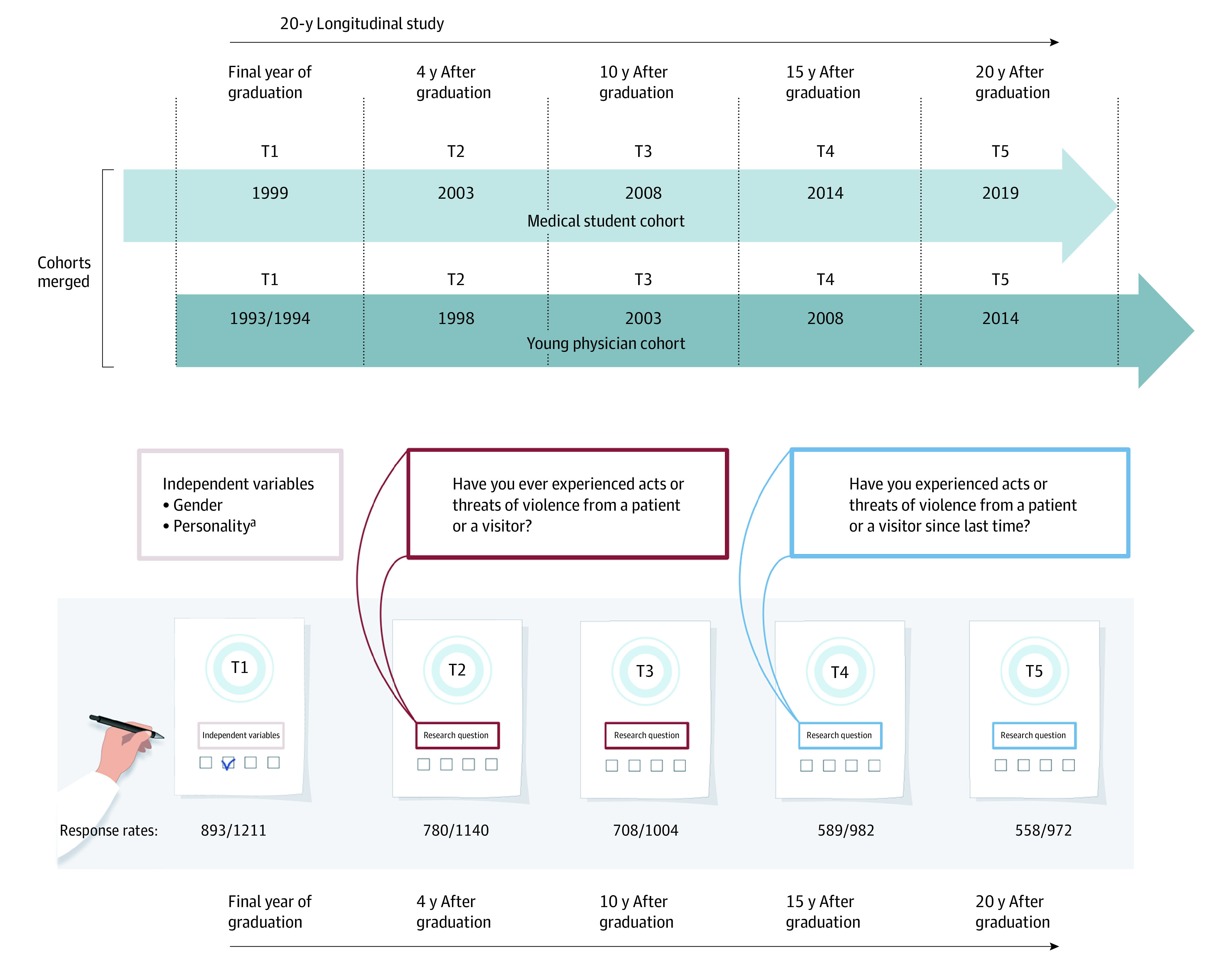
DESIGN, SETTING, AND PARTICIPANTS: This cohort study involved 2 nationwide medical student cohorts who graduated 6 years apart and were surveyed at graduation (T1: 1993-1994 and 1999) and 4 years later (T2), 10 years later (T3), 15 years later (T4), and 20 years after graduation (T5). Generalized estimated equations were used. Statistical analysis was performed from January to September 2020.
Medical career during 20 years in Norway.
WPV was measured as threats or acts of violence from a patient or visitor experienced at least twice, at each of the stages after leaving medical school. Individual factors were obtained at T1 and work-related factors at T2 through T5. We analyzed WPV by repeated measures.
At T1, a total of 893 participants (with a mean [SD] age of 28 (2.83) years; 499 [56%] women) responded to the questionnaire. The prevalence of multiple threats of violence was 20.3% (156 of 769) at T2, 17.1% (118 of 691) at T3, 11.2% (66 of 588) at T4, and 8.6% (46 of 536) at T5; and the prevalence of multiple acts of violence was 4.3% (33 of 763) at T2, 5.2% (36 of 687) at T3, 3.1% (18 of 584) at T4, and 2.2% (12 of 532) at T5. There was a decline from T2 to T5 of both multiple threats (β = -1.06; 95% CI, -1.31 to -0.09; P < .001) and acts of violence (β = -1.13; 95% CI, -1.73 to -0.53; P < .001). In adjusted analysis, factors associated with multiple threats of violence were male gender (odds ratio [OR], 2.76; 95% CI, 1.73 to 4.40; P < .001), vulnerability trait (neuroticism) (OR, 0.90; 95% CI, 0.82 to 0.99; P = .03), young physician cohort (OR, 1.63; 95% CI, 1.04 to 2.58; P = .04), and working in psychiatry (OR, 7.50; 95% CI, 4.42 to 12.71; P < .001). Factors associated with multiple acts of violence in adjusted analysis were male gender (OR, 3.37; 95% CI, 1.45 to 7.84; P = .005), young physician cohort (OR, 6.08; 95% CI, 1.68 to 21.97; P = .006), and working in psychiatry (OR, 12.34; 95% CI, 5.40 to 28.23; P < .001). There were no interactions with gender or cohort in the significant associated factors.
Higher rates of multiple threats and acts of violence were observed during early medical careers, among male physicians, and in psychiatry. Low levels of the vulnerability trait (neuroticism) were associated with the experience of multiple threats. There was an association between the young physician cohort and WPV. Preventive efforts should include early-career and male physicians, with additional emphasis on personality.
工作场所暴力(WPV)是全球卫生服务中的一个问题。有几项研究指出,组织因素,如在精神病学工作和工作压力,与 WPV 有关。然而,对于在职业生涯中的趋势以及医生个体因素,缺乏长期的纵向队列研究。
调查挪威医生职业生涯中的 WPV 趋势,并在一项长期的纵向研究中评估与 WPV 相关的个体和工作相关因素。
设计、设置和参与者:这项队列研究涉及 2 个全国性的医学生队列,他们毕业时间相隔 6 年,并在毕业时(T1:1993-1994 年和 1999 年)和 4 年后(T2)、10 年后(T3)、15 年后(T4)和毕业后 20 年(T5)进行了调查。使用广义估计方程进行统计分析。分析时间为 2020 年 1 月至 9 月。
在挪威的 20 年医疗生涯。
WPV 被定义为至少两次经历过来自患者或访客的威胁或暴力行为,在离开医学院后的各个阶段进行测量。个体因素在 T1 获得,工作相关因素在 T2 至 T5 获得。我们通过重复测量分析 WPV。
在 T1,共有 893 名参与者(平均年龄为 28(2.83)岁;499[56%]名女性)对问卷做出了回应。T2 时,多次受到威胁的流行率为 20.3%(156/769),T3 时为 17.1%(118/691),T4 时为 11.2%(66/588),T5 时为 8.6%(46/536);T2 时多次发生暴力行为的流行率为 4.3%(33/763),T3 时为 5.2%(36/687),T4 时为 3.1%(18/584),T5 时为 2.2%(12/532)。从 T2 到 T5,多次受到威胁(β=-1.06;95%置信区间,-1.31 至 -0.09;P<0.001)和发生暴力行为(β=-1.13;95%置信区间,-1.73 至 -0.53;P<0.001)均呈下降趋势。在调整分析中,与多次受到威胁相关的因素包括男性性别(优势比[OR],2.76;95%置信区间,1.73 至 4.40;P<0.001)、易感性特质(神经质)(OR,0.90;95%置信区间,0.82 至 0.99;P=0.03)、年轻医生队列(OR,1.63;95%置信区间,1.04 至 2.58;P=0.04)和从事精神病学工作(OR,7.50;95%置信区间,4.42 至 12.71;P<0.001)。在调整分析中,与多次发生暴力行为相关的因素包括男性性别(OR,3.37;95%置信区间,1.45 至 7.84;P=0.005)、年轻医生队列(OR,6.08;95%置信区间,1.68 至 21.97;P=0.006)和从事精神病学工作(OR,12.34;95%置信区间,5.40 至 28.23;P<0.001)。在有意义的相关因素中,没有性别或队列的交互作用。
在早期医疗生涯中,男性医生和从事精神病学工作的医生中,WPV 的发生率更高。易感性特质(神经质)水平较低与多次受到威胁有关。年轻医生队列与 WPV 有关。预防工作应包括早期职业和男性医生,并特别强调个性。
