Medical Oncology, Department Internal Medicine, University Hospital Basel, Basel, Switzerland.
Department of Medical Oncology and Hematology, Cantonal Hospital St. Gallen, St. Gallen, Switzerland.
PLoS One. 2021 Jun 28;16(6):e0253601. doi: 10.1371/journal.pone.0253601. eCollection 2021.
Brain metastases occur in about 30% of all patients with non-small cell lung cancer (NSCLC). In selected patients, long-term survival can be achieved by resection of brain metastases. In this retrospective study, we investigate the prognosis of NSCLC patients with resected brain metastases and possible prognostic factors.
In 119 patients with NSCLC and resected brain metastases, we report the following parameters: extent of resection, resection status, postoperative complications and overall survival (OS). We used the log-rank test to compare unadjusted survival probabilities and multivariable Cox regression to investigate potential prognostic factors with respect to OS.
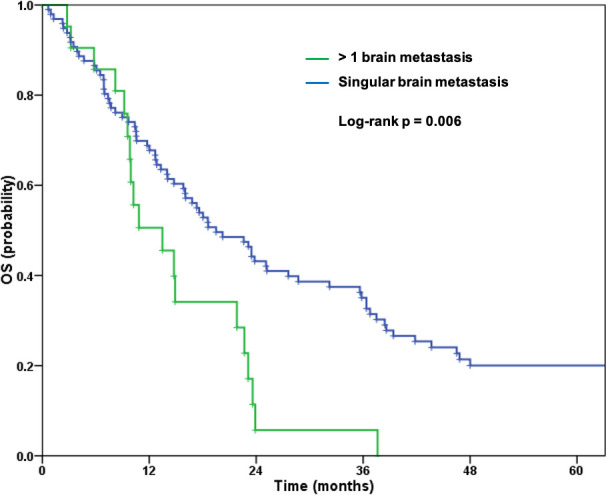
A total of 146 brain metastases were resected in 119 patients. The median survival was 18.0 months. Postoperative cerebral radiotherapy was performed in 86% of patients. Patients with postoperative radiotherapy had significantly longer survival (median OS 20.2 vs. 9.0 months, p = 0.002). The presence of multiple brain metastases was a negative prognostic factor (median OS 13.5 vs. 19.5 months, p = 0.006). Survival of patients with extracerebral metastases of NSCLC was significantly shorter than in patients who had exclusively brain metastases (median OS 14.0 vs. 23.1 months, p = 0.005). Both of the latter factors were independent prognostic factors for worse outcome in multivariate analysis.
Based on these data, resection of solitary brain metastases in patients with NSCLC and controlled extracerebral tumor disease is safe and leads to an overall favorable outcome. Postoperative radiotherapy is recommended to improve prognosis.
脑转移发生在约 30%的非小细胞肺癌(NSCLC)患者中。在选择的患者中,通过切除脑转移瘤可以实现长期生存。在这项回顾性研究中,我们研究了接受手术切除脑转移瘤的 NSCLC 患者的预后以及可能的预后因素。
在 119 例 NSCLC 伴脑转移的患者中,我们报告了以下参数:切除范围、切除状态、术后并发症和总生存(OS)。我们使用对数秩检验比较未调整的生存概率,并使用多变量 Cox 回归分析与 OS 相关的潜在预后因素。
在 119 例患者中,共切除了 146 个脑转移瘤。中位生存时间为 18.0 个月。术后 86%的患者行脑部放疗。行术后放疗的患者生存时间显著延长(中位 OS 20.2 个月比 9.0 个月,p = 0.002)。多发脑转移是一个负性预后因素(中位 OS 13.5 个月比 19.5 个月,p = 0.006)。同时存在 NSCLC 脑外转移的患者生存时间显著短于仅有脑转移的患者(中位 OS 14.0 个月比 23.1 个月,p = 0.005)。这两个因素在多变量分析中都是预后不良的独立预后因素。
基于这些数据,在 NSCLC 患者中切除单发脑转移瘤并控制脑外肿瘤疾病是安全的,并且总体预后良好。建议术后行放疗以改善预后。