Department of Medicine and Center for Global Health, University of Chicago, Chicago, USA.
Department of Public Health Sciences, University of Chicago, Chicago, USA.
Environ Health. 2021 Jun 23;20(1):74. doi: 10.1186/s12940-021-00756-5.
Low birthweight, intrauterine growth restriction (IUGR) and perinatal mortality have been associated with air pollution. However, intervention studies that use ultrasound measurements to assess the effects of household air pollution (HAP) on fetal biometric parameters (FBP) are rare. We investigated the effect of a cookstove intervention on FBP and IUGR in a randomized controlled trial (RCT) cohort of HAP-exposed pregnant Nigerian women.
We recruited 324 women early in the second trimester of pregnancy. Between 16 and 18 weeks, we randomized them to either continue cooking with firewood/kerosene (control group) or receive a CleanCook stove and ethanol fuel (intervention group). We measured fetal biparietal diameter (BPD), head circumference (HC), femur length (FL), abdominal circumference (AC) and ultrasound-estimated fetal weight (U-EFW) in the second and third trimesters. The women were clinically followed up at six regular time points during their pregnancies. Once during the women's second trimester and once during the third, we made 72-h continuous measurements of their personal exposures to particulate matter having aerodynamic diameter < 2.5 μm (PM). We adopted a modified intent-to-treat approach for the analysis. Differences between the intervention and control groups on impact of HAP on fetal growth trajectories were analyzed using mixed effects regression models.
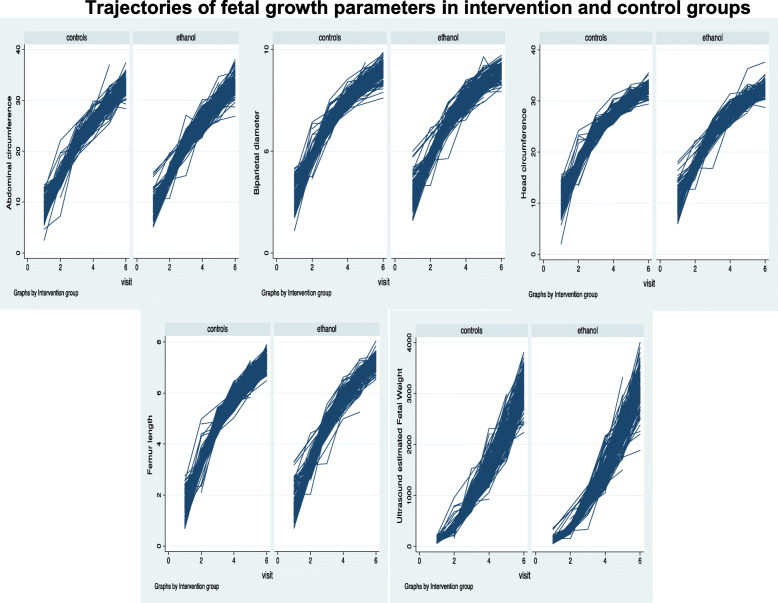
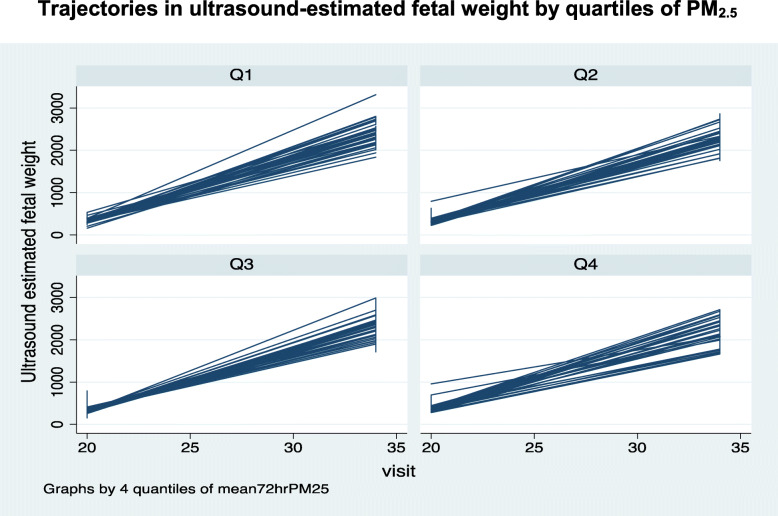
There were no significant differences in fetal growth trajectories between the intervention and control groups.
Larger studies in a setting of low ambient air pollution are required to further investigate the effect of transitioning to a cleaner fuel such as ethanol on intrauterine growth.
ClinicalTrials.gov NCT02394574 ; September 2012.
低出生体重、宫内生长受限(IUGR)和围产儿死亡与空气污染有关。然而,使用超声测量评估家庭空气污染(HAP)对胎儿生物测量参数(FBP)影响的干预研究很少。我们在一项暴露于 HAP 的尼日利亚孕妇的随机对照试验(RCT)队列中,调查了炊具干预对 FBP 和 IUGR 的影响。
我们在妊娠中期早期招募了 324 名女性。在 16 至 18 周时,我们将她们随机分为继续使用木柴/煤油做饭(对照组)或接受清洁炊具和乙醇燃料(干预组)。我们在第二和第三孕期测量胎儿双顶径(BPD)、头围(HC)、股骨长(FL)、腹围(AC)和超声估计胎儿体重(U-EFW)。这些女性在怀孕期间定期进行了 6 次临床随访。在女性的第二个和第三个孕期中,我们进行了 72 小时的连续个人暴露于空气动力学直径 < 2.5μm 的颗粒物(PM)测量。我们采用修改后的意向治疗方法进行分析。采用混合效应回归模型分析 HAP 对胎儿生长轨迹的影响在干预组和对照组之间的差异。
干预组和对照组之间的胎儿生长轨迹没有显著差异。
需要在环境空气污染程度较低的环境中进行更大规模的研究,以进一步调查过渡到更清洁的燃料(如乙醇)对宫内生长的影响。
ClinicalTrials.gov NCT02394574;2012 年 9 月。