Iwar Raphael Terungwa, Ogedengbe Kola', Katibi Kamil Kayode, Oshido Linus Esekwe
Department of Agricultural and Environmental Engineering, College of Engineering, Federal University of Agriculture, Makurdi, Nigeria.
Department of Agricultural and Environmental Engineering, Faculty of Technology, University of Ibadan, Ibadan, Nigeria.
Heliyon. 2021 Jun 12;7(6):e07301. doi: 10.1016/j.heliyon.2021.e07301. eCollection 2021 Jun.
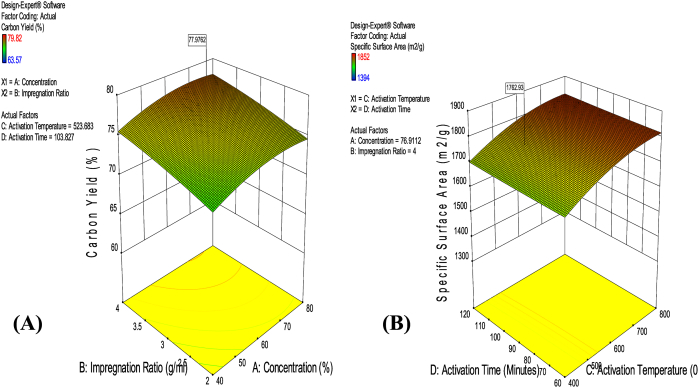
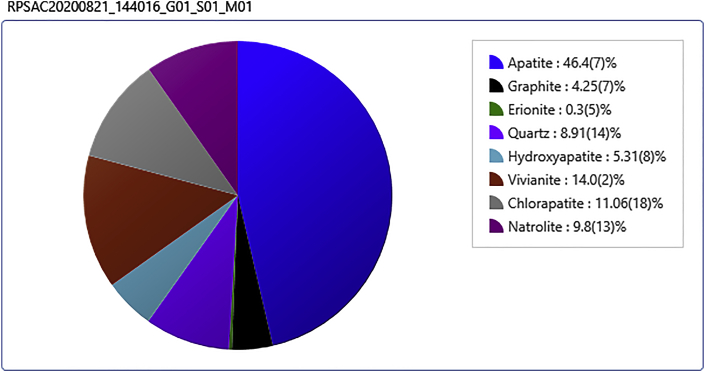
This study investigated the optimal synthesis conditions for the production of Raffia Palm Shell Activated Carbon (RPSAC) using phosphoric acid as activation agent. The optimization of the synthesis conditions was achieved using the Central Composite Design (CDD) in Response Surface Methodology (RSM). The influences of impregnation ratio, temperature, time and concentration on the specific surface area and yield of RPSAC were evaluated. Based on the CDD, 2FI and quadratic models were developed for the two responses. Analysis of Variance (ANOVA) was utilized to determine the significant factors and factor interactions for each response. All process variables except impregnation ratio were observed to significantly influence the quality of RPSAC. The optimal synthesis conditions for RPSAC were; 523.68 °C, 76.91%, and 103.83 min for temperature, concentration, and time respectively which provided a specific surface area and yield of 1762.92 m/g and 77.98 % respectively. The Scanning Electron Microscopy (SEM) with Energy Dispersive X-Ray (EDX) analyses proved that RPSAC had a meso-micro-porous morphology with high carbon and oxygen contents. Fourier-transform infrared spectroscopy (FTIR) revealed the abundance of hydroxyl, carbonyl and carboxylic groups on RPSAC. X-ray Powder Diffraction (XRD) analysis showed that RPSAC composed mainly of amorphous and disordered microcrystalline phases ascribed to the high quartz content of the precursor. The Brunauer-Emmett-Teller (BET) surface area, average pore diameter, total pore volume, and pH of RPSAC were obtained as 456.10 m/g, 0.25 cm/g, 2.13 nm and 2.10 correspondingly. Thus, RSM was found to be an excellent and desirable tool for optimal synthesis of RPSAC that possess high surface area and porosity suitable for application in the adsorption of both large and small molecular sized pollutants such as dyes and fluoride in real and aqueous solution.
本研究考察了以磷酸为活化剂制备酒椰壳活性炭(RPSAC)的最佳合成条件。采用响应面法(RSM)中的中心复合设计(CCD)实现了合成条件的优化。评估了浸渍比、温度、时间和浓度对RPSAC比表面积和产率的影响。基于CCD,针对这两个响应建立了二阶多项式(2FI)和二次模型。利用方差分析(ANOVA)确定每个响应的显著因素和因素相互作用。观察到除浸渍比外的所有工艺变量均对RPSAC的质量有显著影响。RPSAC的最佳合成条件为:温度523.68℃、浓度76.91%、时间103.83分钟,分别提供了1762.92 m²/g的比表面积和77.98%的产率。扫描电子显微镜(SEM)结合能量色散X射线(EDX)分析证明,RPSAC具有中微孔形态,碳和氧含量高。傅里叶变换红外光谱(FTIR)显示RPSAC上存在大量的羟基、羰基和羧基。X射线粉末衍射(XRD)分析表明,RPSAC主要由非晶态和无序微晶相组成,这归因于前驱体中石英含量高。RPSAC的布鲁诺尔-埃米特-泰勒(BET)表面积、平均孔径、总孔体积和pH值分别为456.10 m²/g、0.25 cm³/g、2.13 nm和2.10。因此,发现RSM是优化合成RPSAC的优良且理想的工具,RPSAC具有高表面积和孔隙率,适用于吸附实际和水溶液中大小分子尺寸的污染物,如染料和氟化物。