Institute of Head and Neck Studies and Education (InHANSE), Institute of Cancer and Genomic Sciences, College of Medical and Dental Sciences, University of Birmingham, Birmingham, United Kingdom.
Institute of Head and Neck Studies and Education (InHANSE), Institute of Cancer and Genomic Sciences, College of Medical and Dental Sciences, University of Birmingham, Birmingham, United Kingdom.
Adv Drug Deliv Rev. 2021 Sep;176:113854. doi: 10.1016/j.addr.2021.113854. Epub 2021 Jun 27.
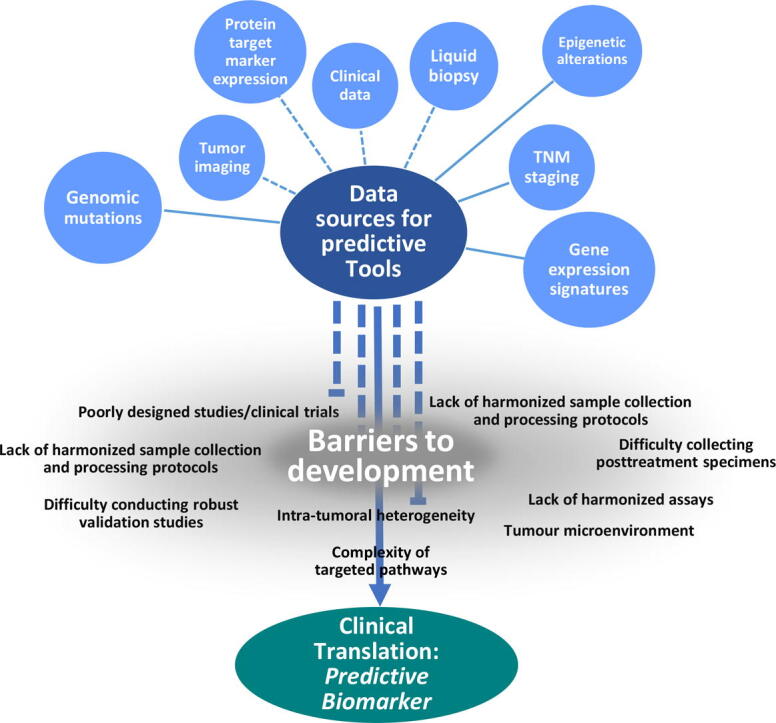
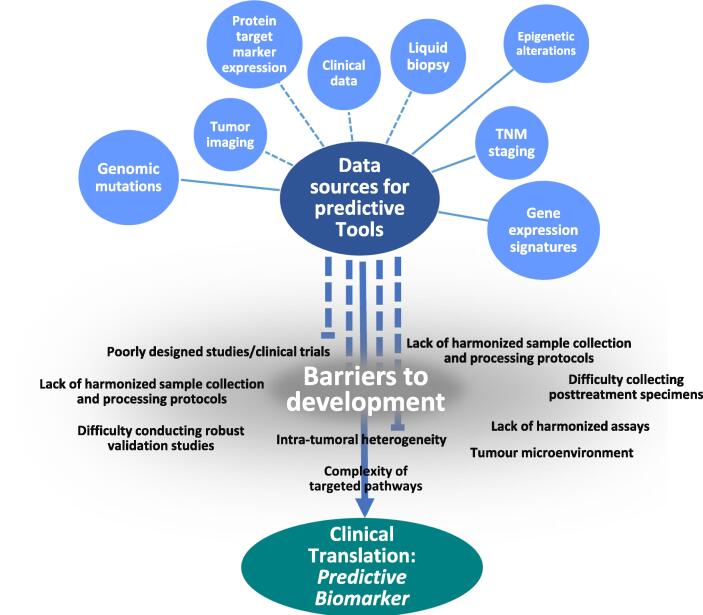
Predictive tools, utilising biomarkers, aim to objectively assessthe potentialresponse toa particular clinical intervention in order to direct treatment.Conventional cancer therapy remains poorly served by predictive biomarkers, despite being the mainstay of treatment for most patients. In contrast, targeted therapy benefits from a clearly defined protein target for potential biomarker assessment. We discuss potential data sources of predictive biomarkers for conventional and targeted therapy, including patient clinical data andmulti-omicbiomarkers (genomic, transcriptomic and protein expression).Key examples, either clinically adopted or demonstrating promise for clinical translation, are highlighted. Following this, we provide an outline of potential barriers to predictive biomarker development; broadly discussing themes of approaches to translational research and study/trial design, and the impact of cellular and molecular tumor heterogeneity. Future avenues of research are also highlighted.
预测工具利用生物标志物,旨在客观评估对特定临床干预的潜在反应,以指导治疗。尽管是大多数患者治疗的主要手段,但传统的癌症治疗仍然缺乏预测生物标志物。相比之下,靶向治疗受益于明确的潜在生物标志物评估的蛋白质靶标。我们讨论了常规和靶向治疗的预测生物标志物的潜在数据来源,包括患者的临床数据和多组学生物标志物(基因组、转录组和蛋白质表达)。重点介绍了一些已经临床采用或有临床转化前景的关键实例。接下来,我们概述了预测生物标志物开发的潜在障碍;广泛讨论了转化研究方法和研究/试验设计的主题,以及细胞和分子肿瘤异质性的影响。还强调了未来的研究方向。