Brütting Christine, Hildebrand Pia, Brandsch Corinna, Stangl Gabriele I
Institute of Agricultural and Nutritional Sciences, Martin Luther University Halle-Wittenberg, Von-Danckelmann-Platz 2, 06120, Halle (Saale), Germany.
Nutr Metab (Lond). 2021 Jun 30;18(1):68. doi: 10.1186/s12986-021-00594-9.
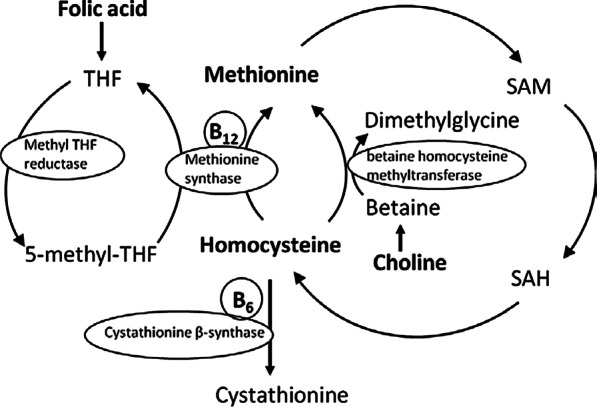
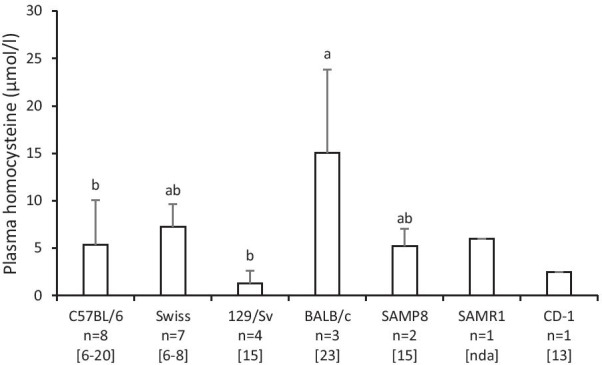
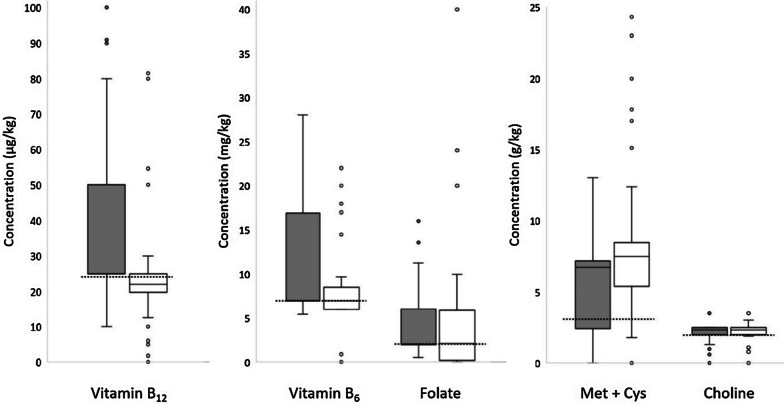
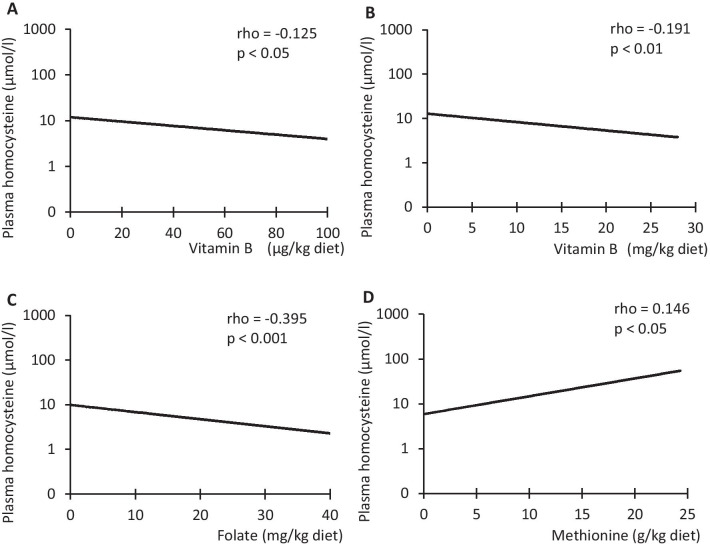
Homocysteine is associated with several diseases, and a series of dietary factors are known to modulate homocysteine levels. As mice are often used as model organisms to study the effects of dietary hyperhomocysteinemia, we collected data about concentrations of vitamin B, vitamin B, folate, methionine, cystine, and choline in mouse diets and the associated plasma/serum homocysteine levels. In addition, we more closely examined the composition of the control diet, the impact of the mouse strain, sex and age, and the duration of the dietary intervention on homocysteine levels. In total, 113 out of 1103 reviewed articles met the inclusion criteria. In the experimental and control diets, homocysteine levels varied from 0.1 to 280 µmol/l. We found negative correlations between dietary vitamin B (rho = - 0.125; p < 0.05), vitamin B (rho = - 0.191; p < 0.01) and folate (rho = - 0.395; p < 0.001) and circulating levels of homocysteine. In contrast, a positive correlation was observed between dietary methionine and homocysteine (methionine: rho = 0.146; p < 0.05). No significant correlations were found for cystine or choline and homocysteine levels. In addition, there was no correlation between the duration of the experimental diets and homocysteine levels. More importantly, the data showed that homocysteine levels varied widely in mice fed control diets as well. When comparing control diets with similar nutrient concentrations (AIN-based), there were significant differences in homocysteine levels caused by the strain (ANOVA, p < 0.05) and age of the mice at baseline (r = 0.47; p < 0.05). When comparing homocysteine levels and sex, female mice tended to have higher homocysteine levels than male mice (9.3 ± 5.9 µmol/l vs. 5.8 ± 4.5 µmol/l; p = 0.069). To conclude, diets low in vitamin B, vitamin B, or folate and rich in methionine are similarly effective in increasing homocysteine levels. AIN recommendations for control diets are adequate with respect to the amounts of homocysteine-modulating dietary parameters. In addition, the mouse strain and the age of mice can affect the homocysteine level.
同型半胱氨酸与多种疾病相关,已知一系列饮食因素可调节同型半胱氨酸水平。由于小鼠常被用作研究饮食性高同型半胱氨酸血症影响的模式生物,我们收集了小鼠饮食中维生素B、维生素B、叶酸、蛋氨酸、胱氨酸和胆碱的浓度以及相关血浆/血清同型半胱氨酸水平的数据。此外,我们更仔细地研究了对照饮食的组成、小鼠品系、性别和年龄的影响以及饮食干预持续时间对同型半胱氨酸水平的影响。在1103篇综述文章中,共有113篇符合纳入标准。在实验饮食和对照饮食中,同型半胱氨酸水平在0.1至280µmol/l之间变化。我们发现饮食中的维生素B(rho = -0.125;p < 0.05)、维生素B(rho = -0.191;p < 0.01)和叶酸(rho = -0.395;p < 0.001)与同型半胱氨酸的循环水平呈负相关。相反,饮食中的蛋氨酸与同型半胱氨酸呈正相关(蛋氨酸:rho = 0.146;p < 0.05)。未发现胱氨酸或胆碱与同型半胱氨酸水平之间存在显著相关性。此外,实验饮食的持续时间与同型半胱氨酸水平之间也没有相关性。更重要的是,数据表明,喂食对照饮食的小鼠中同型半胱氨酸水平也有很大差异。当比较营养浓度相似(基于AIN)的对照饮食时,品系(方差分析,p < 0.05)和基线时小鼠的年龄(r = 0.47;p < 0.05)对同型半胱氨酸水平有显著影响。当比较同型半胱氨酸水平和性别时,雌性小鼠的同型半胱氨酸水平往往高于雄性小鼠(9.3±5.9µmol/l对5.8±4.5µmol/l;p = 0.069)。总之,低维生素B、维生素B或叶酸且富含蛋氨酸的饮食在提高同型半胱氨酸水平方面同样有效。关于调节同型半胱氨酸的饮食参数的量,AIN对照饮食建议是合适的。此外,小鼠品系和小鼠年龄会影响同型半胱氨酸水平。