Rani S, Maharana Satyapriya, Metri Kashinath G, Bhargav Hemant, Nagaratna R
Division of Yoga and Life Sciences, Swami Vivekananda Yoga AnusandhanaSamsthana (SVYASA University), Bengaluru, India.
Department of Yoga, Central University of Rajasthan, Bandar Sindri, Ajmer, Rajasthan, India.
J Tradit Complement Med. 2021 Jan 6;11(4):375-380. doi: 10.1016/j.jtcme.2021.01.001. eCollection 2021 Jul.
The prevalence of hypothyroidism among Indian women is 15.8%. Depression is frequently reported in hypothyroidism. Yoga is an effective intervention for depression. However, the influence of yoga on depression in patients with hypothyroidism has not been studied.
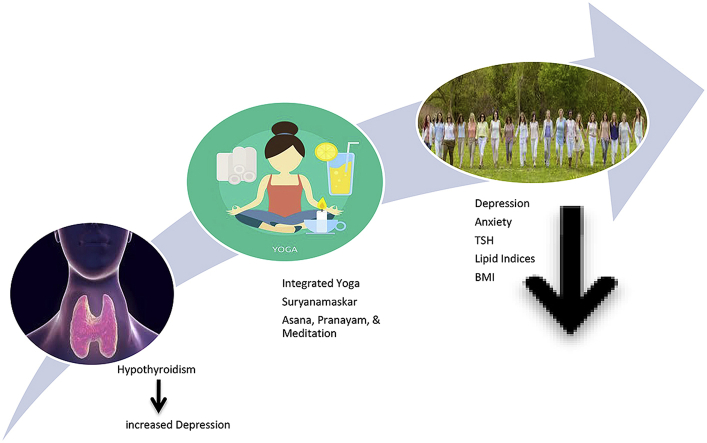
The present study investigated the effect of a 3-month integrated yoga intervention (3-IY) on depression, lipid indices, and serum thyroid-stimulating hormone (sTSH) levels among female patients having hypothyroidism, and mild-to-moderate depression.
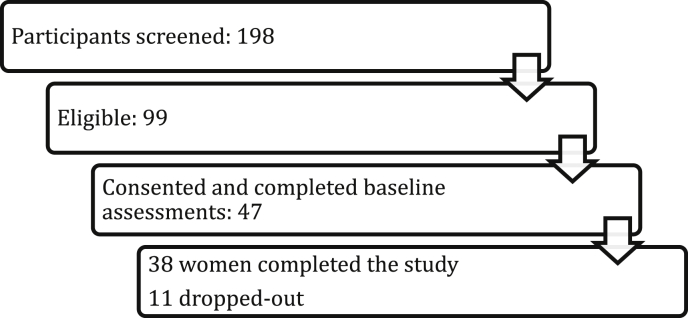
The present single-arm pre-post design study was conducted in thirty-eight women (average age 34.2 ± 4.7 years). Participants received a 3-IY comprising asanas, pranayama, and relaxation techniques for 60 min daily (5 days a week). Depression, sTSH, lipid profile indices, Body Mass Index (BMI), fatigue, anxiety, and stress were assessed at baseline and after 12 weeks. Thyroid medication was kept constant during the study period. Data were analysed using R Studio software.
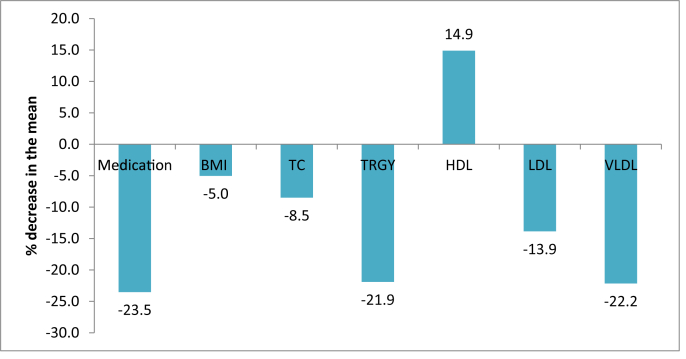
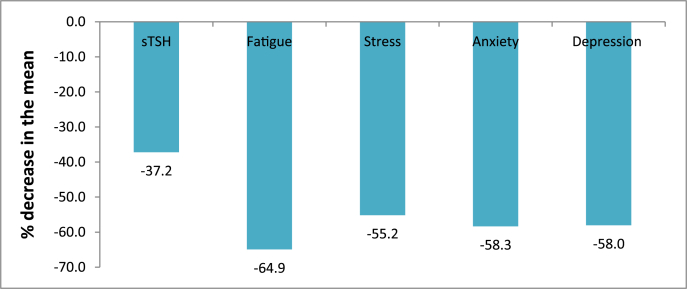
A significant (P < 0.05) reduction in depression (58%), sTSH (37%), BMI (6%), fatigue (64%), anxiety (57%), lipid profile indices (HLD increased significanty), and stress (55%) levels was observed after 3 months, compared with the corresponding baseline levels.
The 3-IY is useful for reducing depression, dyslipidemia, and sTSH in women with hypothyroidism and depression. Further studies with a larger sample size and a robust research design using objective variables must be conducted to strengthen the study findings.
印度女性甲状腺功能减退症的患病率为15.8%。甲状腺功能减退症患者常伴有抑郁症。瑜伽是治疗抑郁症的有效干预措施。然而,瑜伽对甲状腺功能减退症患者抑郁症的影响尚未得到研究。
本研究调查了为期3个月的综合瑜伽干预(3-IY)对患有甲状腺功能减退症且伴有轻至中度抑郁症的女性患者的抑郁、血脂指标和血清促甲状腺激素(sTSH)水平的影响。
本单臂前后设计研究共纳入38名女性(平均年龄34.2±4.7岁)。参与者接受为期3个月的综合瑜伽干预,包括体式、呼吸法和放松技巧,每天60分钟(每周5天)。在基线和12周后评估抑郁、sTSH、血脂谱指标、体重指数(BMI)、疲劳、焦虑和压力。在研究期间,甲状腺药物治疗保持不变。使用R Studio软件进行数据分析。
与相应的基线水平相比,3个月后抑郁(降低58%)、sTSH(降低37%)、BMI(降低6%)、疲劳(降低64%)、焦虑(降低57%)、血脂谱指标(高密度脂蛋白显著升高)和压力(降低55%)水平均有显著降低(P<0.05)。
3-IY有助于降低甲状腺功能减退症和抑郁症女性患者的抑郁、血脂异常和sTSH水平。必须进行更大样本量和使用客观变量的稳健研究设计的进一步研究,以加强研究结果。