Department of Financial Economics and Accounting, Faculty of Economics and Business, University of Murcia, 30100 Murcia, Spain.
Int J Environ Res Public Health. 2021 Jun 27;18(13):6900. doi: 10.3390/ijerph18136900.
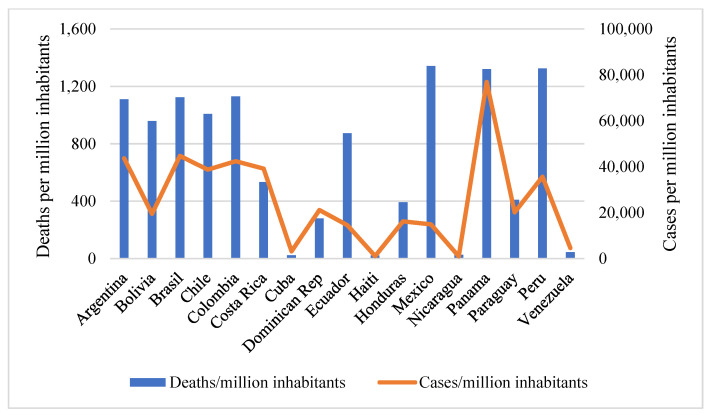
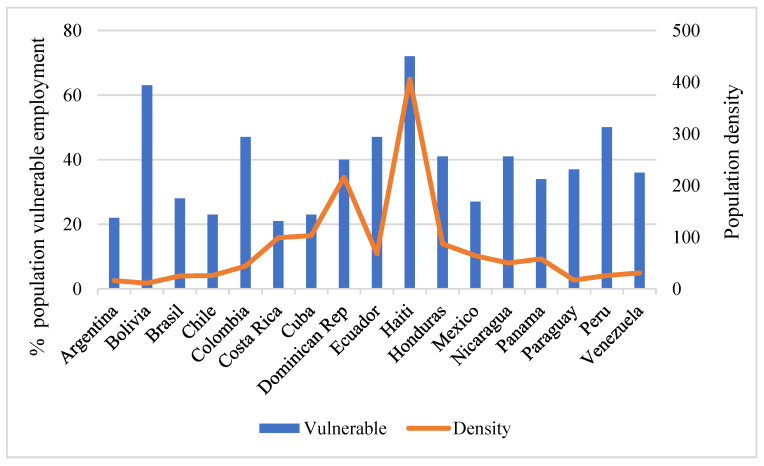
The pandemic caused by COVID-19 has left millions infected and dead around the world, with Latin America being one of the most affected areas. In this work, we have sought to determine, by means of a multiple regression analysis and a study of correlations, the influence of population density, life expectancy, and proportion of the population in vulnerable employment, together with GDP per capita, on the mortality rate due to COVID-19 in Latin American countries. The results indicated that countries with higher population density had lower numbers of deaths. Population in vulnerable employment and GDP showed a positive influence, while life expectancy did not appear to significantly affect the number of COVID-19 deaths. In addition, the influence of these variables on the number of confirmed cases of COVID-19 was analyzed. It can be concluded that the lack of resources can be a major burden for the vulnerable population in combating COVID-19 and that population density can ensure better designed institutions and quality infrastructure to achieve social distancing and, together with effective measures, lower death rates.
由 COVID-19 引发的大流行导致全球数百万人感染和死亡,拉丁美洲是受影响最严重的地区之一。在这项工作中,我们通过多元回归分析和相关性研究,试图确定人口密度、预期寿命、脆弱就业人口比例以及人均国内生产总值对拉丁美洲国家 COVID-19 死亡率的影响。结果表明,人口密度较高的国家死亡人数较少。脆弱就业人口和 GDP 显示出积极的影响,而预期寿命似乎没有对 COVID-19 死亡人数产生显著影响。此外,还分析了这些变量对 COVID-19 确诊病例数量的影响。可以得出结论,资源匮乏可能是弱势群体在抗击 COVID-19 方面的主要负担,而人口密度可以确保更好的设计机构和高质量的基础设施,以实现社交距离,并结合有效措施降低死亡率。