Laboratory of Epigenetics, Istituti Clinici Scientifici Maugeri IRCCS, Via Maugeri 10, 27100 Pavia, Italy.
Foundation "Policlinico Universitario A. Gemelli IRCCS", Department of Translational Medicine & Surgery, Faculty of Medicine, and Department of Cardiovascular Science, Catholic University of the Sacred Heart, 00168 Rome, Italy.
Int J Mol Sci. 2021 Jun 7;22(11):6151. doi: 10.3390/ijms22116151.
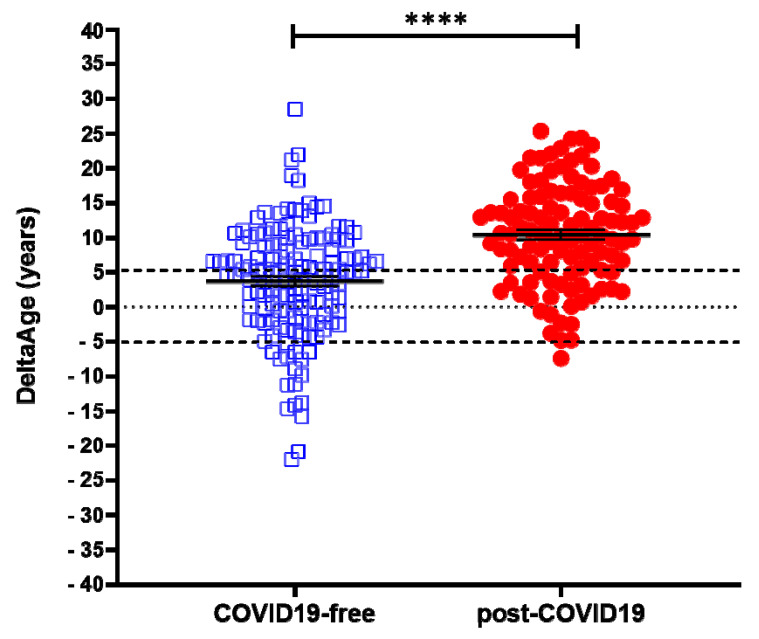
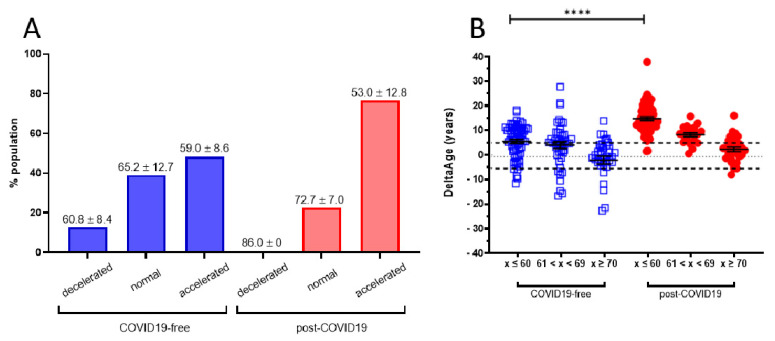
The SARS-CoV-2 infection determines the COVID-19 syndrome characterized, in the worst cases, by severe respiratory distress, pulmonary and cardiac fibrosis, inflammatory cytokine release, and immunosuppression. This condition has led to the death of about 2.15% of the total infected world population so far. Among survivors, the presence of the so-called persistent post-COVID-19 syndrome (PPCS) is a common finding. In COVID-19 survivors, PPCS presents one or more symptoms: fatigue, dyspnea, memory loss, sleep disorders, and difficulty concentrating. In this study, a cohort of 117 COVID-19 survivors (post-COVID-19) and 144 non-infected volunteers (COVID-19-free) was analyzed using pyrosequencing of defined CpG islands previously identified as suitable for biological age determination. The results show a consistent biological age increase in the post-COVID-19 population, determining a DeltaAge acceleration of 10.45 ± 7.29 years (+5.25 years above the range of normality) compared with 3.68 ± 8.17 years for the COVID-19-free population ( < 0.0001). A significant telomere shortening parallels this finding in the post-COVID-19 cohort compared with COVID-19-free subjects ( < 0.0001). Additionally, ACE2 expression was decreased in post-COVID-19 patients, compared with the COVID-19-free population, while DPP-4 did not change. In light of these observations, we hypothesize that some epigenetic alterations are associated with the post-COVID-19 condition, particularly in younger patients (< 60 years).
严重急性呼吸综合征冠状病毒 2 型(SARS-CoV-2)感染可引发 COVID-19 综合征,在最严重的情况下,可导致严重呼吸窘迫、肺和心脏纤维化、炎症细胞因子释放以及免疫抑制。迄今为止,这种情况导致全球约 2.15%的总感染人口死亡。在幸存者中,存在所谓的持续性 COVID-19 后综合征(PPCS)是一种常见现象。在 COVID-19 幸存者中,PPCS 表现为一种或多种症状:疲劳、呼吸困难、记忆力减退、睡眠障碍和注意力不集中。在这项研究中,分析了 117 名 COVID-19 幸存者(COVID-19 后)和 144 名未感染志愿者(COVID-19 阴性)的队列,使用先前确定的适合生物年龄测定的特定 CpG 岛进行焦磷酸测序。结果显示,COVID-19 后人群的生物年龄持续增加,与 COVID-19 阴性人群相比,DeltaAge 加速了 10.45±7.29 岁(比正常值范围高 5.25 岁)(<0.0001)。与 COVID-19 阴性受试者相比,COVID-19 后队列中存在明显的端粒缩短(<0.0001)。此外,与 COVID-19 阴性人群相比,COVID-19 后患者的 ACE2 表达降低,而 DPP-4 没有变化。鉴于这些观察结果,我们假设一些表观遗传改变与 COVID-19 后状况有关,特别是在年轻患者(<60 岁)中。