Department of Oncology, Guizhou Provincial People's Hospital, Guiyang, Guizhou, China.
Guangdong Institute of Gastroenterology, Guangdong Provincial Key Laboratory of Colorectal and Pelvic Floor Disease, The Sixth Affiliated Hospital, Sun Yat-sen University, Guangzhou, Guangdong, China.
Nat Commun. 2022 Apr 19;13(1):2135. doi: 10.1038/s41467-022-29801-8.
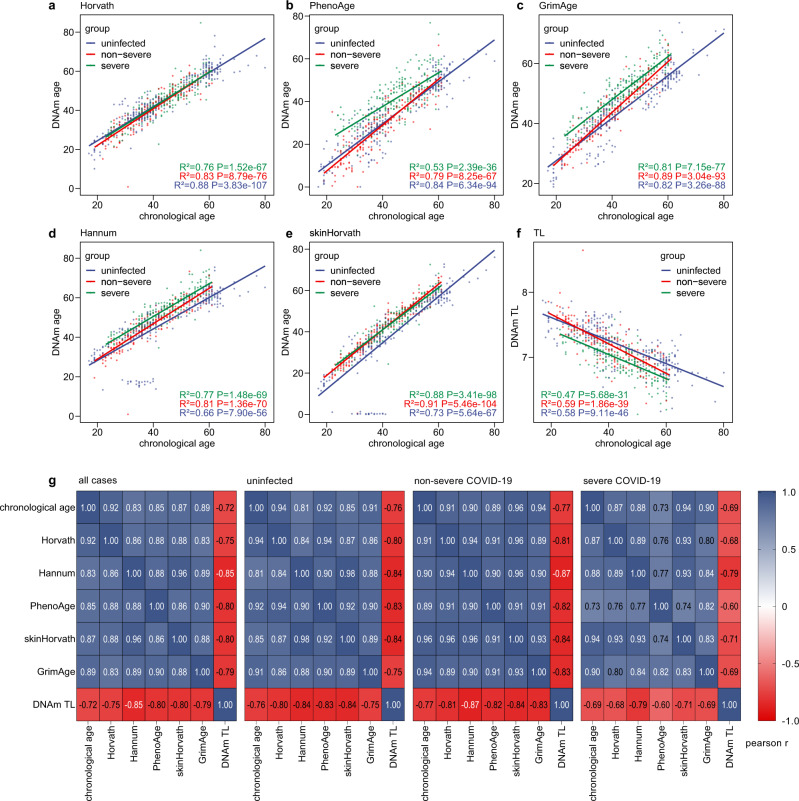
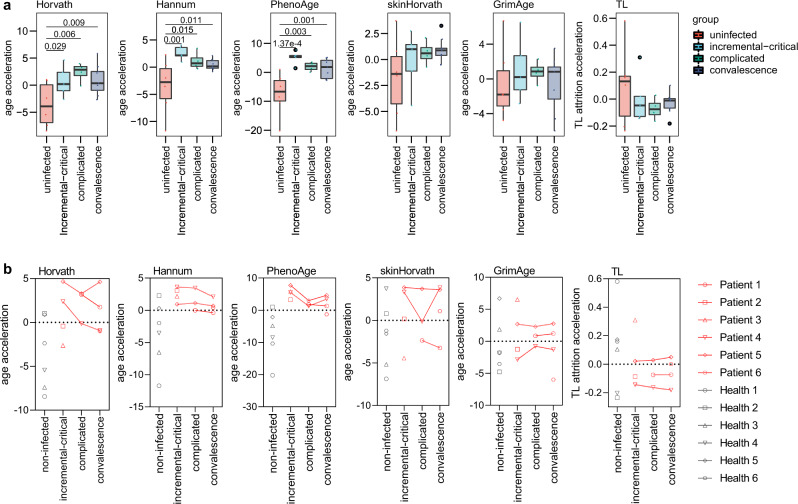
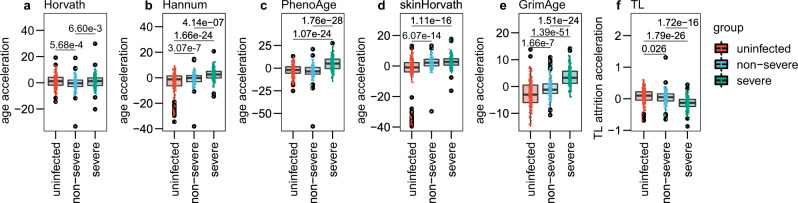
Chronological age is a risk factor for SARS-CoV-2 infection and severe COVID-19. Previous findings indicate that epigenetic age could be altered in viral infection. However, the epigenetic aging in COVID-19 has not been well studied. In this study, DNA methylation of the blood samples from 232 healthy individuals and 413 COVID-19 patients is profiled using EPIC methylation array. Epigenetic ages of each individual are determined by applying epigenetic clocks and telomere length estimator to the methylation profile of the individual. Epigenetic age acceleration is calculated and compared between groups. We observe strong correlations between the epigenetic clocks and individual's chronological age (r > 0.8, p < 0.0001). We also find the increasing acceleration of epigenetic aging and telomere attrition in the sequential blood samples from healthy individuals and infected patients developing non-severe and severe COVID-19. In addition, the longitudinal DNA methylation profiling analysis find that the accumulation of epigenetic aging from COVID-19 syndrome could be partly reversed at late clinic phases in some patients. In conclusion, accelerated epigenetic aging is associated with the risk of SARS-CoV-2 infection and developing severe COVID-19. In addition, the accumulation of epigenetic aging from COVID-19 may contribute to the post-COVID-19 syndrome among survivors.
年龄是感染 SARS-CoV-2 和发生重症 COVID-19 的危险因素之一。先前的研究结果表明,在病毒感染时表观遗传年龄可能会发生改变。然而,COVID-19 中的表观遗传衰老尚未得到充分研究。在这项研究中,我们使用 EPIC 甲基化芯片对 232 名健康个体和 413 名 COVID-19 患者的血液样本进行了 DNA 甲基化分析。通过将表观遗传时钟和端粒长度估算器应用于个体的甲基化图谱,确定了每个个体的表观遗传年龄。在组间比较表观遗传年龄的加速。我们观察到表观遗传时钟与个体的实际年龄之间存在很强的相关性(r>0.8,p<0.0001)。我们还发现,在从健康个体和感染患者中发展出非重症和重症 COVID-19 的连续血液样本中,表观遗传衰老和端粒损耗的加速增加。此外,纵向 DNA 甲基化谱分析发现,COVID-19 综合征引起的表观遗传衰老的积累在某些患者的晚期临床阶段可能部分逆转。总之,加速的表观遗传衰老与 SARS-CoV-2 感染和发生重症 COVID-19 的风险相关。此外,COVID-19 引起的表观遗传衰老的积累可能是幸存者发生 COVID-19 后综合征的原因之一。