Jeong Yoo-Seong, Jusko William J
Department of Pharmaceutical Sciences, School of Pharmacy and Pharmaceutical Sciences, State University of New York at Buffalo, Buffalo, NY 14214, USA.
Pharmaceuticals (Basel). 2021 Jun 7;14(6):545. doi: 10.3390/ph14060545.
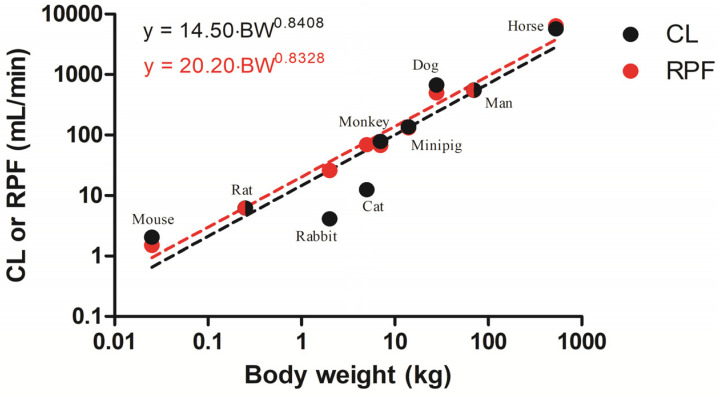
The objective of this study was to systematically assess literature datasets and quantitatively analyze metformin PK in plasma and some tissues of nine species. The pharmacokinetic (PK) parameters and profiles of metformin in nine species were collected from the literature. Based on a simple allometric scaling, the systemic clearances (CL) of metformin in these species highly correlate with body weight (BW) (R = 0.85) and are comparable to renal plasma flow in most species except for rabbit and cat. Reported volumes of distribution (VSS) varied appreciably (0.32 to 10.1 L/kg) among species. Using the physiological and anatomical variables for each species, a minimal physiologically based pharmacokinetic (mPBPK) model consisting of blood and two tissue compartments (Tissues 1 and 2) was used for modeling metformin PK in the nine species. Permeability-limited distribution (low fd1 and fd2) and a single tissue-to-plasma partition coefficient (Kp) value for Tissues 1 and 2 were applied in the joint mPBPK fitting. Nonlinear regression analysis for common tissue distribution parameters along with species-specific CL values reasonably captured the plasma PK profiles of metformin across most species, except for rat and horse with later time deviations. In separate fittings of the mPBPK model to each species, Tissue 2 was considered as slowly-equilibrating compartment consisting of muscle and skin based on in silico calculations of the mean transit times through tissues. The well-fitted mPBPK model parameters for absorption and disposition PK of metformin for each species were compared with in vitro/in vivo results found in the literature with regard to the physiological details and physicochemical properties of metformin. Bioavailability and absorption rates decreased with the increased BW among the species. Tissues such as muscle dominate metformin distribution with low permeability and partitioning while actual tissue concentrations found in rats and mice show likely transporter-mediated uptake in liver, kidney, and gastrointestinal tissues. Metformin has diverse pharmacologic actions, and this assessment revealed allometric relationships in its absorption and renal clearance but considerable variability in actual and modeled tissue distribution probably caused by transporter differences.
本研究的目的是系统评估文献数据集,并对九种物种血浆和部分组织中的二甲双胍药代动力学(PK)进行定量分析。从文献中收集了九种物种二甲双胍的药代动力学(PK)参数和曲线。基于简单的异速生长标度,这些物种中二甲双胍的全身清除率(CL)与体重(BW)高度相关(R = 0.85),并且在除兔子和猫之外的大多数物种中与肾血浆流量相当。报道的分布容积(VSS)在物种间差异明显(0.32至10.1 L/kg)。利用每个物种的生理和解剖学变量,使用由血液和两个组织隔室(组织1和组织2)组成的最小生理药代动力学(mPBPK)模型对九种物种的二甲双胍PK进行建模。在联合mPBPK拟合中应用了通透性限制分布(低fd1和fd2)以及组织1和组织2的单一组织与血浆分配系数(Kp)值。对常见组织分布参数以及物种特异性CL值进行非线性回归分析,合理地捕捉了除大鼠和马在后期出现时间偏差外,大多数物种二甲双胍的血浆PK曲线。在将mPBPK模型分别拟合到每个物种时,基于对组织平均转运时间的计算机模拟计算,将组织2视为由肌肉和皮肤组成的缓慢平衡隔室。将每个物种二甲双胍吸收和处置PK的拟合良好的mPBPK模型参数与文献中关于二甲双胍生理细节和理化性质的体外/体内结果进行比较。生物利用度和吸收率随物种体重增加而降低。肌肉等组织以低通透性和分配主导二甲双胍分布,而在大鼠和小鼠中发现的实际组织浓度表明肝脏、肾脏和胃肠道组织中可能存在转运体介导的摄取。二甲双胍具有多种药理作用,该评估揭示了其吸收和肾清除中的异速生长关系,但实际和模拟的组织分布存在相当大的变异性,这可能是由转运体差异引起的。