Department of Microbiology and Immunology, Institute of Biomedicine, University of Gothenburg, 405 30 Gothenburg, Sweden.
Calmino Group AB, Research and Development, 413 46 Gothenburg, Sweden.
Cells. 2021 Jun 10;10(6):1459. doi: 10.3390/cells10061459.
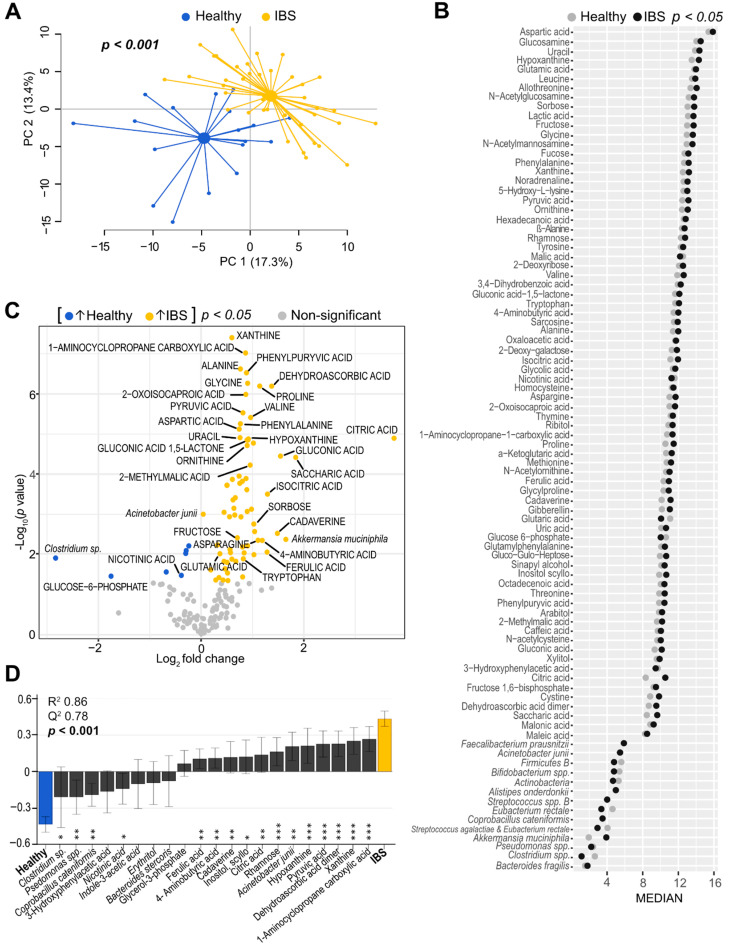
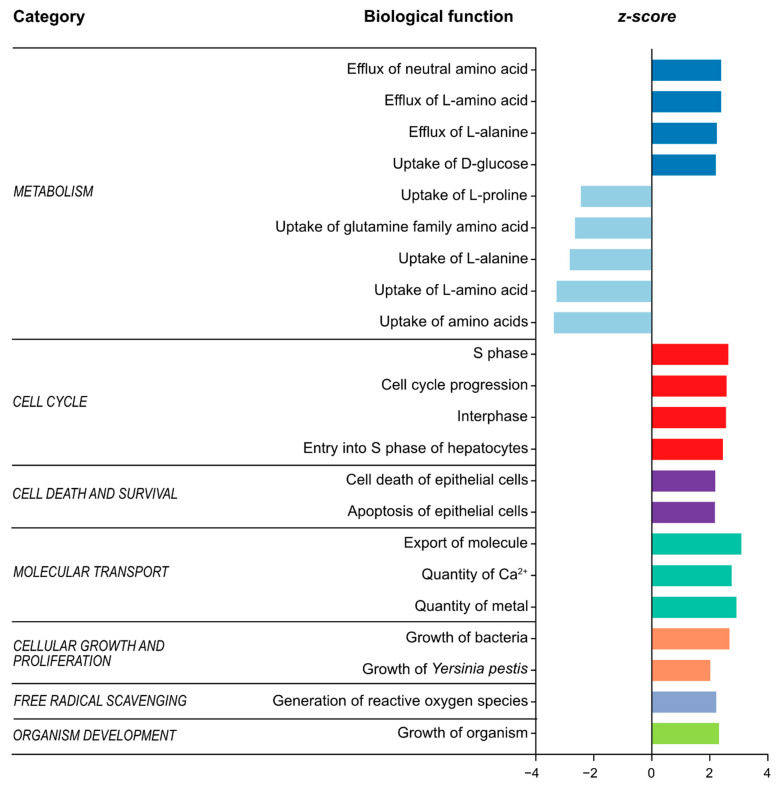
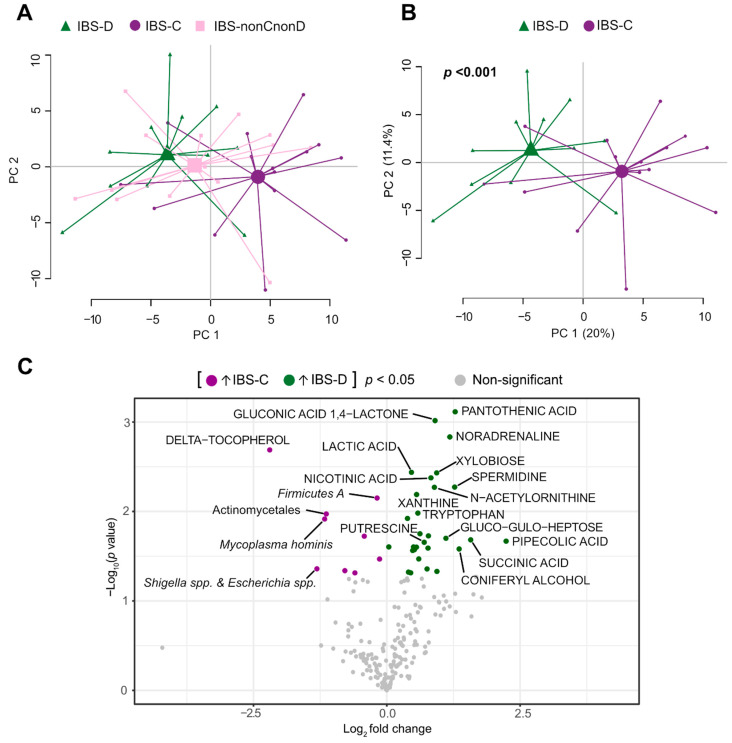
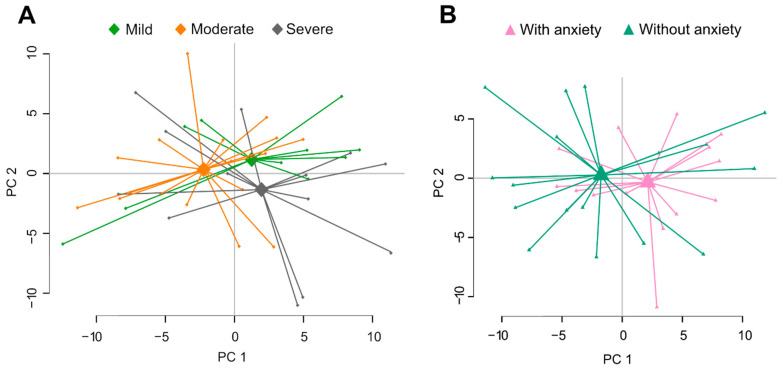
Patients with irritable bowel syndrome (IBS) are suggested to have an altered intestinal microenvironment. We therefore aimed to determine the intestinal microenvironment profile, based on faecal microbiota and metabolites, and the potential link to symptoms in IBS patients. The faecal microbiota was evaluated by the GA-map dysbiosis test, and tandem mass spectrometry (GC-MS/MS) was used for faecal metabolomic profiling in patients with IBS and healthy subjects. Symptom severity was assessed using the IBS Severity Scoring System and anxiety and depression were assessed using the Hospital Anxiety and Depression Scale. A principal component analysis based on faecal microbiota ( = 54) and metabolites ( = 155) showed a clear separation between IBS patients ( = 40) and healthy subjects ( = 18). Metabolites were the main driver of this separation. Additionally, the intestinal microenvironment profile differed between IBS patients with constipation ( = 15) and diarrhoea ( = 11), while no clustering was detected in subgroups of patients according to symptom severity or anxiety. Furthermore, ingenuity pathway analysis predicted amino acid metabolism and several cellular and molecular functions to be altered in IBS patients. Patients with IBS have a distinct faecal microbiota and metabolite profile linked to bowel habits. Intestinal microenvironment profiling, based on faecal microbiota and metabolites, may be considered as a future non-invasive diagnostic tool, alongside providing valuable insights into the pathophysiology of IBS.
患有肠易激综合征(IBS)的患者被认为其肠道微环境发生了改变。因此,我们旨在确定基于粪便微生物群和代谢物的肠道微环境特征,以及与 IBS 患者症状的潜在联系。通过 GA-map 失调测试评估粪便微生物群,串联质谱(GC-MS/MS)用于评估 IBS 患者和健康受试者的粪便代谢组学特征。使用 IBS 严重程度评分系统评估症状严重程度,使用医院焦虑和抑郁量表评估焦虑和抑郁。基于粪便微生物群(n = 54)和代谢物(n = 155)的主成分分析显示,IBS 患者(n = 40)和健康受试者(n = 18)之间存在明显分离。代谢物是这种分离的主要驱动因素。此外,便秘型 IBS 患者(n = 15)和腹泻型 IBS 患者(n = 11)之间的肠道微环境特征不同,而根据症状严重程度或焦虑程度,患者亚组中未检测到聚类。此外,Ingenuity 通路分析预测 IBS 患者的氨基酸代谢和几个细胞和分子功能发生改变。IBS 患者具有与肠道习惯相关的独特粪便微生物群和代谢物特征。基于粪便微生物群和代谢物的肠道微环境分析,可能被视为一种未来的非侵入性诊断工具,同时为 IBS 的病理生理学提供有价值的见解。