Doulberis Michael, Pierre Noah Thierry, Manzini Giulia, Papaefthymiou Apostolis, Kountouras Jannis, Klukowska-Rötzler Jolanta, Polyzos Stergios A, Srivastava Simone, Exadaktylos Aristomenis K, Knuchel Jürg, Kuntzen Thomas, Srivastava David S
Emergency Department, University Hospital Inselspital of Bern, 3010 Bern, Switzerland.
Division of Gastroenterology and Hepatology, Medical University Department, Kantonsspital Aarau, 5001 Aarau, Switzerland.
Microorganisms. 2021 Jun 23;9(7):1361. doi: 10.3390/microorganisms9071361.
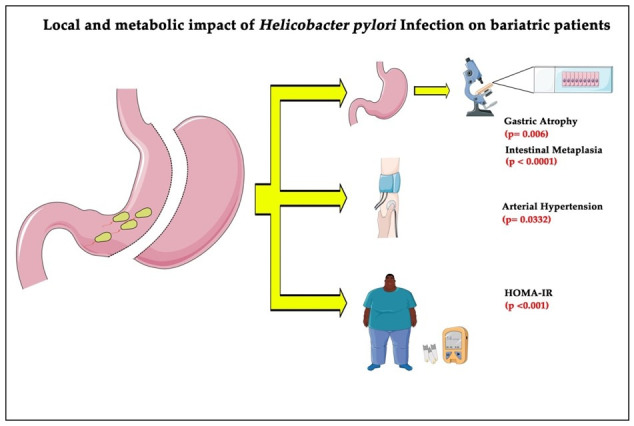
Obesity, as a major risk factor of metabolic syndrome (MetS), represents a pandemic, especially in Western societies, and is considered a risk factor for malignancies. (), is a definite carcinogen with global distribution. We aimed to investigate, for the first time in Switzerland, the main gastric mucosa premalignant histological lesions of bariatric patients in correlation with MetS components and Infection (-I). By reviewing retrospectively 94304 patient cases, a total of 116 eligible patients having undergone bariatric surgery were identified. The mean patient age was 48.66 years. (+) patients were 24% (28/116). Presence of gastric mucosa atrophy was documented in 8/28 (+) patients (29%) and (2/88) (-) ones (2%) ( = 0.006). Gastric mucosa intestinal metaplasia was observed in 14/28 (50%) (+) patients versus 3/88 (3.4%) of (-) group ( < 0.0001). (+) patients exhibited statistically higher arterial hypertension ( = 0.033). The homeostatic model of assessment insulin resistance was also statistically significantly higher for the (+) group ( < 0.001). In a multivariate analysis, including arterial hypertension, gastric mucosa atrophy, and intestinal metaplasia as variables, statistical significance remained only for intestinal metaplasia ( = 0.001). In conclusion, -I is associated with premalignant gastric mucosa histologic lesions and MetS components, including arterial hypertension and IR. Further large-scale prospective studies are required to confirm these findings.
肥胖作为代谢综合征(MetS)的主要危险因素,是一种广泛流行的疾病,尤其在西方社会,并且被认为是恶性肿瘤的危险因素。()是一种全球分布的明确致癌物。我们旨在首次在瑞士调查肥胖症患者的主要胃黏膜癌前组织学病变与MetS各组分及(-I)感染之间的关系。通过回顾性分析94304例患者病例,共确定了116例接受过减肥手术的符合条件的患者。患者平均年龄为48.66岁。(+)患者占24%(28/116)。在28例(+)患者中有8例(29%)记录到胃黏膜萎缩,而在88例(-)患者中有2例(2%)出现胃黏膜萎缩(P = 0.006)。在28例(+)患者中有14例(50%)观察到胃黏膜肠化生,而在(-)组的88例患者中有3例(3.4%)出现胃黏膜肠化生(P < 0.0001)。(+)患者的动脉高血压发生率在统计学上更高(P = 0.033)。(+)组的稳态模型评估胰岛素抵抗在统计学上也显著更高(P < 0.001)。在多变量分析中,将动脉高血压、胃黏膜萎缩和肠化生作为变量,仅肠化生仍具有统计学意义(P = 0.001)。总之,(-I)与胃黏膜癌前组织学病变以及包括动脉高血压和胰岛素抵抗(IR)在内的MetS各组分相关。需要进一步的大规模前瞻性研究来证实这些发现。