Tuck School of Business, Dartmouth College, Hanover, NH 30755, USA.
School of Business, Simmons University, Boston, MA 02115, USA.
Int J Environ Res Public Health. 2021 Jun 15;18(12):6465. doi: 10.3390/ijerph18126465.
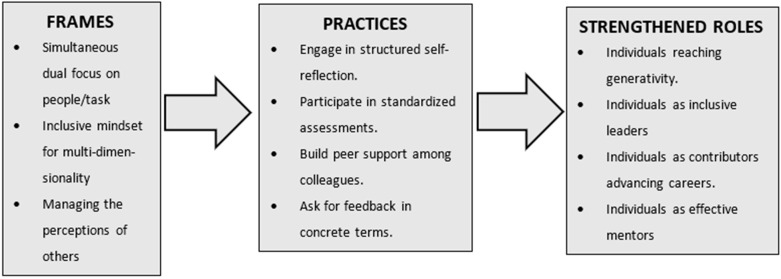
The extensive body of literature on mentoring has largely ignored the developmental needs of mentors themselves. This conceptual and practice-oriented paper asks mentors and others to consider the needs of mentors who may or may not arrive ready to deal with the challenges of being effective mentors. The authors ask: how should mentors think about their own growth and development? Drawing on a broad spectrum of academic literatures, three frames are proposed for guiding mentors' thinking about themselves and four practices to spur their continuous improvement. The three frames are a simultaneous dual focus on people and tasks as mentors exercise leadership; an inclusive mind-set that works across the multidimensionality of identities in others and themselves; and a keen sense of the threats and rewards of managing the perceptions of others. We recommend the use of four practices for self-examination: engage in structured self-reflection; participate in standardized assessments to see others and one's self differently; build peer support among colleagues; and ask for feedback in concrete terms. We conclude by offering the benefits and challenges as mentors engage in the difficult work of acquiring in-depth self-awareness.
关于指导的文献浩如烟海,但大多忽略了指导者自身的发展需求。本文从概念和实践两个角度出发,呼吁指导者和其他相关人员关注那些可能已经准备好应对指导挑战,也可能尚未准备好的指导者的需求。作者提出了这样一个问题:指导者应该如何思考自身的成长和发展?本文借鉴了广泛的学术文献,提出了三个框架,以指导指导者思考自身,并提出了四项实践,以激励他们不断提高。这三个框架是:在指导者发挥领导力时,同时关注人和任务;包容的心态,跨越他人和自身多维身份的界限;敏锐地意识到管理他人看法的威胁和回报。我们建议使用四项自我检查实践:进行结构化的自我反思;参与标准化评估,以不同的方式看待他人和自己;在同事中建立同伴支持;并以具体的方式寻求反馈。最后,我们讨论了指导者在深入了解自我时所面临的挑战和获益。