Graduate Institute of Acupuncture Science, China Medical University, Taichung 404, Taiwan.
Department of Acupuncture, China Medical University Hospital, Taichung 404, Taiwan.
Nutrients. 2021 Jun 19;13(6):2110. doi: 10.3390/nu13062110.
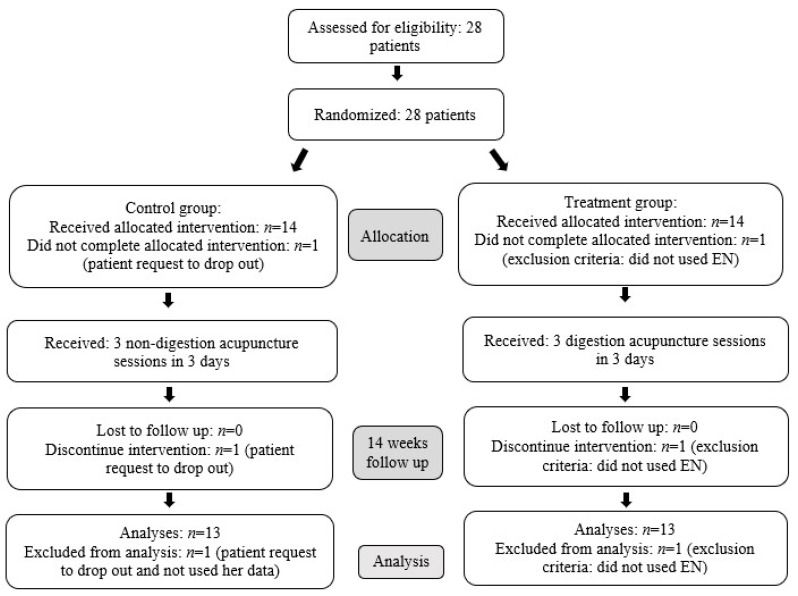
Malnourishment is prevalent in patients suffering from head and neck cancer. The postoperative period is crucial in terms of nutritional support, especially after composite resection and reconstruction surgery. These patients present with a number of risk factors that aggravate feeding intolerance, including postoperative status, prolonged immobility, decreased head elevation, mechanical ventilation, and applied sedative agents. Routine management protocols for feeding intolerance include prokinetic drug use and post-pyloric tube insertion, which could be both limited and accompanied by detrimental adverse events. This single-blind clinical trial aimed to investigate the effects of acupuncture in postoperative feeding intolerance in critically ill oral and hypopharyngeal cancer patients. Twenty-eight patients were randomized into two groups: Intervention group and Control group. Interventions were administered daily over three consecutive postoperative days. The primary outcome revealed that the intervention group reached 70% and 80% of target energy expenditure (EE) significantly earlier than the control group (4.00 ± 1.22 versus 6.69 ± 3.50 days, = 0.012), accompanied by higher total calorie intake within the first postoperative week (10263.62 ± 1086.11 kcals versus 8384.69 ± 2120.05 kcals, = 0.004). Furthermore, the intervention group also needed less of the prokinetic drug (Metoclopramide, 20.77 ± 48.73 mg versus 68.46 ± 66.56 mg, = 0.010). In conclusion, digestion-specific acupuncture facilitated reduced postoperative feeding intolerance in oral and hypopharyngeal cancer patients.
营养不良在头颈部癌症患者中很常见。术后营养支持至关重要,尤其是在进行复合切除和重建手术后。这些患者存在许多加重喂养不耐受的风险因素,包括术后状态、长时间不动、头部抬高减少、机械通气和应用镇静剂。喂养不耐受的常规管理方案包括使用促动力药物和胃后置管,但这些方法可能受到限制,并伴有有害的不良事件。这项单盲临床试验旨在研究针灸对口腔和下咽癌重症患者术后喂养不耐受的影响。将 28 名患者随机分为两组:干预组和对照组。干预措施在连续三个术后日每天进行。主要结果显示,干预组达到目标能量消耗(EE)的 70%和 80%的时间明显早于对照组(4.00 ± 1.22 与 6.69 ± 3.50 天, = 0.012),并且在术后第一周内的总热量摄入更高(10263.62 ± 1086.11 kcals 与 8384.69 ± 2120.05 kcals, = 0.004)。此外,干预组还需要更少的促动力药物(甲氧氯普胺,20.77 ± 48.73 mg 与 68.46 ± 66.56 mg, = 0.010)。总之,消化特异性针灸有助于减少口腔和下咽癌患者的术后喂养不耐受。