Immunology Program, Sloan Kettering Institute, Memorial Sloan Kettering Cancer Center, New York, NY 10065, USA.
Weill Cornell Graduate School of Medical Sciences, New York, NY 10065, USA.
Science. 2021 Jul 2;373(6550). doi: 10.1126/science.abe9383.
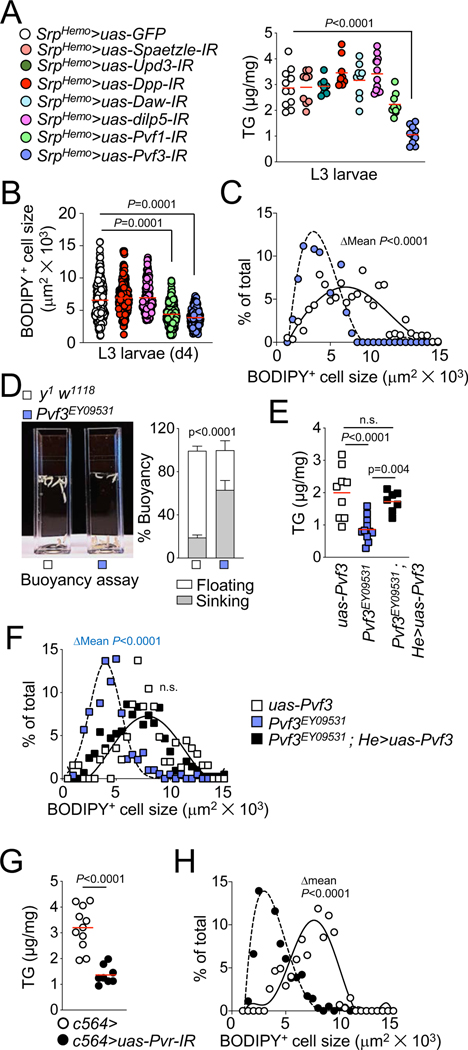
The mechanisms by which macrophages regulate energy storage remain poorly understood. We identify in a genetic screen a platelet-derived growth factor (PDGF)/vascular endothelial growth factor (VEGF)-family ortholog, Pvf3, that is produced by macrophages and is required for lipid storage in fat-body cells of larvae. Genetic and pharmacological experiments indicate that the mouse Pvf3 ortholog PDGFcc, produced by adipose tissue-resident macrophages, controls lipid storage in adipocytes in a leptin receptor- and C-C chemokine receptor type 2-independent manner. PDGFcc production is regulated by diet and acts in a paracrine manner to control lipid storage in adipose tissues of newborn and adult mice. At the organismal level upon PDGFcc blockade, excess lipids are redirected toward thermogenesis in brown fat. These data identify a macrophage-dependent mechanism, conducive to the design of pharmacological interventions, that controls energy storage in metazoans.
巨噬细胞调节能量储存的机制仍知之甚少。我们在一项遗传筛选中发现了一个血小板衍生生长因子 (PDGF)/血管内皮生长因子 (VEGF) 家族同源物 Pvf3,它由巨噬细胞产生,是幼虫脂肪体细胞中脂质储存所必需的。遗传和药理学实验表明,由脂肪组织驻留巨噬细胞产生的小鼠 Pvf3 同源物 PDGFcc 以瘦素受体和 C-C 趋化因子受体 2 非依赖性方式控制脂肪细胞中的脂质储存。PDGFcc 的产生受饮食调节,并以旁分泌方式作用于新生和成年小鼠的脂肪组织中控制脂质储存。在机体水平上,阻断 PDGFcc 后,多余的脂质会重新定向到棕色脂肪的产热中。这些数据确定了一种依赖于巨噬细胞的机制,有利于设计药理学干预措施,控制后生动物的能量储存。