Harmand Thibault J, Islam Ashraful, Pishesha Novalia, Ploegh Hidde L
Program in Cellular and Molecular Medicine, Boston Children's Hospital, Harvard Medical School Boston MA USA
Department of Clinical Medicine, UiT The Arctic University of Norway Tromso Norway.
RSC Chem Biol. 2021 Mar 8;2(3):685-701. doi: 10.1039/d1cb00023c.
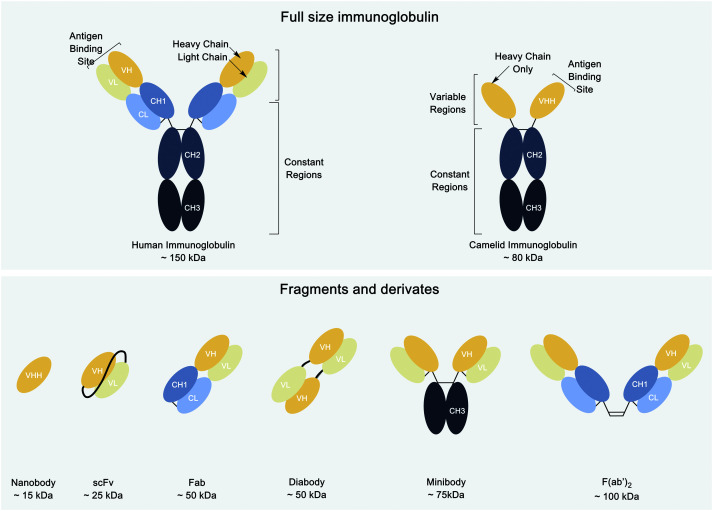
imaging has become in recent years an incredible tool to study biological events and has found critical applications in diagnostic medicine. Although a lot of efforts and applications have been achieved using monoclonal antibodies, other types of delivery agents are being developed. Among them, VHHs, antigen binding fragments derived from camelid heavy chain-only antibodies, also known as nanobodies, have particularly attracted attention. Indeed, their stability, fast clearance, good tissue penetration, high solubility, simple cloning and recombinant production make them attractive targeting agents for imaging modalities such as PET, SPECT or Infra-Red. In this review, we discuss the pioneering work that has been carried out using VHHs and summarize the recent developments that have been made using nanobodies for , non-invasive, imaging.
近年来,成像已成为研究生物事件的一项不可思议的工具,并在诊断医学中得到了关键应用。尽管使用单克隆抗体已经取得了很多成果和应用,但其他类型的递送剂也在不断研发。其中,源自骆驼科动物仅重链抗体的抗原结合片段VHHs,也被称为纳米抗体,尤其受到关注。事实上,它们的稳定性、快速清除率、良好的组织穿透性、高溶解性、简单的克隆和重组生产,使其成为正电子发射断层扫描(PET)、单光子发射计算机断层扫描(SPECT)或红外等成像模态的有吸引力的靶向剂。在这篇综述中,我们讨论了使用VHHs开展的开创性工作,并总结了使用纳米抗体进行非侵入性成像的最新进展。