University College Hospital, Ibadan.
Afr J Prim Health Care Fam Med. 2021 Jun 15;13(1):e1-e8. doi: 10.4102/phcfm.v13i1.2812.
The responsibility of caring for patients with advanced cancer in sub-Saharan Africa is mostly shouldered by family members because of paucity of institutional facilities. There is a growing concern that the number of women needing treatment for advanced breast cancer is rising at an unprecedented rate in Nigeria.
To assess the caregiver burden and its associated factors amongst family caregivers of women with advanced breast cancer.
The study was conducted at the radiation oncology clinic of the University College Hospital, Ibadan, Nigeria.
A cross-sectional descriptive study was conducted amongst 157 eligible family caregivers of women with advanced breast cancer. The family caregivers completed an interviewer-administered questionnaire, which included the socio-demographic data, the caregiving process and the Zarit Burden Interview (ZBI). Logistic regression was used to identify factors, and ethical approval was obtained.
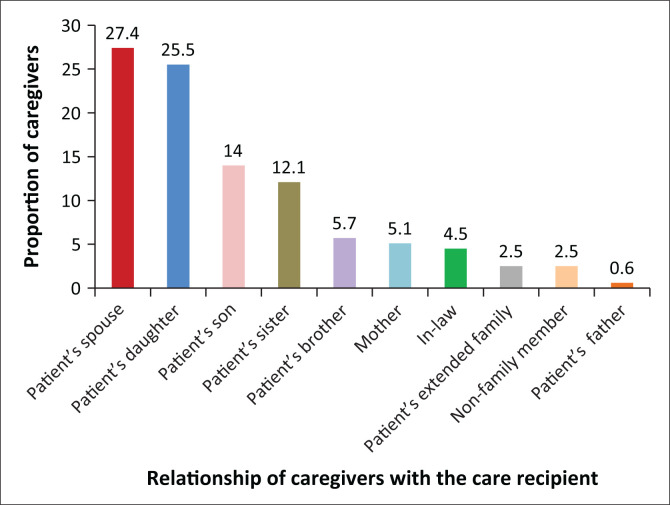
Over half (53%) of the respondents were males with spousal caregivers dominantly constituting 27.4% of all respondents, closely followed by daughters (25.5%) of the care recipients. The mean ZBI score was 29.84 ± 13.9. Most (72%) of the caregivers experienced burden. Factors associated with caregiver burden were previous hospitalisation of the care recipient (odds ratio [OR] = 3.74, confidence interval [CI]: 1.67 to 8.38) and perceived dysfunction in patients activities of daily living (OR = 2.57, CI: 1.14 to 5.78).
Family caregivers of women with advanced breast cancer experience burden of care. Recognition of this vulnerable population and the care recipient as a dyad is a sine qua non in mitigating the burden associated with their caregiving role.
撒哈拉以南非洲地区,由于缺乏机构设施,照顾晚期癌症患者的责任主要由家庭成员承担。人们越来越担心,在尼日利亚,需要治疗晚期乳腺癌的女性人数正在以前所未有的速度增长。
评估晚期乳腺癌女性家庭照顾者的照顾负担及其相关因素。
该研究在尼日利亚伊巴丹大学教学医院的放射肿瘤科诊所进行。
对 157 名符合条件的晚期乳腺癌女性家庭照顾者进行了横断面描述性研究。家庭照顾者完成了一份由访谈者管理的问卷,其中包括社会人口统计学数据、照顾过程和 Zarit 负担访谈(ZBI)。使用逻辑回归来确定因素,并获得了伦理批准。
超过一半(53%)的受访者为男性,配偶照顾者占所有受访者的 27.4%,其次是照顾对象的女儿(25.5%)。ZBI 平均得分为 29.84 ± 13.9。大多数(72%)的照顾者有负担。与照顾者负担相关的因素包括照顾对象的既往住院治疗(优势比[OR] = 3.74,置信区间[CI]:1.67 至 8.38)和患者日常生活活动功能障碍的感知(OR = 2.57,CI:1.14 至 5.78)。
晚期乳腺癌女性的家庭照顾者承受着照顾的负担。认识到这一弱势群体和照顾对象是一个不可或缺的因素,可以减轻他们照顾角色相关的负担。