Zhang Yijie, Yao Bin, Li Zhao, Song Wei, Li Jianjun, Zhu Dongzhen, Wang Yuzhen, Duan Xianlan, Yuan Xingyu, Huang Sha, Fu Xiaobing
Research Center for Tissue Repair and Regeneration, Medical Innovation Research Department and the Fourth Medical Center, Chinese PLA General Hospital and PLA Medical College, Beijing 100048, China.
PLA Key Laboratory of Tissue Repair and Regenerative Medicine and Beijing Key Research Laboratory of Skin Injury, Repair and Regeneration, Chinese PLA General Hospital and PLA Medical College, Beijing 100853, China.
Burns Trauma. 2021 May 4;9:tkab013. doi: 10.1093/burnst/tkab013. eCollection 2021.
Sweat glands (SGs) and hair follicles (HFs) are two important cutaneous appendages that play crucial roles in homeostatic maintenance and thermoregulation, and their interaction is involved in wound healing. SGs can be regenerated from mesenchymal stem cell-laden 3D bioprinted scaffolds, based on our previous studies, whereas regeneration of HFs could not be achieved in the same model. Due to the lack of an model, the underlying molecular mechanism of the interaction between SGs and HFs in regeneration could not be fully understood. The purpose of the present study was to establish an model of skin constructs with SGs and HFs and explore the interaction between these two appendages in regeneration.
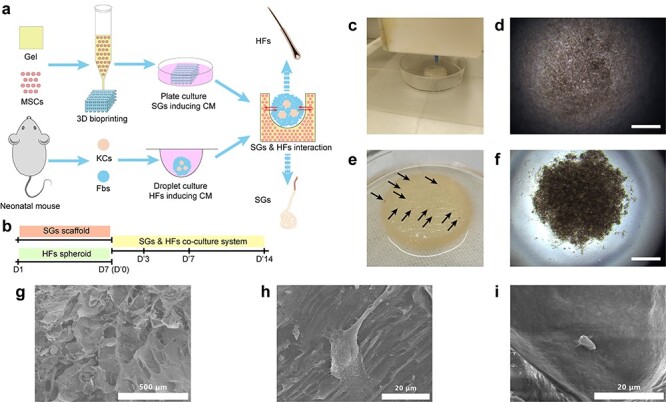
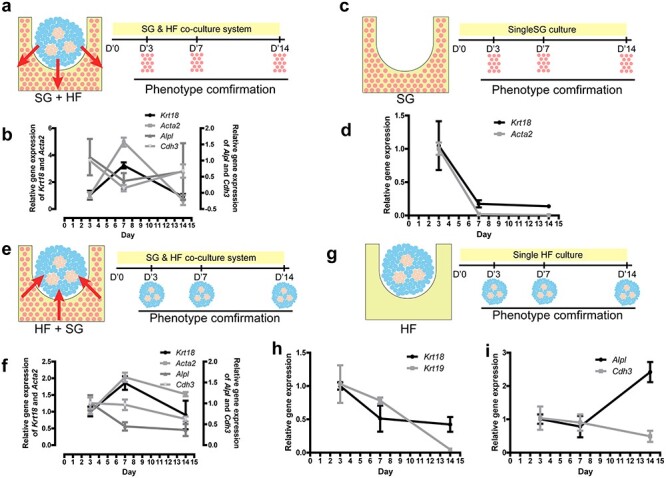
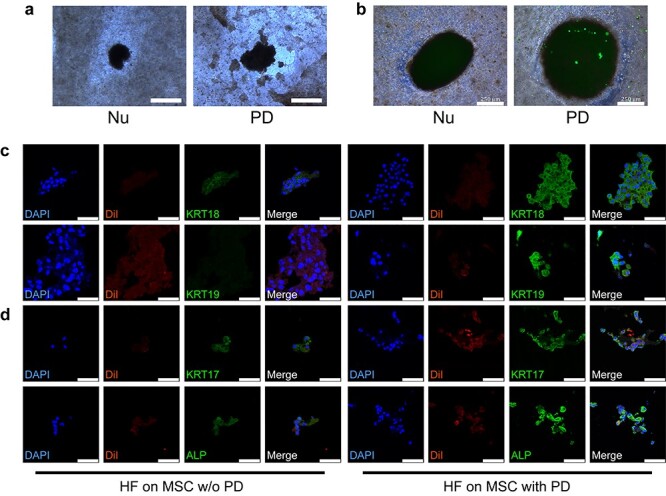
To investigate the interaction effects between SGs and HFs during their regeneration processes, a combined model was created by seeding HF spheroids on 3D printed SG scaffolds. The interaction between SG scaffolds and HF spheroids was detected using RNA expression and immunofluorescence staining. The effects of microenvironmental cues on SG and HF regeneration were analysed by altering seed cell types and plantar dermis homogenate in the scaffold.
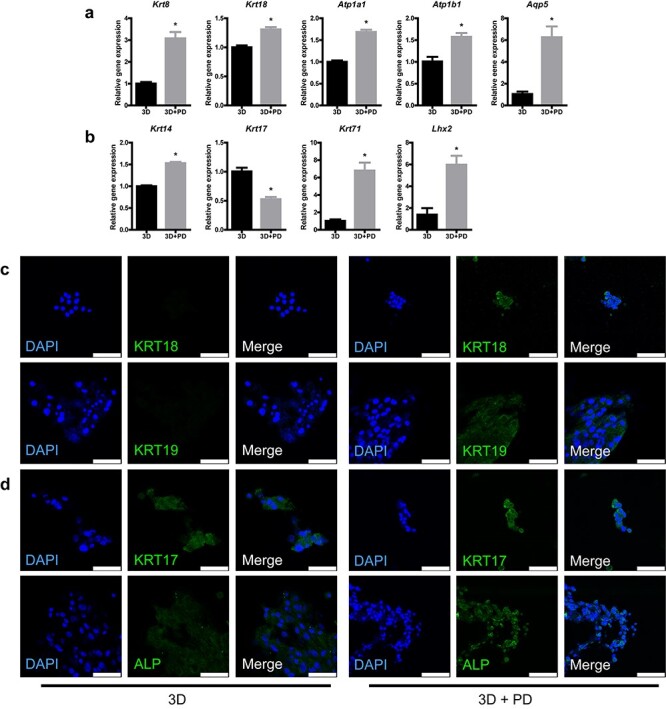
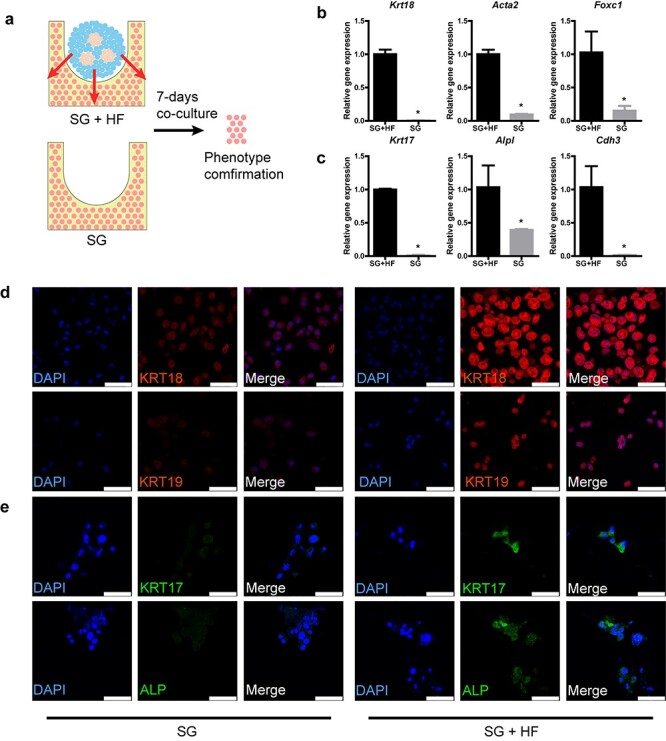
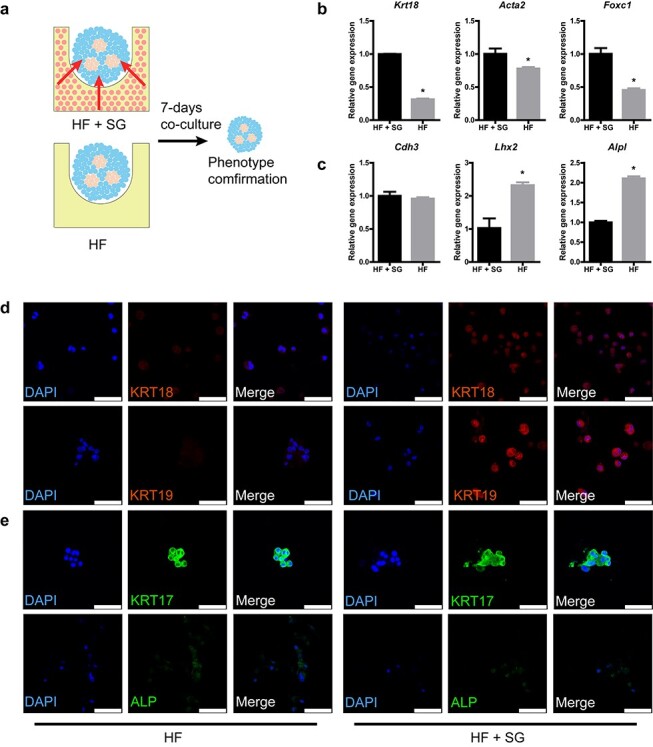
According to this model, we overcame the difficulties in simultaneously inducing SG and HF regeneration and explored the interaction effects between SG scaffolds and HF spheroids. Surprisingly, HF spheroids promoted both SG and HF differentiation in SG scaffolds, while SG scaffolds promoted SG differentiation but had little effect on HF potency in HF spheroids. Specifically, microenvironmental factors (plantar dermis homogenate) in SG scaffolds effectively promoted SG and HF genesis in HF spheroids, no matter what the seed cell type in SG scaffolds was, and the promotion effects were persistent.
Our approach elucidated a new model for SG and HF formation and provided an applicable platform to investigate the interaction between SGs and HFs . This platform might facilitate 3D skin constructs with multiple appendages and unveil the spatiotemporal molecular program of multiple appendage regeneration.
汗腺(SGs)和毛囊(HFs)是两种重要的皮肤附属器,在体内稳态维持和体温调节中发挥关键作用,它们之间的相互作用参与伤口愈合。根据我们之前的研究,汗腺可从负载间充质干细胞的3D生物打印支架中再生,而在同一模型中无法实现毛囊的再生。由于缺乏这样的模型,汗腺和毛囊在再生过程中相互作用的潜在分子机制尚不完全清楚。本研究的目的是建立一个包含汗腺和毛囊的皮肤构建体模型,并探索这两种附属器在再生过程中的相互作用。
为了研究汗腺和毛囊在再生过程中的相互作用,通过将毛囊球体接种到3D打印的汗腺支架上创建了一个联合模型。利用RNA表达和免疫荧光染色检测汗腺支架与毛囊球体之间的相互作用。通过改变支架中的种子细胞类型和足底真皮匀浆来分析微环境线索对汗腺和毛囊再生的影响。
根据该模型,我们克服了同时诱导汗腺和毛囊再生的困难,并探索了汗腺支架与毛囊球体之间的相互作用。令人惊讶的是,毛囊球体促进了汗腺支架中汗腺和毛囊的分化,而汗腺支架促进了汗腺的分化,但对毛囊球体中的毛囊潜能影响不大。具体而言,汗腺支架中的微环境因素(足底真皮匀浆)有效地促进了毛囊球体中汗腺和毛囊的形成,无论汗腺支架中的种子细胞类型如何,且促进作用持续存在。
我们的方法阐明了一种汗腺和毛囊形成的新模型,并提供了一个适用的平台来研究汗腺和毛囊之间的相互作用。该平台可能有助于构建具有多种附属器的3D皮肤构建体,并揭示多种附属器再生的时空分子程序。