Department of Health Promotion, Mother and Child Care, Internal Medicine and Medical Specialties "G. D'Alessandro", University of Palermo, Palermo, Italy.
Unit of Pediatrics, Campus Bio-Medico University, Rome, Italy.
Ital J Pediatr. 2021 Jul 2;47(1):150. doi: 10.1186/s13052-021-01102-8.
The lives of many children and adolescents are today increasingly influenced by new technological devices, including smartphones. The coronavirus disease 2019 (COVID-19) pandemic occurred in a time of outstanding scientific progress and global digitalization. Young people had relevant adverse psychological and behavioral effects due to the COVID-19 pandemic, mainly related to infection control measures, which led them to spend more time at home and with major use of technological tools. The goal this study proposes is to evaluate health and social outcomes of smartphone overuse among Italian children and adolescents during the COVID-19 pandemic, analyzing patterns and aims of utilization, as well as the eventual presence and degree of addiction.
This study was based on a self-report and anonymous questionnaire, which was administered to 184 Italian school-age (6-18 years) children and adolescents during the second wave of the COVID-19 pandemic. The test was electronically (email, whatsapp) explained and sent by pediatricians either directly to older children (middle and high school), or indirectly, through the help of teachers, to younger ones (primary school). All participants spontaneously and voluntarily joined the present study. The survey was made by 4 sections, and designed to know and outline modalities (frequency, patterns and aims) of smartphone use, adverse outcomes, and related parental behaviors, also in order to reveal the eventual occurrence and degree of addiction. The same information, related to the pre-epidemic period, was also investigated and analyzed.
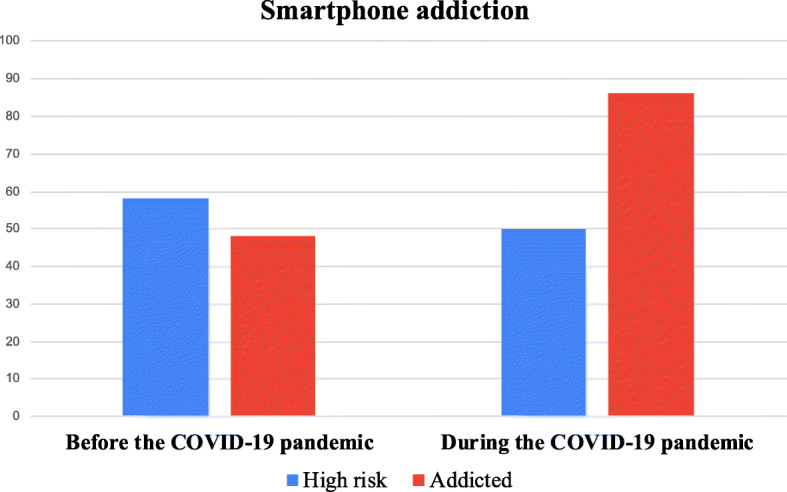
The data obtained revealed a significantly greater adhesion to the questionnaire by females, likely reflecting higher attention and interest than boys to initiatives relating to health education. Our study showed more frequent smartphone use among Italian children and adolescents during the COVID-19 pandemic, compared to the pre-epidemic period. This may be related to the social distancing measures adopted during the months under investigation. The present survey also outlined the changing patterns and aims in the use of smartphones among young people, which allowed to limit some effects of the crisis. Indeed, they were used for human connection, learning and entertainment, providing psychological and social support. Finally, it was observed a significant increase of overuse and addiction. This led to many clinical (sleep, ocular and musculoskeletal disorders), psychological (distraction, mood modification, loss of interest) and social (superficial approach to learning, isolation) unfavorable outcomes.
Pediatricians and health care professionals should be aware of the potential risks related to inappropriate use of smartphones. They should monitor, in cooperation with parents, possible associated adverse effects, in order to early recognize signs and symptoms suggestive, or at high risk, for addiction. They must carry out, as well, the necessary interventions to prevent and/or lower the detrimental impact of smartphone overuse on children and adolescents' health, oriented to sustain adequate physical and psychological development as well as social relationships.
如今,许多儿童和青少年的生活越来越受到包括智能手机在内的新技术设备的影响。2019 年冠状病毒病(COVID-19)大流行发生在科学进步和全球数字化的时代。由于 COVID-19 大流行,年轻人出现了相关的不良心理和行为影响,主要与感染控制措施有关,这些措施导致他们更多地待在家里,更多地使用技术工具。本研究旨在评估意大利儿童和青少年在 COVID-19 大流行期间过度使用智能手机的健康和社会结果,分析利用模式和目的,以及潜在的存在和成瘾程度。
本研究基于自我报告和匿名问卷,在 COVID-19 大流行的第二波期间,对 184 名意大利学龄(6-18 岁)儿童和青少年进行了测试。儿科医生通过电子邮件、whatsapp 等方式向年龄较大的儿童(中学和高中)直接解释并发送测试,或通过教师间接向年龄较小的儿童(小学)发送测试。所有参与者都是自发自愿参加本研究的。该调查分为 4 个部分,旨在了解和概述智能手机使用的方式(频率、模式和目的)、不良后果以及相关的父母行为,以便揭示潜在的成瘾发生和程度。还调查和分析了与大流行前时期相关的相同信息。
研究结果表明,女性对问卷的参与度明显更高,这可能反映出与健康教育相关的倡议比男孩更受关注和兴趣。我们的研究表明,意大利儿童和青少年在 COVID-19 大流行期间使用智能手机的频率明显高于大流行前。这可能与调查期间采取的社交距离措施有关。本调查还概述了年轻人在使用智能手机方面模式和目的的变化,这有助于限制危机的一些影响。事实上,它们被用于人际联系、学习和娱乐,提供心理和社会支持。最后,观察到过度使用和成瘾的显著增加。这导致了许多临床(睡眠、眼部和肌肉骨骼障碍)、心理(分心、情绪改变、兴趣丧失)和社会(学习表面化、孤立)不良后果。
儿科医生和医疗保健专业人员应该意识到与智能手机不当使用相关的潜在风险。他们应该与父母合作,监测可能存在的不良影响,以便及早识别提示或高风险成瘾的迹象和症状。他们还必须进行必要的干预,以防止和/或降低智能手机过度使用对儿童和青少年健康的不利影响,以维持适当的身心发展和社会关系。
