Montag Christian, Elhai Jon D
Department of Molecular Psychology, Institute of Psychology and Education, Ulm University, Ulm, Germany.
Department of Psychology, and Department of Psychiatry, University of Toledo, Toledo, OH, USA.
Addict Behav Rep. 2020 Nov 9;12:100313. doi: 10.1016/j.abrep.2020.100313. eCollection 2020 Dec.
During the 2020 COVID-19 pandemic and associated lockdown/social distancing, many scientists pointed towards the problem of increased digital technology overuse in both children and adolescents.
Although a review of the literature shows that digital technology overuse in youth represents an important topic to be studied itself (during the pandemic and afterwards), the present work also takes into account findings from Affective Neuroscience Theory (ANT).
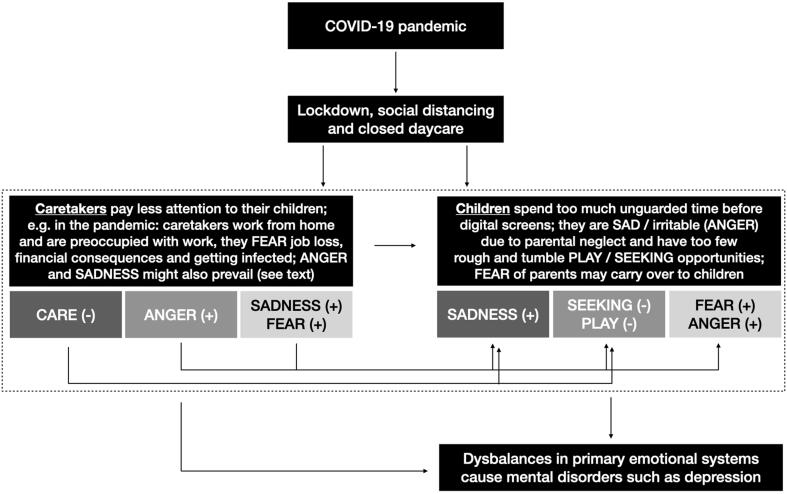
An investigation of digital overuse while the COVID-19 pandemic (and beyond) against the background of ANT calls for a shift of perspective in research, at least as an important supplement to research efforts querying the actual nature of digital overuse. In the present work, we argue that it is high time to more comprehensively address why children spend too much time with screens and to also highlight the media effects of screen time use (e.g. less mammalian rough and tumble PLAY time outside and elevated SADNESS due to parental neglect).
In sum, insights from ANT are put forward to guide research shedding light on detrimental aspects of too much screen time in youth.
在2020年新冠疫情期间以及相关的封锁措施/社交距离限制实施期间,许多科学家指出了儿童和青少年过度使用数字技术的问题。
尽管文献综述表明,青少年过度使用数字技术本身就是一个值得研究的重要课题(在疫情期间及之后),但本研究还考虑了情感神经科学理论(ANT)的研究结果。
在情感神经科学理论的背景下,对新冠疫情期间(及之后)数字技术过度使用情况的调查要求研究视角发生转变,至少作为对探究数字技术过度使用实际本质的研究工作的重要补充。在本研究中,我们认为现在是时候更全面地探讨儿童为何花太多时间在屏幕前,并强调屏幕使用时间的媒体效应(例如户外较少的哺乳动物式打闹玩耍时间以及因父母忽视导致的悲伤情绪增加)。
总之,提出情感神经科学理论的见解以指导研究,揭示青少年过多屏幕使用时间的有害影响。