Department of Health Sciences Research, Mayo Clinic, Rochester, MN.
Department of Health Sciences Research, Mayo Clinic, Rochester, MN.
Mayo Clin Proc. 2021 Jul;96(7):1890-1895. doi: 10.1016/j.mayocp.2021.04.012. Epub 2021 Apr 27.
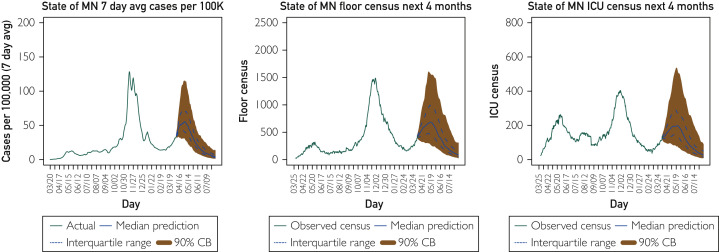
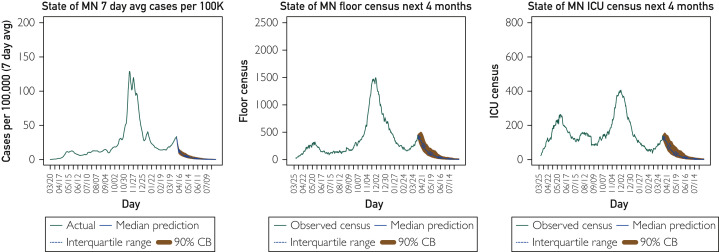
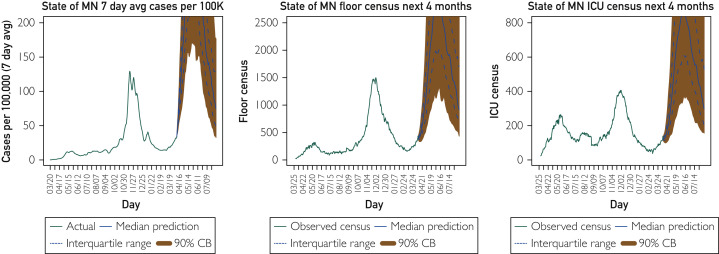
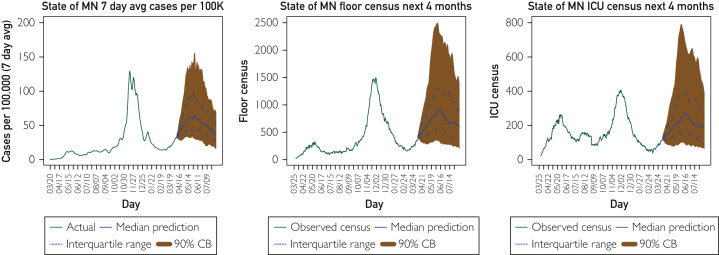
Predictive models have played a critical role in local, national, and international response to the COVID-19 pandemic. In the United States, health care systems and governmental agencies have relied on several models, such as the Institute for Health Metrics and Evaluation, Youyang Gu (YYG), Massachusetts Institute of Technology, and Centers for Disease Control and Prevention ensemble, to predict short- and long-term trends in disease activity. The Mayo Clinic Bayesian SIR model, recently made publicly available, has informed Mayo Clinic practice leadership at all sites across the United States and has been shared with Minnesota governmental leadership to help inform critical decisions during the past year. One key to the accuracy of the Mayo Clinic model is its ability to adapt to the constantly changing dynamics of the pandemic and uncertainties of human behavior, such as changes in the rate of contact among the population over time and by geographic location and now new virus variants. The Mayo Clinic model can also be used to forecast COVID-19 trends in different hypothetical worlds in which no vaccine is available, vaccinations are no longer being accepted from this point forward, and 75% of the population is already vaccinated. Surveys indicate that half of American adults are hesitant to receive a COVID-19 vaccine, and lack of understanding of the benefits of vaccination is an important barrier to use. The focus of this paper is to illustrate the stark contrast between these 3 scenarios and to demonstrate, mathematically, the benefit of high vaccine uptake on the future course of the pandemic.
预测模型在应对 COVID-19 大流行的本地、国家和国际反应中发挥了关键作用。在美国,医疗保健系统和政府机构依赖于多种模型,如健康计量与评估研究所、Youyang Gu(YYG)、麻省理工学院和疾病控制与预防中心综合模型,以预测疾病活动的短期和长期趋势。最近公开的梅奥诊所贝叶斯 SIR 模型为美国各地的梅奥诊所实践领导层提供了信息,并与明尼苏达州政府领导层共享,以帮助在过去一年中做出关键决策。梅奥诊所模型准确性的一个关键是它能够适应大流行不断变化的动态和人类行为的不确定性,例如随着时间的推移和地理位置的变化,人群之间的接触率的变化,以及现在新的病毒变体。该模型还可以用于预测在不同假设世界中 COVID-19 的趋势,在这些假设世界中,没有疫苗可用,从现在开始不再接受疫苗接种,并且 75%的人口已经接种了疫苗。调查表明,一半的美国成年人对接种 COVID-19 疫苗犹豫不决,对疫苗接种益处的缺乏理解是使用疫苗的一个重要障碍。本文的重点是说明这 3 种情况之间的鲜明对比,并从数学上证明高疫苗接种率对大流行未来进程的益处。