Department of Biological Sciences, Boise State University, 1910 University Drive, Boise, ID, 83725, USA.
Conservatoire et Jardin botaniques de Genève, ch. de l'Impératrice 1, CP 71, 1292, Chambésy, Switzerland.
Am J Bot. 2021 Jul;108(7):1234-1251. doi: 10.1002/ajb2.1693. Epub 2021 Jul 5.
The economically important, cosmopolitan soapberry family (Sapindaceae) comprises ca. 1900 species in 144 genera. Since the seminal work of Radlkofer, several authors have attempted to overcome challenges presented by the family's complex infra-familial classification. With the advent of molecular systematics, revisions of the various proposed groupings have provided significant momentum, but we still lack a formal classification system rooted in an evolutionary framework.
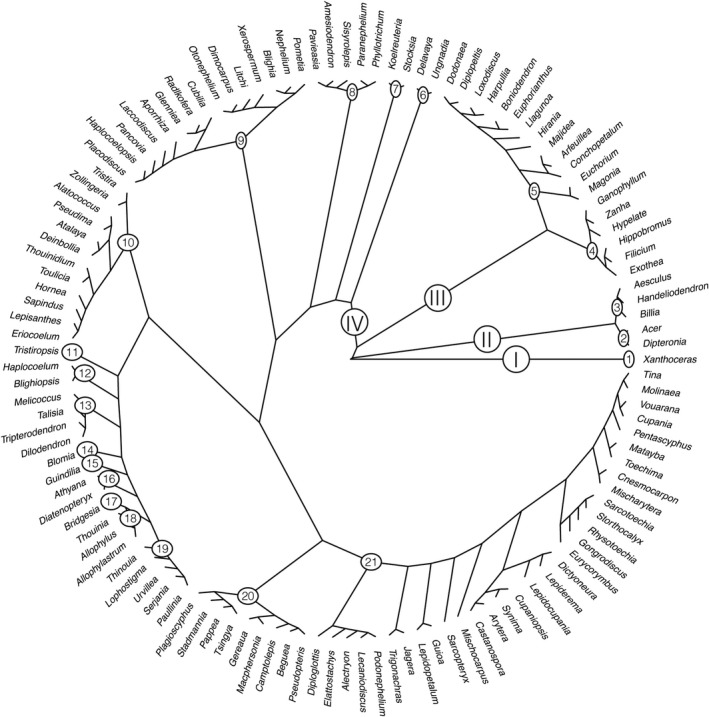
Nuclear DNA sequence data were generated for 123 genera (86%) of Sapindaceae using target sequence capture with the Angiosperms353 universal probe set. HybPiper was used to produce aligned DNA matrices. Phylogenetic inferences were obtained using coalescence-based and concatenated methods. The clades recovered are discussed in light of both benchmark studies to identify synapomorphies and distributional evidence to underpin an updated infra-familial classification.
Coalescence-based and concatenated phylogenetic trees had identical topologies and node support, except for the placement of Melicoccus bijugatus Jacq. Twenty-one clades were recovered, which serve as the basis for a revised infra-familial classification.
Twenty tribes are recognized in four subfamilies: two tribes in Hippocastanoideae, two in Dodonaeoideae, and 16 in Sapindoideae (no tribes are recognized in the monotypic subfamily Xanthoceratoideae). Within Sapindoideae, six new tribes are described: Blomieae Buerki & Callm.; Guindilieae Buerki, Callm. & Acev.-Rodr.; Haplocoeleae Buerki & Callm.; Stadmanieae Buerki & Callm.; Tristiropsideae Buerki & Callm.; and Ungnadieae Buerki & Callm. This updated classification provides a backbone for further research and conservation efforts on this family.
经济上重要的、世界性的皂角科(Sapindaceae)包含约 1900 种,分布于 144 属。自拉德科弗(Radlkofer)开创性的工作以来,多位作者试图克服该科复杂的亚科分类所带来的挑战。随着分子系统学的出现,对各种提出的分组的修订提供了重大动力,但我们仍然缺乏基于进化框架的正式分类系统。
使用 Angiosperms353 通用探针组对皂角科的 123 属(86%)进行了核 DNA 序列数据生成,采用目标序列捕获方法。使用 HybPiper 生成对齐的 DNA 矩阵。使用基于合并的方法和连锁方法获得系统发育推断。恢复的分支是根据识别同源特征的基准研究和支持更新的亚科分类的分布证据来讨论的。
基于合并的和连锁的系统发育树具有相同的拓扑结构和节点支持,除了 Melicoccus bijugatus Jacq 的位置不同。恢复了 21 个分支,它们是修订后的亚科分类的基础。
在四个亚科中识别出 21 个部落:在 Hippocastanoideae 中有两个部落,在 Dodonaeoideae 中有两个部落,在 Sapindoideae 中有 16 个部落(在单型亚科 Xanthoceratoideae 中没有部落)。在 Sapindoideae 中,描述了六个新的部落:Blomieae Buerki & Callm.;Guindilieae Buerki, Callm. & Acev.-Rodr.;Haplocoeleae Buerki & Callm.;Stadmanieae Buerki & Callm.;Tristiropsideae Buerki & Callm.;和 Ungnadieae Buerki & Callm.。这个更新的分类为进一步的研究和保护工作提供了一个基础。