Department of Pharmacology & Toxicology Brody School of MedicineEast Carolina University Greenville NC.
Fraternal Order of Eagles Diabetes Research Center University of Iowa Iowa City IA.
J Am Heart Assoc. 2021 Jul 20;10(14):e019877. doi: 10.1161/JAHA.120.019877. Epub 2021 Jul 3.
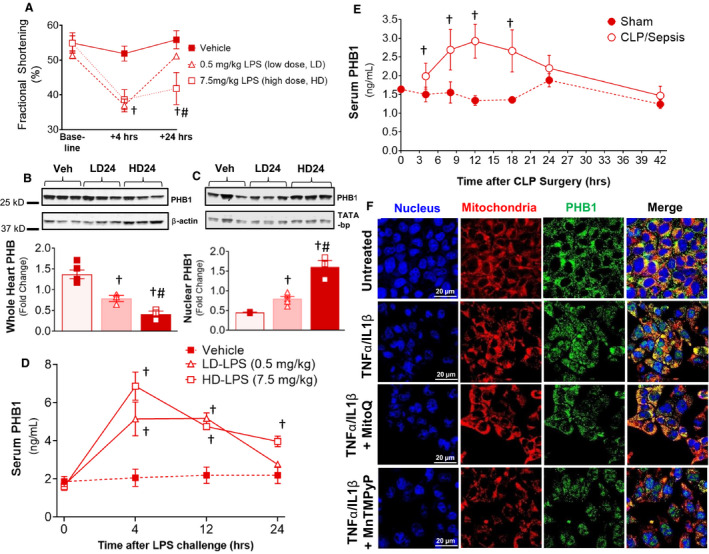
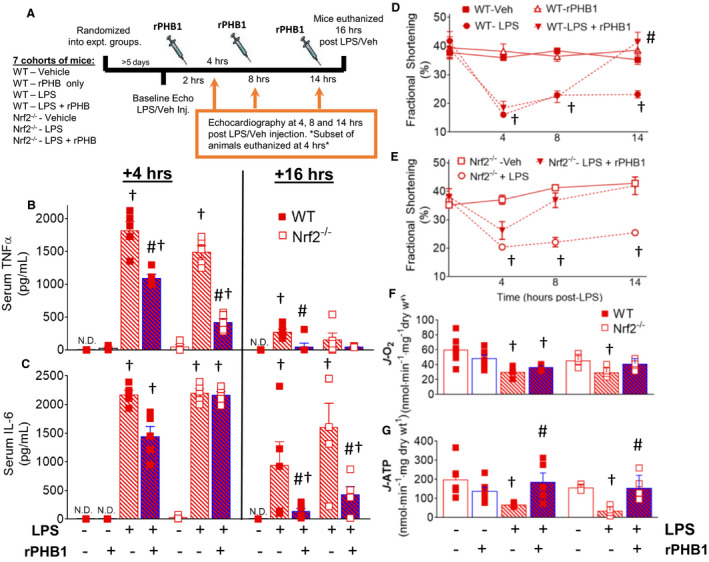
Background In sepsis, circulating cytokines and lipopolysaccharide elicit mitochondrial dysfunction and cardiomyopathy, a major cause of morbidity and mortality with this condition. Emerging research places the PHB1 (lipid raft protein prohibitin-1) at the nexus of inflammation, metabolism, and oxidative stress. PHB1 has also been reported in circulation, though its function in this compartment is completely unknown. Methods and Results Using a wide-ranging approach across multiple in vitro and in vivo models, we interrogated the functional role of intracellular and circulating PHB1 in the heart during sepsis, and elucidated some of the mechanisms involved. Upon endotoxin challenge or sepsis induction in rodent models, PHB1 translocates from mitochondria to nucleus in cardiomyocytes and is secreted into the circulation from the liver in a manner dependent on nuclear factor (erythroid-derived 2)-like 2, a key transcriptional regulator of the antioxidant response. Overexpression or treatment with recombinant human PHB1 enhances the antioxidant/anti-inflammatory response and protects HL-1 cardiomyocytes from mitochondrial dysfunction and toxicity from cytokine stress. Importantly, administration of recombinant human PHB1 blunted inflammation and restored cardiac contractility and ATP production in mice following lipopolysaccharide challenge. This cardioprotective, anti-inflammatory effect of recombinant human PHB1 was determined to be independent of nuclear factor (erythroid-derived 2)-like 2, but partially dependent on PI3K/AKT signaling in the heart. Conclusions These findings reveal a previously unknown cardioprotective effect of PHB1 during sepsis, and illustrate a pro-survival, protective role for PHB1 in the circulation. Exploitation of circulating PHB1 as a biomarker and/or therapeutic could have widespread benefit in the clinical management of sepsis and other severe inflammatory disorders.
在败血症中,循环细胞因子和脂多糖会引发线粒体功能障碍和心肌病,这是该疾病发病率和死亡率的主要原因。新的研究将 PHB1(脂筏蛋白抑制素-1)置于炎症、代谢和氧化应激的交汇点。PHB1 也已在循环中被报道,但它在该隔室中的功能完全未知。
我们使用多种体外和体内模型进行了广泛的研究,探讨了 PHB1 在败血症中心脏中的细胞内和循环中的功能作用,并阐明了其中涉及的一些机制。在内毒素挑战或啮齿动物模型中的败血症诱导后,PHB1 从线粒体易位到心肌细胞的细胞核,并以依赖核因子(红系衍生 2)样 2 的方式从肝脏分泌到循环中,核因子(红系衍生 2)样 2 是抗氧化反应的关键转录调节剂。过表达或用重组人 PHB1 处理可增强抗氧化/抗炎反应,并保护 HL-1 心肌细胞免受细胞因子应激引起的线粒体功能障碍和毒性。重要的是,在脂多糖挑战后,给予重组人 PHB1 可减轻炎症并恢复小鼠的心脏收缩力和 ATP 产生。重组人 PHB1 的这种心脏保护、抗炎作用被确定不依赖于核因子(红系衍生 2)样 2,但部分依赖于心脏中的 PI3K/AKT 信号通路。
这些发现揭示了 PHB1 在败血症中以前未知的心脏保护作用,并说明了 PHB1 在循环中的生存、保护作用。循环 PHB1 作为生物标志物和/或治疗剂的开发可能会在败血症和其他严重炎症性疾病的临床管理中带来广泛的益处。