Koo Yu Wen, Neumann David L, Ownsworth Tamara, Shum David H K
School of Applied Psychology, Griffith University, Mt Gravatt, QLD, Australia.
Menzies Health Institute of Queensland, Griffith University, Gold Coast, QLD, Australia.
Front Psychol. 2021 Jun 17;12:691752. doi: 10.3389/fpsyg.2021.691752. eCollection 2021.
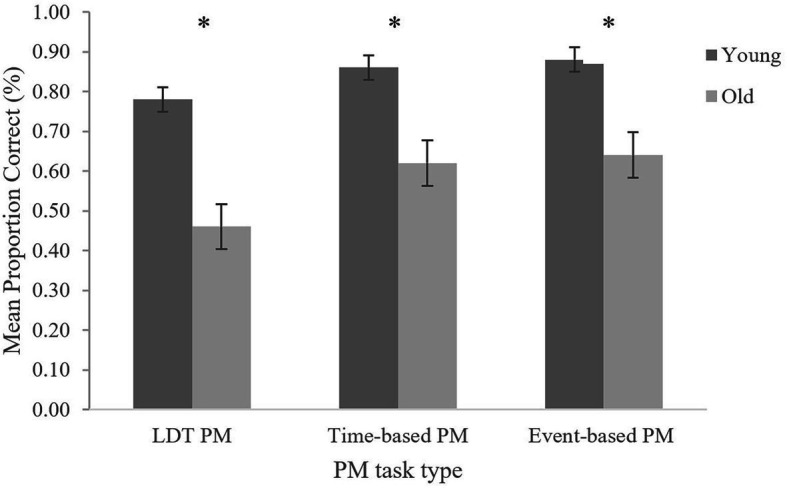
Prospective memory (PM) is the ability to perform a planned action at a future time. Older adults have shown moderate declines in PM, which are thought to be driven by age-related changes in the prefrontal cortex. However, an age-PM paradox is often reported, whereby deficits are evident in laboratory-based PM tasks, but not naturalistic PM tasks. The key aims of this study were to: (1) examine the age-PM paradox using the same sample across laboratory and ecological settings; and (2) determine whether self-reported PM and cognitive factors such as working memory and IQ are associated PM performance. Two PM tasks were administered (ecological vs. laboratory) to a sample of 23 community-dwelling older adults ( = 72.30, = 5.62) and 28 young adults ( = 20.18, = 3.30). Participants also completed measures of general cognitive function, working memory, IQ, and self-reported memory. Our results did not support the existence of the age-PM paradox. Strong age effects across both laboratory and ecological PM tasks were observed in which older adults consistently performed worse on the PM tasks than young adults. In addition, PM performance was significantly associated with self-reported PM measures in young adults. For older adults, IQ was associated with time-based PM. These findings suggest that the age-PM paradox is more complex than first thought and there are differential predictors of PM performance for younger and older adults.
前瞻性记忆(PM)是指在未来某个时间执行计划行动的能力。老年人的前瞻性记忆表现出适度下降,这被认为是由前额叶皮质的年龄相关变化所驱动。然而,经常有年龄 - 前瞻性记忆悖论的报道,即在基于实验室的前瞻性记忆任务中存在缺陷,但在自然情境下的前瞻性记忆任务中却不明显。本研究的主要目的是:(1)在实验室和生态环境中使用相同样本检验年龄 - 前瞻性记忆悖论;(2)确定自我报告的前瞻性记忆以及工作记忆和智商等认知因素是否与前瞻性记忆表现相关。对23名社区居住的老年人(平均年龄 = 72.30,标准差 = 5.62)和28名年轻人(平均年龄 = 20.18,标准差 = 3.30)的样本进行了两项前瞻性记忆任务(生态任务与实验室任务)。参与者还完成了一般认知功能、工作记忆、智商和自我报告记忆的测量。我们的结果不支持年龄 - 前瞻性记忆悖论的存在。在实验室和生态前瞻性记忆任务中均观察到明显的年龄效应,老年人在前瞻性记忆任务中的表现始终比年轻人差。此外,年轻人的前瞻性记忆表现与自我报告的前瞻性记忆测量显著相关。对于老年人,智商与基于时间的前瞻性记忆相关。这些发现表明,年龄 - 前瞻性记忆悖论比最初认为的更为复杂,年轻人和老年人前瞻性记忆表现的预测因素存在差异。