Johansen Cæcilie Bachdal, Egeberg Alexander, Jimenez Solem Espen, Vittrup Ida, Skov Lone, Francis Thomsen Simon
Department of Dermatology and Venereology, Copenhagen University Hospital Bispebjerg and Frederiksberg, Copenhagen, Denmark.
Department of Clinical Pharmacology, Copenhagen University Hospital Bispebjerg and Frederiksberg, Copenhagen, Denmark.
Int J Womens Dermatol. 2020 Nov 27;7(3):246-258. doi: 10.1016/j.ijwd.2020.11.004. eCollection 2021 Jun.
Psoriasis is a disease that extends beyond the skin, with profound medical, social, and mental health implications. To our knowledge, no previous studies have specifically investigated the medical and socioeconomic characteristics of women with versus without psoriasis.
We investigated whether women with psoriasis differed from women without psoriasis with respect to comorbidities, socioeconomic status, healthcare consumption, and drug use, as well as how these characteristics differed according to psoriasis severity.
In this nationwide, register-based, cross-sectional study, data were collected from Danish registries from 1977 to 2017, linked at the individual level, and identified by International Classification of Diseases codes, prescription data, income and educational information, and contact with public health care services. Psoriasis was defined by either a hospital International Classification of Diseases code for psoriasis or calcipotriol prescription data. Psoriasis severity was stratified based on psoriasis treatment. Age-adjusted logistic regression models were used to estimate the odds ratios (ORs) of outcomes compared with those of women without psoriasis.
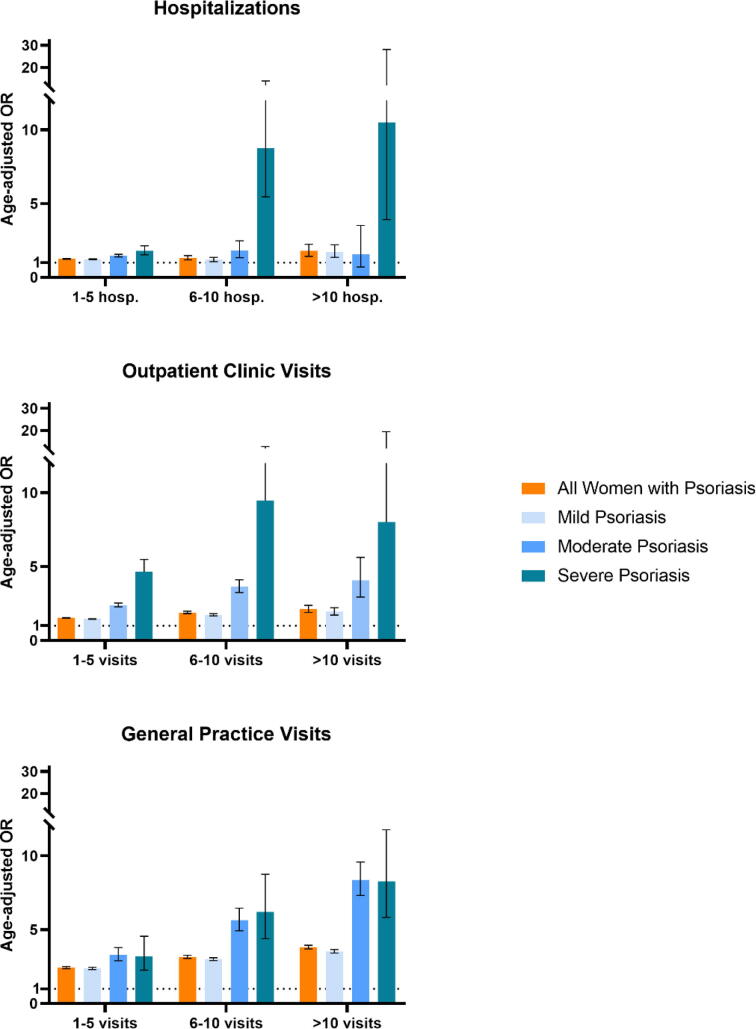
A total of 77,143 women (3%) met the criteria for psoriasis. Psoriasis was significantly associated with all investigated outcomes. Women with psoriasis were less likely to have a high income (OR: 0.89; 95% confidence interval [CI], 0.87-0.91), more likely to visit their general practitioner more often (OR: 3.82; 95% CI, 3.70-3.95), and received pain medication more often (OR: 1.57; 95% CI, 1.52-1.62) compared with women without psoriasis.
Psoriasis was significantly associated with all investigated adverse medical and socioeconomic outcomes. Risk of outcomes increased with psoriasis severity. Our study highlights the need for a multidisciplinary collaboration to optimize medical care for women with (especially moderate and severe) psoriasis.
银屑病是一种不仅累及皮肤的疾病,对医学、社会和心理健康都有深远影响。据我们所知,此前尚无研究专门调查有银屑病与无银屑病女性的医学和社会经济特征。
我们调查了有银屑病的女性与无银屑病的女性在合并症、社会经济地位、医疗保健消费和药物使用方面是否存在差异,以及这些特征如何根据银屑病严重程度而有所不同。
在这项基于全国登记处的横断面研究中,数据收集自丹麦1977年至2017年的登记处,在个体层面进行关联,并通过国际疾病分类代码、处方数据、收入和教育信息以及与公共医疗服务的接触来识别。银屑病由医院的银屑病国际疾病分类代码或卡泊三醇处方数据定义。根据银屑病治疗情况对银屑病严重程度进行分层。使用年龄调整的逻辑回归模型来估计与无银屑病女性相比的结局比值比(OR)。
共有77143名女性(3%)符合银屑病标准。银屑病与所有调查的结局均显著相关。与无银屑病的女性相比,有银屑病的女性收入高的可能性较小(OR:0.89;95%置信区间[CI],0.87 - 0.91),更频繁就诊于全科医生的可能性更大(OR:3.82;95%CI,3.70 - 3.95),且更频繁接受止痛药物治疗(OR:1.57;95%CI,1.52 - 1.62)。
银屑病与所有调查的不良医学和社会经济结局均显著相关。结局风险随银屑病严重程度增加。我们的研究强调了多学科合作以优化对(尤其是中度和重度)银屑病女性医疗护理的必要性。