College of Pharmacy, Sookmyung Women's University, Seoul, South Korea.
College of Pharmacy, Chung-Ang University, Seoul, South Korea.
Health Qual Life Outcomes. 2018 Sep 12;16(1):180. doi: 10.1186/s12955-018-1007-7.
This study aimed to determine the socioeconomic and clinical characteristics affecting health-related quality of life (HRQoL) in patients with psoriasis.
A cross-sectional study was conducted between March and June 2015 using data obtained via an Internet-based survey completed by a psoriasis patient group in Korea. The survey included items regarding demographic, socioeconomic, and clinical characteristics and HRQoL. Patients' HRQoL impairment was classified as severe if their Dermatology Life Quality Index Scores were ≥ 11. Factors influencing HRQoL impairment were identified using multivariate logistic regression analysis.
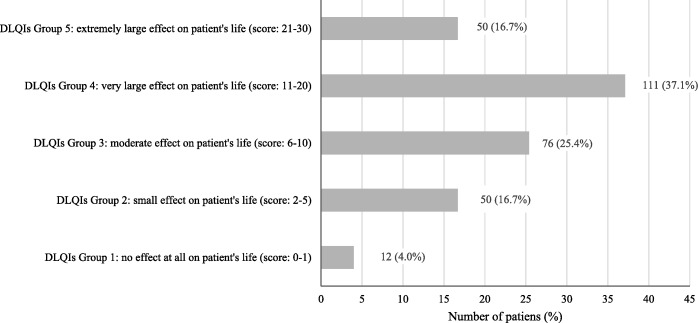
Of the 299 respondents, 161 (53.8%) exhibited severe HRQoL impairment. The Dermatology Life Quality Index scores were significantly associated with gender, annual income, neck psoriasis, psoriasis-related resignation from work, and use of oral and herbal medications. The severity of HRQoL impairment in women was twice that observed in men (odds ratio [OR] = 2.00, 95% confidence interval (CI): 1.05-3.80). Patients with psoriasis on the neck exhibited significantly greater HRQoL impairment than those with psoriasis on other areas of their bodies (OR = 2.30, 95% CI: 1.20-4.43). With respect to the socioeconomic status, patients who earned > 40 million KRW (approximately 34,000 USD; high-income group) showed less HRQoL impairment compared with those who had lower incomes (OR = 0.47, 95% CI: 0.28-0.80). Patients with severe HRQoL impairment used oral (OR = 2.04, 95% CI: 1.20-3.44) and herbal (OR = 1.86, 95% CI: 1.04-3.34) medications more often relative to patients with less severe HRQoL impairment.
HRQoL in patients with psoriasis was significantly associated with their demographic and socioeconomic characteristics and employment status. The presence of psoriasis on exposed areas of the body was significantly associated with patients' HRQoL and employment status. Further research is required to evaluate the impact of psoriasis on patients' productivity.
本研究旨在确定影响银屑病患者健康相关生活质量(HRQoL)的社会经济和临床特征。
2015 年 3 月至 6 月期间进行了一项横断面研究,使用韩国银屑病患者组通过互联网调查获得的数据。该调查包括人口统计学、社会经济和临床特征以及 HRQoL 相关项目。如果患者的皮肤病生活质量指数(Dermatology Life Quality Index,DLQI)评分≥11,则认为其 HRQoL 受损严重。使用多变量逻辑回归分析确定影响 HRQoL 受损的因素。
在 299 名受访者中,161 名(53.8%)表现出严重的 HRQoL 受损。DLQI 评分与性别、年收入、颈部银屑病、与银屑病相关的辞职以及使用口服和草药药物显著相关。女性的 HRQoL 受损严重程度是男性的两倍(优势比[OR] = 2.00,95%置信区间[CI]:1.05-3.80)。颈部有银屑病的患者与身体其他部位有银屑病的患者相比,HRQoL 受损更为严重(OR = 2.30,95%CI:1.20-4.43)。在社会经济地位方面,收入超过 4000 万韩元(约合 34000 美元;高收入组)的患者与收入较低的患者相比,HRQoL 受损程度较轻(OR = 0.47,95%CI:0.28-0.80)。与 HRQoL 受损程度较轻的患者相比,严重 HRQoL 受损的患者更常使用口服(OR = 2.04,95%CI:1.20-3.44)和草药(OR = 1.86,95%CI:1.04-3.34)药物。
银屑病患者的 HRQoL 与他们的人口统计学和社会经济特征以及就业状况显著相关。暴露部位有银屑病与患者的 HRQoL 和就业状况显著相关。需要进一步研究评估银屑病对患者生产力的影响。