Yeager R, Holm R H, Saurabh K, Fuqua J L, Talley D, Bhatnagar A, Smith T
Christina Lee Brown Enviroment Institute University of Louisville Louisville KY USA.
Department of Environmental and Occupational Health Sciences School of Public Health and Information Sciences University of Louisville Louisville KY USA.
Geohealth. 2021 Jul 1;5(7):e2021GH000420. doi: 10.1029/2021GH000420. eCollection 2021 Jul.
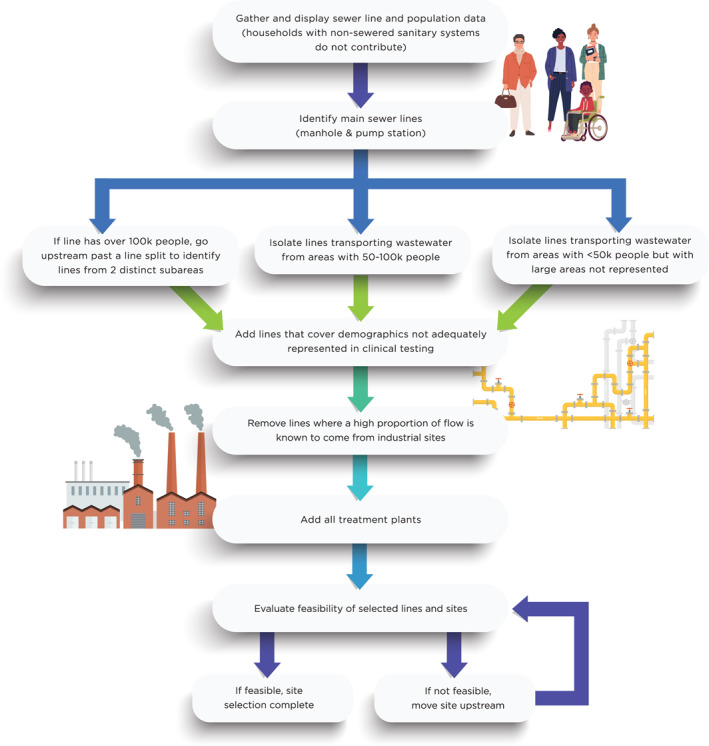
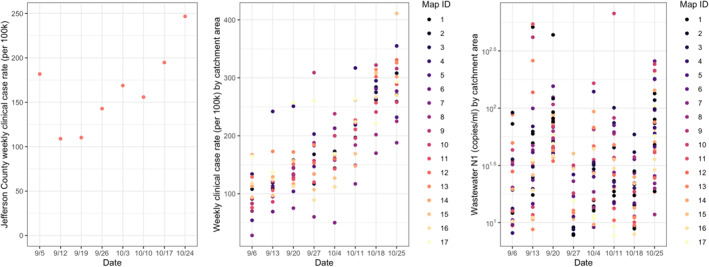
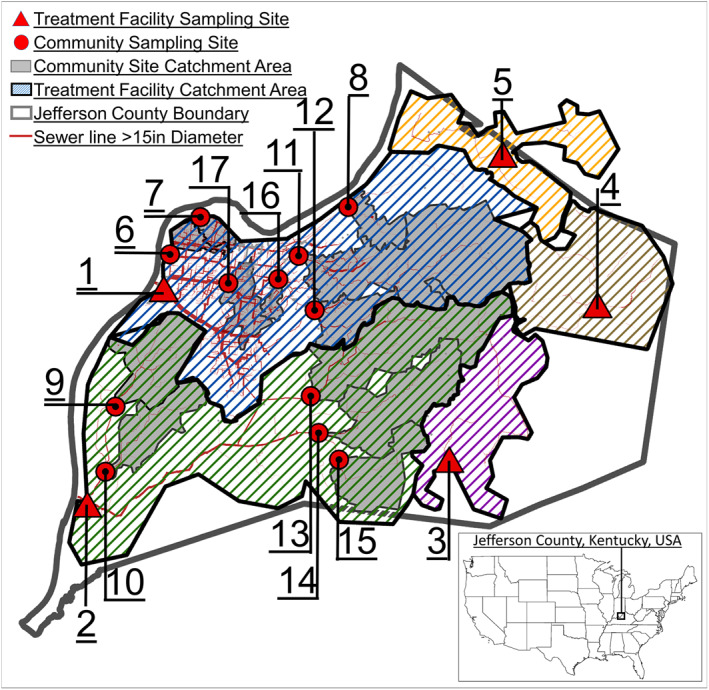
Wastewater monitoring for virus infections within communities can complement conventional clinical surveillance. Currently, most SARS-CoV-2 (severe acute respiratory syndrome coronavirus 2) clinical testing is voluntary and inconsistently available, except for a few occupational and educational settings, and therefore likely underrepresents actual population prevalence. Randomized testing on a regular basis to estimate accurate population-level infection rates is prohibitively costly and is hampered by a range of limitations and barriers associated with participation in clinical research. In comparison, community-level fecal monitoring can be performed through wastewater surveillance to effectively surveil communities. However, epidemiologically defined protocols for wastewater sample site selection are lacking. Herein, we describe methods for developing a geographically resolved population-level wastewater sampling approach in Jefferson County, Kentucky, and present preliminary results. Utilizing this site selection protocol, samples ( = 237) were collected from 17 wastewater catchment areas, September 8 to October 30, 2020 from one to four times per week in each area and compared to concurrent clinical data aggregated to wastewater catchment areas and county level. SARS-CoV-2 RNA was consistently present in wastewater during the studied period, and varied by area. Data obtained using the site selection protocol showed variation in geographically resolved wastewater SARS-CoV-2 RNA concentration compared to clinical rates. These findings highlight the importance of neighborhood-equivalent spatial scales and provide a promising approach for viral epidemic surveillance, thus better guiding spatially targeted public health mitigation strategies.
对社区内病毒感染进行废水监测可补充传统的临床监测。目前,除了一些职业和教育场所外,大多数严重急性呼吸综合征冠状病毒2(SARS-CoV-2)的临床检测是自愿的且供应不一致,因此可能无法准确反映实际人群患病率。定期进行随机检测以估计准确的人群感染率成本过高,并且受到一系列与参与临床研究相关的限制和障碍的阻碍。相比之下,可以通过废水监测进行社区层面的粪便监测,以有效监测社区。然而,目前缺乏针对废水样本采样点选择的流行病学定义方案。在此,我们描述了在肯塔基州杰斐逊县开发一种地理分辨率的人群层面废水采样方法的步骤,并展示初步结果。利用该采样点选择方案,于2020年9月8日至10月30日期间,从17个废水集水区每周采集1至4次样本(共237个),并与汇总到废水集水区和县级层面的同期临床数据进行比较。在研究期间,废水中始终存在SARS-CoV-2 RNA,且因区域而异。使用该采样点选择方案获得的数据显示,与临床发病率相比,地理分辨率的废水SARS-CoV-2 RNA浓度存在差异。这些发现突出了邻里等效空间尺度的重要性,并为病毒流行监测提供了一种有前景的方法,从而更好地指导有针对性的空间公共卫生缓解策略。