Balalla Shivanthi, Krägeloh Chris, Medvedev Oleg, Siegert Richard
Department of Psychology and Neuroscience, Auckland University of Technology, Northcote, Auckland, New Zealand.
School of Psychology, University of Waikato, Hamilton, New Zealand.
Neurotrauma Rep. 2020 Aug 11;1(1):63-72. doi: 10.1089/neur.2020.0017. eCollection 2020.
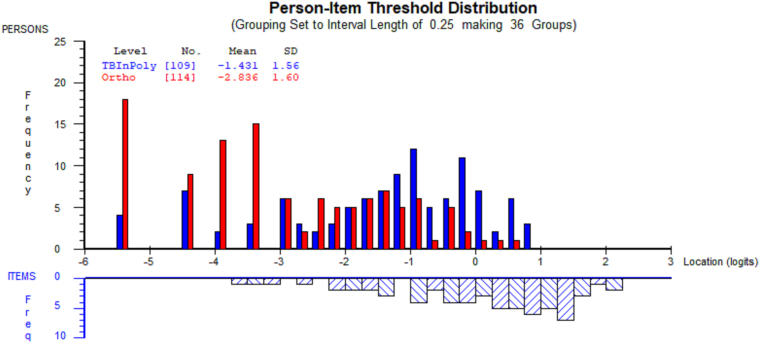
Persistent post-concussion syndrome (PCS) symptoms are known to last years after traumatic brain injury (TBI), and similar symptoms are increasingly being documented among those who have not experienced a TBI. There remains however, a dearth of empirical evidence on the structural composition of symptoms beyond the post-acute symptom phase after TBI, and little is known about the potential use of PCS symptom scales to measure PCS-like symptoms in non-TBI individuals. Our objective was therefore to examine the psychometric performance and dimensionality of the Rivermead Post-Concussion Symptoms Questionnaire (RPQ) as a measure of long-term PCS symptoms among a TBI and non-TBI sample. A case-control sample of 223 patients with injury, consisting of age- and sex-matched TBI participants ( = 109) and orthopedic participants ( = 114) were recruited from a regional trauma registry in New Zealand (NZ), and assessed at mean 2.5 years post-injury. Results from the Rasch analysis showed that the RPQ achieved fit to the Rasch model, demonstrating very good reliability (Person Separation Index [PSI] = 0.87), thereby indicating that the measure can be used reliably for individual and group assessment of symptoms among both TBI and orthopedic patients. In this study we demonstrated evidence of a unidimensional construct of PCS symptoms in both groups, which helps alleviate previous uncertainty about factor structure, and permits the calculation of a total RPQ score. Conversion of ordinal to interval total scores presented within are recommended for clinicians and researchers, to improve instrument precision, and to facilitate the interpretation of change scores and use of parametric methods in data analysis.
持续性脑震荡后综合征(PCS)症状已知会在创伤性脑损伤(TBI)后持续数年,并且在未经历过TBI的人群中也越来越多地记录到类似症状。然而,对于TBI后急性症状期之外症状的结构组成,仍然缺乏实证证据,并且对于PCS症状量表在测量非TBI个体中PCS样症状的潜在用途知之甚少。因此,我们的目标是检验Rivermead脑震荡后症状问卷(RPQ)作为TBI和非TBI样本中长期PCS症状测量工具的心理测量性能和维度。从新西兰(NZ)的一个区域创伤登记处招募了223名受伤患者的病例对照样本,包括年龄和性别匹配的TBI参与者(n = 109)和骨科参与者(n = 114),并在受伤后平均2.5年进行评估。拉施分析结果表明,RPQ符合拉施模型,显示出非常好的信度(个人分离指数[PSI]=0.87),从而表明该测量工具可可靠地用于TBI和骨科患者症状的个体和组间评估。在本研究中,我们证明了两组中PCS症状的单维结构,这有助于减轻先前关于因子结构的不确定性,并允许计算RPQ总分。建议临床医生和研究人员将文中给出的顺序总分转换为区间总分,以提高工具的精度,并便于解释变化分数和在数据分析中使用参数方法。