Parihar Raminder, Ferastraoaru Victor, Galanopoulou Aristea S, Geyer Howard L, Kaufman David M
Saul R. Korey Department of Neurology Albert Einstein College of Medicine Bronx New York USA.
Isabelle Rapin Division of Child Neurology, Dominick P. Purpura Department of Neuroscience Albert Einstein College of Medicine Bronx New York USA.
Mov Disord Clin Pract. 2021 May 3;8(6):859-867. doi: 10.1002/mdc3.13231. eCollection 2021 Aug.
The Parkinson's disease (PD) patient population, with an already reduced life expectancy, is rendered particularly vulnerable by the Severe Acute Respiratory Syndrome Coronavirus 2 (SARS-CoV-2).
We determined the risk factors that increase the risk of death in patients with Parkinson's disease who are infected by SARS-CoV-2.
Patients with a diagnosis of PD admitted to Montefiore Hospital (Bronx, New York) and tested for SARS-CoV-2 were identified. Retrospective review of electronic medical records confirmed the diagnosis; patients were classified by severity of PD. PD severity, demographic, socioeconomic factors, and co-morbidities were correlated with mortality rates in patients with SARS-CoV-2.
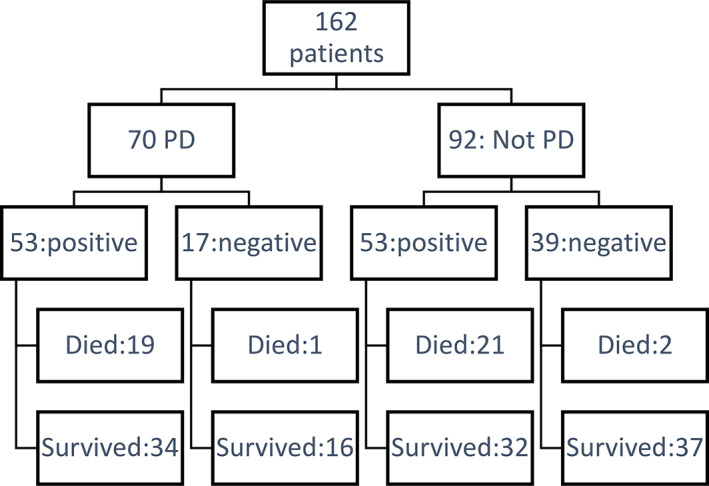
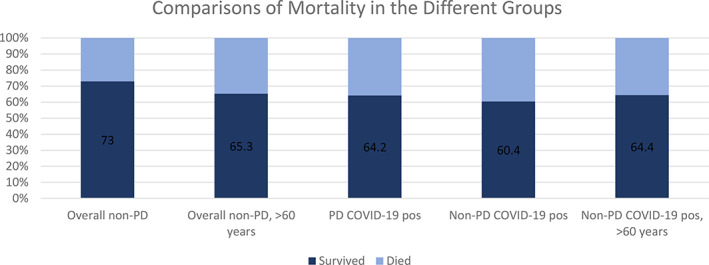
We identified 162 patients meeting criteria; chart review confirmed a diagnosis of PD in 70 patients. Of the 70 patients, 53 were positive for SARS-CoV-2 and 17 were negative. PD patients with SARS-CoV-2 infection had a higher mortality rate (35.8%) compared to PD patients without the infection (5.9%, = 0.028). PD patients older than 70 years of age, those with advanced Parkinson's disease, those with reductions in their medications, and non-Hispanics (largely comprised of Black/African- Americans) had a statistically significant higher mortality rate, if infected.
PD did not increase mortality rates from SARS-CoV-2 infection when age was controlled. However, certain unalterable factors (advanced disease and age greater than 70 years) and alterable ones (reductions in PD medications) placed PD patients at increased risk for mortality. Also several socioeconomic factors contributed to mortality, for example, non-Hispanic patients with SARS-CoV-2 infection fared worse, likely driven by poorer outcomes in the Black/African-American cohort.
帕金森病(PD)患者群体的预期寿命本就缩短,严重急性呼吸综合征冠状病毒2(SARS-CoV-2)使其变得尤为脆弱。
我们确定了感染SARS-CoV-2的帕金森病患者中增加死亡风险的危险因素。
确定了入住蒙特菲奥里医院(纽约州布朗克斯)并接受SARS-CoV-2检测的帕金森病确诊患者。通过回顾电子病历确认诊断;患者按帕金森病严重程度分类。帕金森病严重程度、人口统计学、社会经济因素和合并症与SARS-CoV-2感染患者的死亡率相关。
我们确定了162名符合标准的患者;病历审查确认70名患者患有帕金森病。在这70名患者中,53名SARS-CoV-2检测呈阳性,17名呈阴性。与未感染的帕金森病患者(5.9%,P = 0.028)相比,感染SARS-CoV-2的帕金森病患者死亡率更高(35.8%)。年龄大于70岁的帕金森病患者、帕金森病晚期患者、药物减量患者以及非西班牙裔(主要包括黑人/非裔美国人)患者若感染,死亡率在统计学上显著更高。
在控制年龄因素后,帕金森病本身并未增加SARS-CoV-2感染导致的死亡率。然而,某些不可改变的因素(疾病晚期和年龄大于70岁)以及可改变的因素(帕金森病药物减量)使帕金森病患者的死亡风险增加。此外,一些社会经济因素也导致了死亡率上升,例如,感染SARS-CoV-2的非西班牙裔患者情况更糟,这可能是由黑人/非裔美国人队列中较差的预后所驱动。