Department of Biomedical Engineering, Johns Hopkins University School of Medicine, Baltimore, Maryland 21205, United States.
Translational Tissue Engineering Center, Johns Hopkins University School of Medicine Baltimore, Maryland 21205, United States.
Nano Lett. 2021 Jul 14;21(13):5697-5705. doi: 10.1021/acs.nanolett.1c01421. Epub 2021 Jul 6.
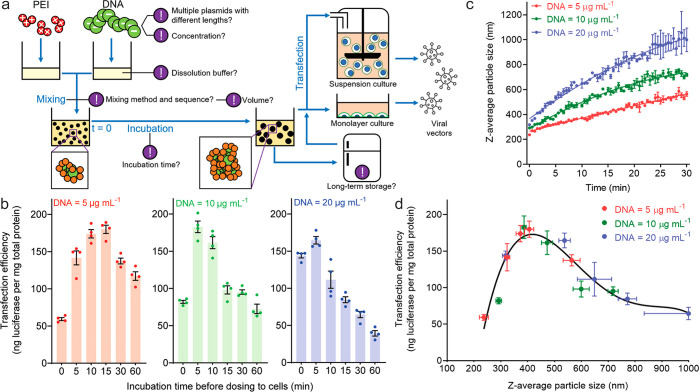
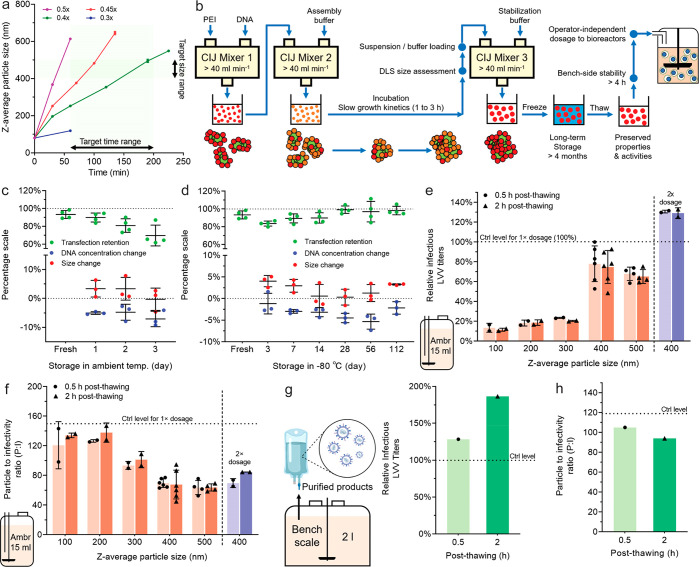
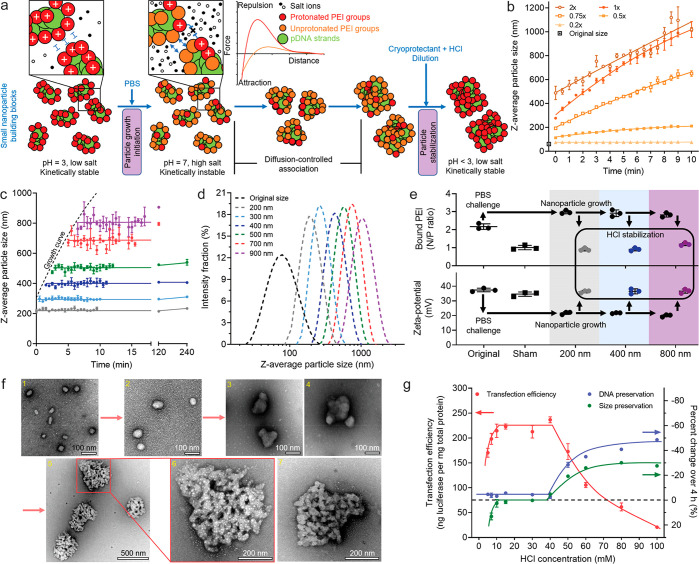
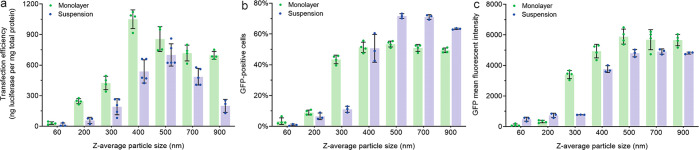
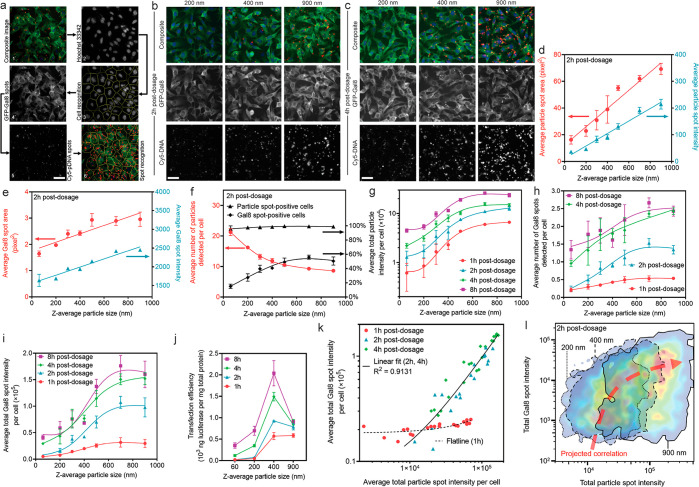
Polyelectrolyte complex particles assembled from plasmid DNA (pDNA) and poly(ethylenimine) (PEI) have been widely used to produce lentiviral vectors (LVVs) for gene therapy. The current batch-mode preparation for pDNA/PEI particles presents limited reproducibility in large-scale LVV manufacturing processes, leading to challenges in tightly controlling particle stability, transfection outcomes, and LVV production yield. Here we identified the size of pDNA/PEI particles as a key determinant for a high transfection efficiency with an optimal size of 400-500 nm, due to a cellular-uptake-related mechanism. We developed a kinetics-based approach to assemble size-controlled and shelf-stable particles using preassembled nanoparticles as building blocks and demonstrated production scalability on a scale of at least 100 mL. The preservation of colloidal stability and transfection efficiency was benchmarked against particles generated using an industry standard protocol. This particle manufacturing method effectively streamlines the viral manufacturing process and improves the production quality and consistency.
由质粒 DNA(pDNA)和聚(亚乙基亚胺)(PEI)组装而成的聚电解质复合物颗粒已被广泛用于生产基因治疗用慢病毒载体(LVV)。目前用于 pDNA/PEI 颗粒的批处理式制备在大规模 LVV 制造过程中呈现出有限的重现性,导致难以严格控制颗粒稳定性、转染结果和 LVV 生产产率。在这里,我们确定了 pDNA/PEI 颗粒的大小是获得高转染效率的关键决定因素,最佳大小为 400-500nm,这与细胞摄取相关的机制有关。我们开发了一种基于动力学的方法,使用预组装的纳米颗粒作为构建块来组装具有可控尺寸和稳定货架期的颗粒,并展示了至少 100mL 规模的生产可扩展性。我们还对使用行业标准协议生成的颗粒进行了胶体稳定性和转染效率的基准测试。这种颗粒制造方法有效地简化了病毒制造过程,并提高了生产质量和一致性。