Department of Collective Behaviour, Max Planck Institute of Animal Behavior, Konstanz, Germany.
Centre for the Advanced Study of Collective Behaviour, University of Konstanz, Konstanz, Germany.
J R Soc Interface. 2021 Jul;18(180):20210142. doi: 10.1098/rsif.2021.0142. Epub 2021 Jul 7.
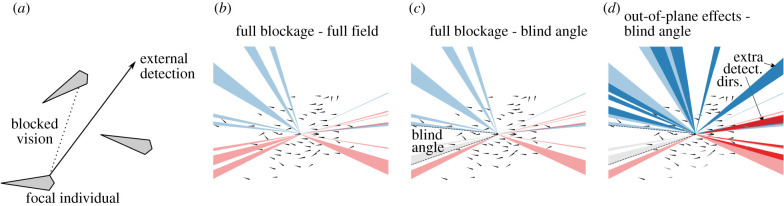
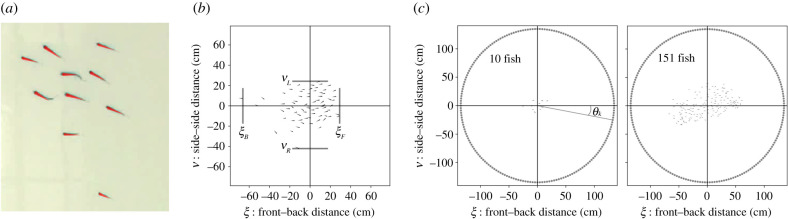
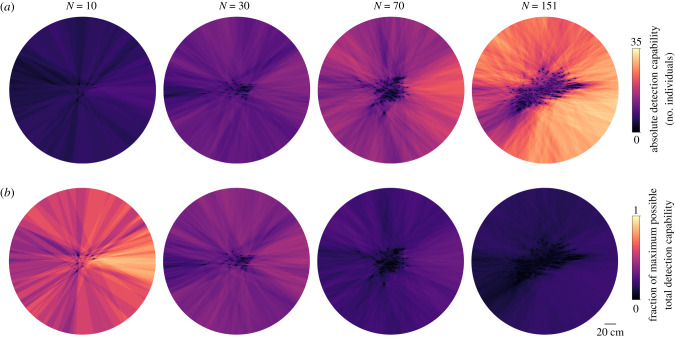
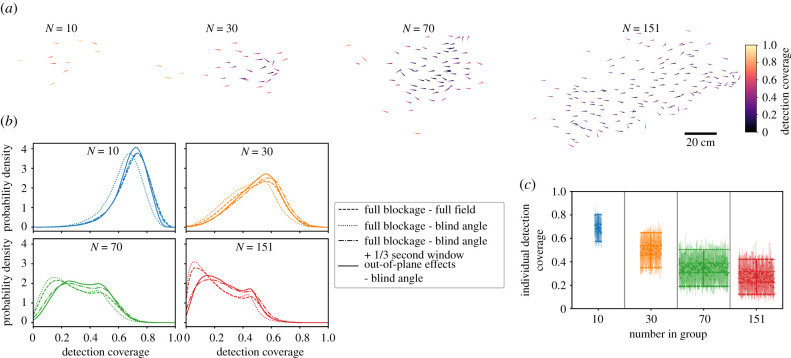
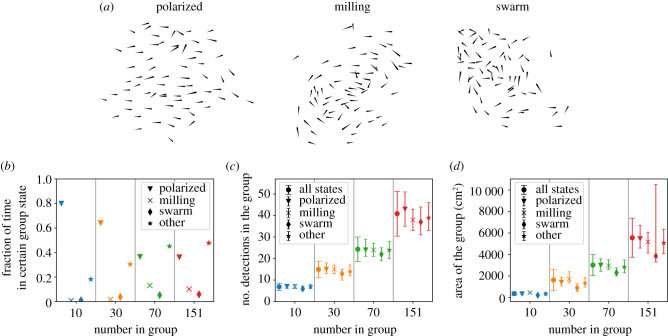
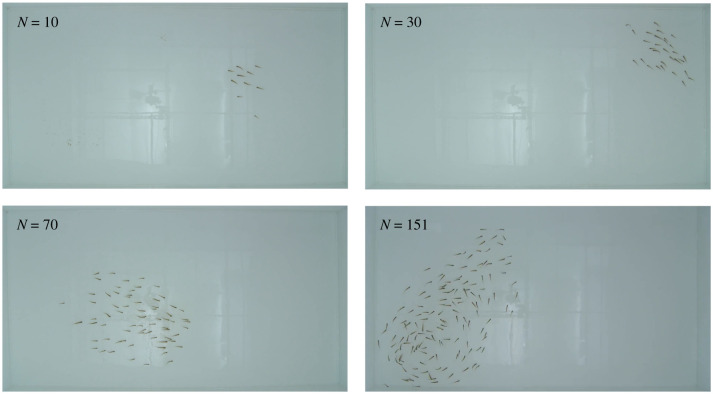
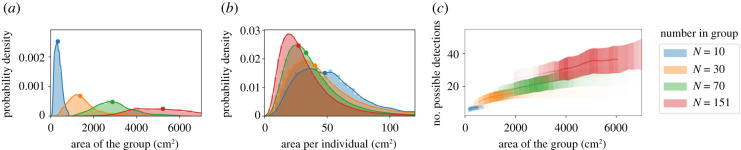
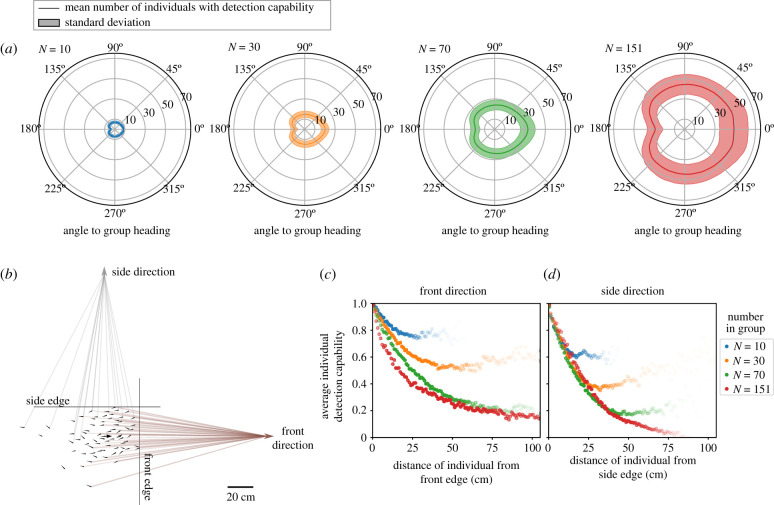
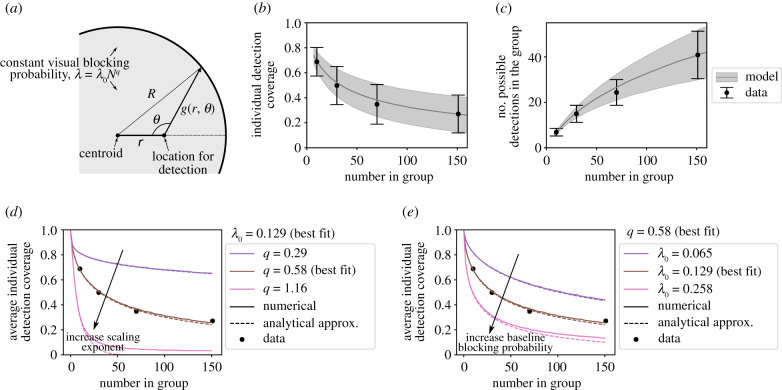
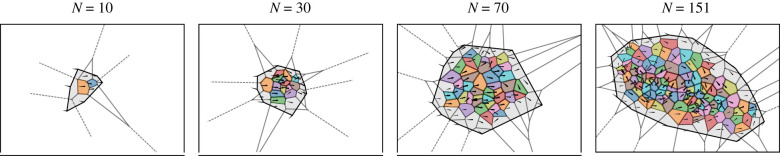
We investigate key principles underlying individual, and collective, visual detection of stimuli, and how this relates to the internal structure of groups. While the individual and collective detection principles are generally applicable, we employ a model experimental system of schooling golden shiner fish () to relate theory directly to empirical data, using computational reconstruction of the visual fields of all individuals. This reveals how the external visual information available to each group member depends on the number of individuals in the group, the position within the group, and the location of the external visually detectable stimulus. We find that in small groups, individuals have detection capability in nearly all directions, while in large groups, occlusion by neighbours causes detection capability to vary with position within the group. To understand the principles that drive detection in groups, we formulate a simple, and generally applicable, model that captures how visual detection properties emerge due to geometric scaling of the space occupied by the group and occlusion caused by neighbours. We employ these insights to discuss principles that extend beyond our specific system, such as how collective detection depends on individual body shape, and the size and structure of the group.
我们研究了个体和集体视觉检测刺激的关键原则,以及这如何与群体的内部结构相关。虽然个体和集体检测原则通常是适用的,但我们采用了群体金色鱼的模型实验系统,将理论直接与经验数据相关联,使用所有个体的视觉场的计算重建。这揭示了每个群体成员可获得的外部视觉信息如何取决于群体中的个体数量、群体内的位置以及外部可视觉检测刺激的位置。我们发现,在小群体中,个体在几乎所有方向上都具有检测能力,而在大群体中,邻居的遮挡导致检测能力随群体内的位置而变化。为了理解群体中检测的原理,我们提出了一个简单且普遍适用的模型,该模型捕捉了由于群体占据的空间的几何缩放和邻居造成的遮挡,视觉检测特性是如何出现的。我们利用这些见解来讨论超越我们特定系统的原理,例如集体检测如何取决于个体的体型,以及群体的大小和结构。