Department of Pharmacy, University of Huddersfield, Queensgate, Huddersfield, HD1 3DH, UK.
Discipline of Pharmaceutical Sciences, School of Health Sciences, Westville Campus, University of KwaZulu-Natal, Private Bag X54001, Durban, 4000, South Africa.
BMC Health Serv Res. 2021 Jul 6;21(1):661. doi: 10.1186/s12913-021-06627-6.
Prices of cancer medicines are a major contributor to the cost of treatment for cancer patients and the comparison of these cost needs to be assessed.
To assess the prices of cancer medicines for the three most common cancers ((breast, prostate and colorectal) in the private healthcare sector of South Africa.
The methodology was adapted from the World Health Organization (WHO)/ Health Action International (HAI) methodology for measuring medicine prices. The Single Exit Price (SEP) variations between product types of the same medicine between the highest- and lowest-priced product and between Originator Brand (OB) and its Lowest Priced Generic (LPG) of the same medicine brand was compared, as of March 2020. The affordability of those medicines for cancer usage based on treatment affordability in relation to the daily wage of the unskilled Lowest-Paid Government Worker (LPGW) was also determined. Also, a comparison of the proportion of the population below the poverty line (PL) before (I) and after (I) procurement of the cancer medicines was determined.
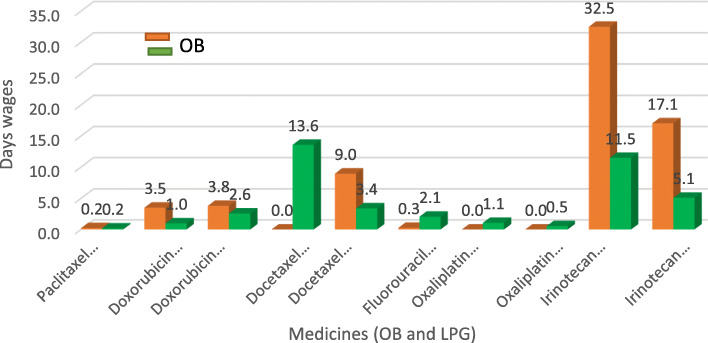
SEP Price differences ranged from 25.46 to 97.33% between highest- and lowest-priced products and a price variation of 72.09% more for the OB than the LPG medicine, except for one LPG that was more expensive than the OB. Affordability calculations showed that All OB treatments for all three cancers (breast, prostate and colorectal), except for paclitaxel 300 mg (0.2 days wage) and Fluorouracil (Fluroblastin) 500 mg (0.3 days wage) costs respectively were more than 1 day's wage, with patients diagnosed with colorectal cancer needing 32.5 days wages in order to afford a standard course of treatment for a month.
There was a considerable variation in the price of different brands of cancer medicines available in the South African private sector.
癌症药物的价格是癌症患者治疗费用的主要组成部分,需要对这些成本进行比较。
评估南非私立医疗保健领域三种最常见癌症(乳腺癌、前列腺癌和结直肠癌)的癌症药物价格。
该方法改编自世界卫生组织(WHO)/国际健康行动(HAI)用于衡量药物价格的方法。比较了同一药物不同产品类型之间最高和最低价格产品之间的单一出口价格(SEP)差异,以及同一药物品牌的原研药(OB)与其最便宜的仿制药(LPG)之间的差异,截至 2020 年 3 月。还根据非熟练政府最低工资工人(LPGW)的日工资与癌症治疗负担能力之间的关系,确定了这些癌症药物的可负担性。此外,还确定了在采购癌症药物之前(I)和之后(I),处于贫困线以下的人口比例(PL)的变化。
最高和最低价格产品之间的 SEP 价格差异范围为 25.46%至 97.33%,OB 药物比 LPG 药物的价格差异为 72.09%,但有一种 LPG 药物比 OB 药物更贵。负担能力计算显示,所有三种癌症(乳腺癌、前列腺癌和结直肠癌)的所有 OB 治疗方法(紫杉醇 300mg(0.2 天工资)和氟尿嘧啶(氟罗他汀)500mg(0.3 天工资)除外)的费用均超过 1 天工资,诊断为结直肠癌的患者需要 32.5 天的工资才能负担一个月的标准治疗费用。
南非私立部门提供的不同品牌癌症药物的价格存在相当大的差异。