Hearing Center, Department of Otolaryngology/Head and Neck Surgery, West China Hospital of Sichuan University, Chengdu, Sichuan, China.
Medicine (Baltimore). 2021 Jul 9;100(27):e26490. doi: 10.1097/MD.0000000000026490.
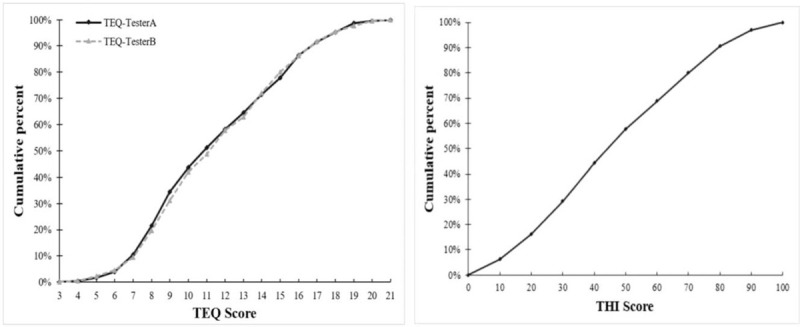
This study sought to validate the applicability of the mandarin Tinnitus Evaluation Questionnaire (TEQ), a brief score method administered by clinicians to quantify the tinnitus severity.A descriptive observational questionnaire study in regard to psychometric properties and practicability was conducted with a total of 414 primary tinnitus outpatients, in which 173 of 414 patients completed the follow-up after receiving an intervention based on the tinnitus educational counseling and the life-style adjustment guidance. For quantifying the tinnitus severity, the TEQ and other 2 self-report questionnaires, Tinnitus Handicap Inventory and visual analog scale, were administered on patients' first-visit and follow-up. With the psychometric analysis, we evaluated the performance of TEQ in tinnitus management, including distinguishing patients with varying severity and detecting the treatment-related outcome.At the first visit, the TEQ showed an excellent inter-rater reliability (Pearson correlation, 0.97, P < .01), a good internal consistency reliability (Cronbach's α, 0.79), and an acceptable convergent validity (Pearson correlation, 0.78 with the Tinnitus Handicap Inventory; 0.62 with a single-question visual analog scale, P < .01). In detecting the treatment-related change, a large effect size of TEQ verified a sensitive responsiveness. After estimating the test-error, a 2-point reduction (2/21) of the TEQ was recommend to be considered a reference outcome indicator for the effective intervention.Even though the TEQ is scored by clinician, it can reflect the clinical features of tinnitus patient. Flexible and simple assessing process makes it a practical tool for patient intake, intervention selection, and outcome measurement.
本研究旨在验证中文耳鸣评估问卷(TEQ)的适用性,这是一种由临床医生使用的简短评分方法,用于量化耳鸣严重程度。
采用描述性观察问卷研究方法,对 414 例原发性耳鸣患者进行了心理测量学特性和实用性研究,其中 414 例患者中有 173 例在接受基于耳鸣教育咨询和生活方式调整指导的干预后完成了随访。为了量化耳鸣严重程度,在患者首次就诊和随访时,使用 TEQ 以及其他 2 种自评问卷,即耳鸣残疾量表和视觉模拟量表进行评估。通过心理测量分析,我们评估了 TEQ 在耳鸣管理中的表现,包括区分不同严重程度的患者和检测与治疗相关的结果。
在首次就诊时,TEQ 表现出极好的评分者间信度(Pearson 相关系数,0.97,P <0.01)、良好的内部一致性信度(Cronbach's α,0.79)和可接受的聚合效度(Pearson 相关系数,与耳鸣残疾量表为 0.78;与单问题视觉模拟量表为 0.62,P <0.01)。在检测与治疗相关的变化方面,TEQ 的大效应量验证了其敏感性。在估计测试误差后,建议 TEQ 减少 2 分(2/21)作为有效干预的参考结局指标。
尽管 TEQ 是由临床医生评分,但它可以反映耳鸣患者的临床特征。灵活简单的评估过程使其成为患者入组、干预选择和结局测量的实用工具。