Department of Entomology and Acarology, University of São Paulo (USP)/Luiz de Queiroz College of Agriculture (ESALQ), Piracicaba, São Paulo, Brazil.
Department of Phytotechnics and Plant Health, Federal University of Paraná, Curitiba, Paraná, Brazil.
Sci Rep. 2021 Jul 8;11(1):14110. doi: 10.1038/s41598-021-93510-3.
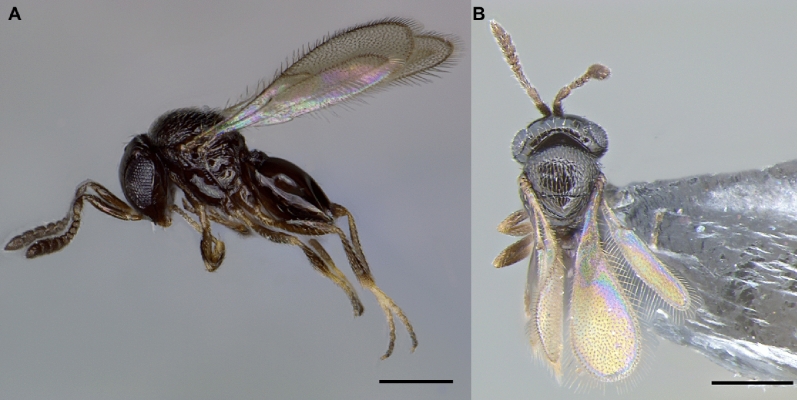
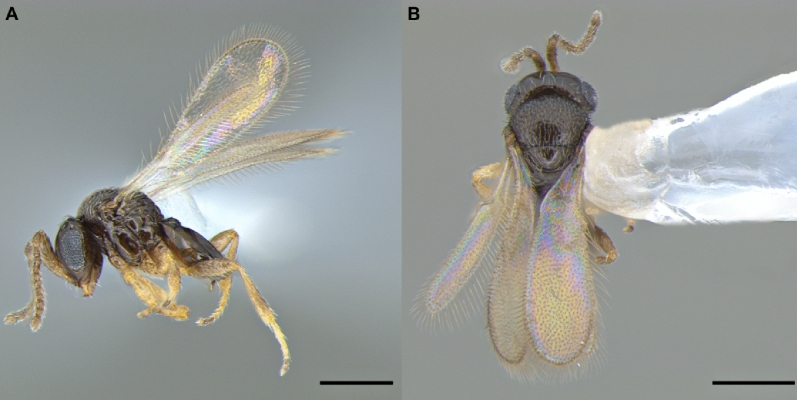
The egg parasitoid Telenomus remus (Hymenoptera: Scelionidae) has been investigated for classical and applied biological control of noctuid pests, especially Spodoptera (Lepidoptera: Noctuidae) species. Although T. remus was introduced into Brazil over three decades ago for classical biological control of S. frugiperda, this wasp has not been recorded as established in corn or soybean crops. We used an integrative approach to identify T. remus, combining a taxonomic key based on the male genitalia with DNA barcoding, using a cytochrome c oxidase subunit I mitochondrial gene fragment. This is the first report of natural parasitism of T. remus on S. frugiperda and S. cosmioides eggs at two locations in Brazil. We also confirmed that the T. remus lineage in Brazil derives from a strain in Venezuela (originally from Papua New Guinea and introduced into the Americas, Africa, and Asia). The occurrence of T. remus parasitizing S. frugiperda and S. cosmioides eggs in field conditions, not associated with inundative releases, suggests that the species has managed to establish itself in the field in Brazil. This opens possibilities for future biological control programs, since T. remus shows good potential for mass rearing and egg parasitism of important agricultural pests such as Spodoptera species.
卵寄生蜂 Telenomus remus(膜翅目:长尾小蜂科)已被用于夜蛾科(鳞翅目)物种,特别是斜纹夜蛾(Spodoptera)的经典和应用生物防治。尽管 T. remus 三十多年前就被引入巴西用于斜纹夜蛾的经典生物防治,但这种黄蜂在玉米或大豆作物中尚未被记录为已建立。我们使用了一种综合方法来鉴定 T. remus,结合了基于雄性生殖器的分类学关键技术和 DNA 条形码技术,使用细胞色素 c 氧化酶亚基 I 线粒体基因片段。这是首次报道 T. remus 在巴西的两个地点自然寄生斜纹夜蛾和 S. cosmioides 的卵。我们还证实,巴西的 T. remus 谱系源自委内瑞拉的一个菌株(最初来自巴布亚新几内亚,引入美洲、非洲和亚洲)。在田间条件下,T. remus 寄生斜纹夜蛾和 S. cosmioides 卵的情况,与密集释放无关,表明该物种在巴西田间已成功建立。这为未来的生物防治计划开辟了可能性,因为 T. remus 具有大规模饲养和寄生重要农业害虫如斜纹夜蛾的良好潜力。