Murillo A M M, Tomé-Amat J, Ramírez Y, Garrido-Arandia M, Valle L G, Hernández-Ramírez G, Tramarin L, Herreros P, Santamaría B, Díaz-Perales A, Holgado M
Center for Biomedical Technology (CTB), Universidad Politécnica de Madrid, Parque Científico y Tecnológico de la UPM, Campus de Montegancedo, 28223, Pozuelo de Alarcón, Madrid, Spain.
BioOptical Detection SL, Centro de Empresas, Campus Montegancedo, 28223, Madrid, Spain.
Sens Actuators B Chem. 2021 Oct 15;345:130394. doi: 10.1016/j.snb.2021.130394. Epub 2021 Jul 3.
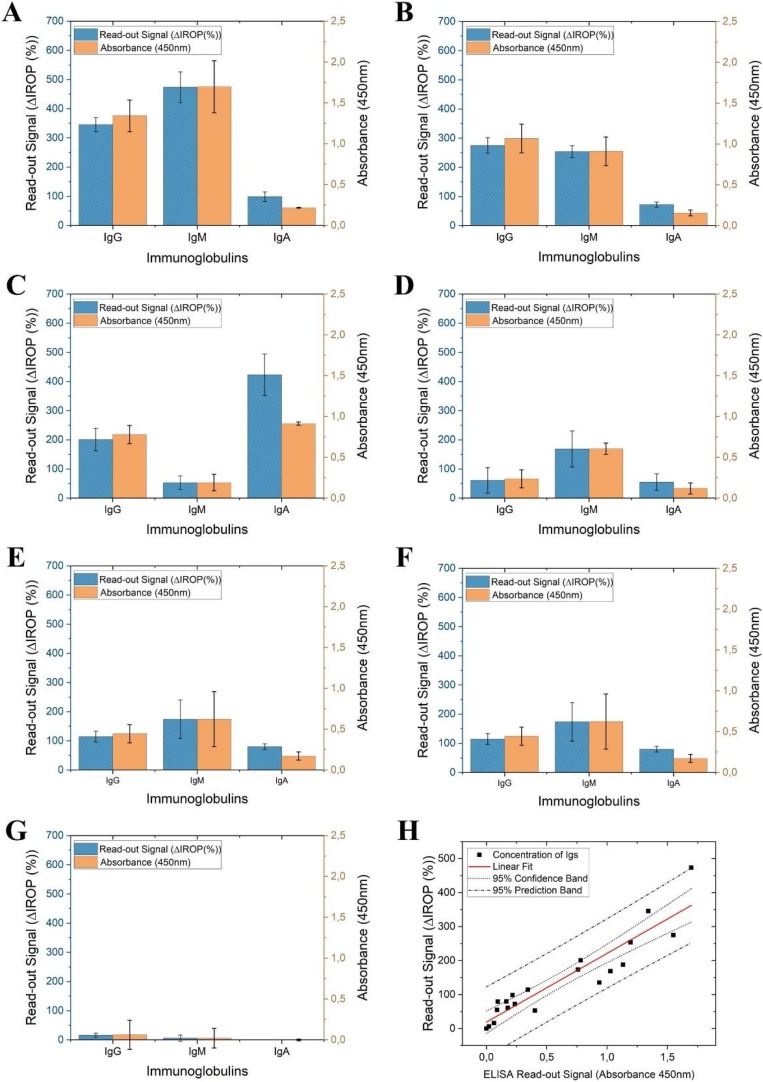
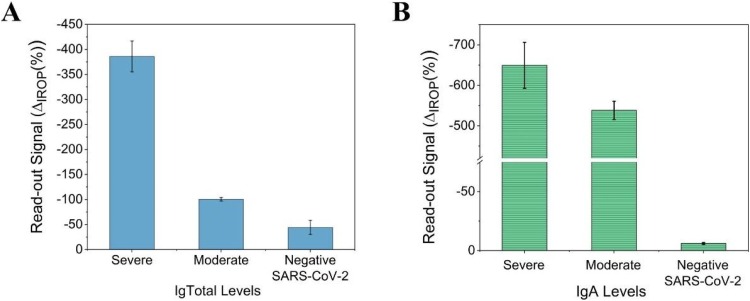
The standard rapid approach for the diagnosis of coronavirus disease 2019 (COVID-19) is the detection of severe acute respiratory syndrome coronavirus 2 (SARS-CoV-2) RNA. The detection of specific anti-SARS-CoV-2 immunoglobulins is crucial for screening people who have been exposed to the virus, whether or not they presented symptoms. Recent publications report different methods for the detection of specific IgGs, IgMs, and IgAs against SARS-CoV-2; these methods mainly detect immunoglobulins in the serum using conventional techniques such as rapid lateral flow tests or enzyme-linked immunosorbent assay (ELISA). In this article, we report the production of recombinant SARS-CoV-2 spike protein and the development of a rapid, reliable, cost-effective test, capable of detecting immunoglobulins in serum and saliva samples. This method is based on interferometric optical detection. The results obtained using this method and those obtained using ELISA were compared. Owing to its low cost and simplicity, this test can be used periodically for the early detection, surveillance, detection of immunity, and control of the spread of COVID-19.
2019年冠状病毒病(COVID-19)的标准快速诊断方法是检测严重急性呼吸综合征冠状病毒2(SARS-CoV-2)RNA。检测特异性抗SARS-CoV-2免疫球蛋白对于筛查接触过该病毒的人至关重要,无论他们是否出现症状。最近的出版物报道了检测针对SARS-CoV-2的特异性IgG、IgM和IgA的不同方法;这些方法主要使用快速侧向流动试验或酶联免疫吸附测定(ELISA)等传统技术检测血清中的免疫球蛋白。在本文中,我们报告了重组SARS-CoV-2刺突蛋白的产生以及一种快速、可靠、经济高效的检测方法的开发,该方法能够检测血清和唾液样本中的免疫球蛋白。此方法基于干涉光学检测。将使用该方法获得的结果与使用ELISA获得的结果进行了比较。由于其成本低且操作简单,该检测可定期用于COVID-19的早期检测、监测、免疫检测和传播控制。