Division of Glycoscience, Department of Chemistry, School of Engineering Sciences in Chemistry, Biotechnology and Health, KTH Royal Institute of Technology, 106 91 Stockholm, Sweden.
Department of Environmental Engineering and Earth Sciences, Clemson University, Clemson, SC 29634, USA.
Biosensors (Basel). 2022 Oct 29;12(11):938. doi: 10.3390/bios12110938.
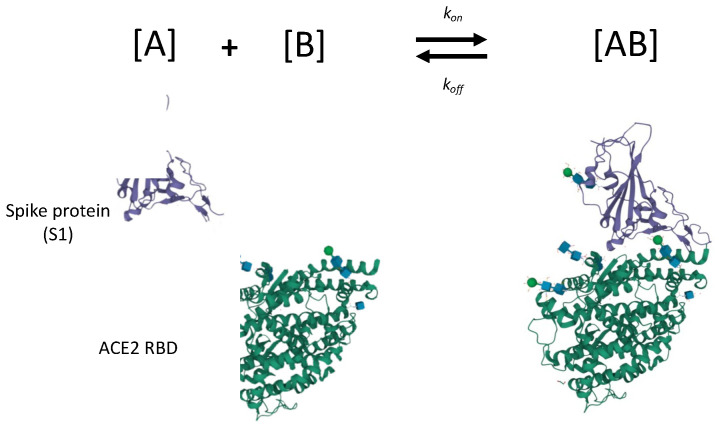
Biolayer interferometry (BLI) is a well-established laboratory technique for studying biomolecular interactions important for applications such as drug development. Currently, there are interesting opportunities for expanding the use of BLI in other fields, including the development of rapid diagnostic tools. To date, there are no detailed frameworks for implementing BLI in target-recognition studies that are pivotal for developing point-of-need biosensors. Here, we attempt to bridge these domains by providing a framework that connects output(s) of molecular interaction studies with key performance indicators used in the development of point-of-need biosensors. First, we briefly review the governing theory for protein-ligand interactions, and we then summarize the approach for real-time kinetic quantification using various techniques. The 2020 PRISMA guideline was used for all governing theory reviews and meta-analyses. Using the information from the meta-analysis, we introduce an experimental framework for connecting outcomes from BLI experiments (, , ) with electrochemical (capacitive) biosensor design. As a first step in the development of a larger framework, we specifically focus on mapping BLI outcomes to five biosensor key performance indicators (sensitivity, selectivity, response time, hysteresis, operating range). The applicability of our framework was demonstrated in a study of case based on published literature related to SARS-CoV-2 spike protein to show the development of a capacitive biosensor based on truncated angiotensin-converting enzyme 2 (ACE2) as the receptor. The case study focuses on non-specific binding and selectivity as research goals. The proposed framework proved to be an important first step toward modeling/simulation efforts that map molecular interactions to sensor design.
生物层干涉技术(BLI)是一种成熟的实验室技术,用于研究对于药物开发等应用至关重要的生物分子相互作用。目前,BLI 在其他领域的应用有很大的扩展机会,包括快速诊断工具的开发。迄今为止,在用于开发即时生物传感器的靶标识别研究中,还没有详细的 BLI 实施框架。在这里,我们尝试通过提供一个将分子相互作用研究的输出与即时生物传感器开发中使用的关键性能指标联系起来的框架来弥合这些领域之间的差距。首先,我们简要回顾了蛋白质-配体相互作用的控制理论,然后总结了使用各种技术进行实时动力学定量的方法。所有控制理论综述和荟萃分析均使用 2020 年 PRISMA 指南。利用荟萃分析的信息,我们引入了一个实验框架,将 BLI 实验的结果(、、)与电化学(电容式)生物传感器设计联系起来。作为更大框架开发的第一步,我们特别关注将 BLI 结果映射到五个生物传感器关键性能指标(灵敏度、选择性、响应时间、滞后、工作范围)上。我们的框架在基于 SARS-CoV-2 刺突蛋白的已发表文献的案例研究中得到了验证,展示了基于截断血管紧张素转换酶 2(ACE2)作为受体的电容式生物传感器的开发。该案例研究侧重于非特异性结合和选择性作为研究目标。所提出的框架被证明是将分子相互作用映射到传感器设计的建模/模拟工作的重要第一步。