Cadegiani F A, Goren A, Wambier C G, McCoy J
Corpometria Institute, Brasília, DF, Brazil.
Applied Biology, Inc., Irvine, CA, USA.
New Microbes New Infect. 2021 Sep;43:100915. doi: 10.1016/j.nmni.2021.100915. Epub 2021 Jul 7.
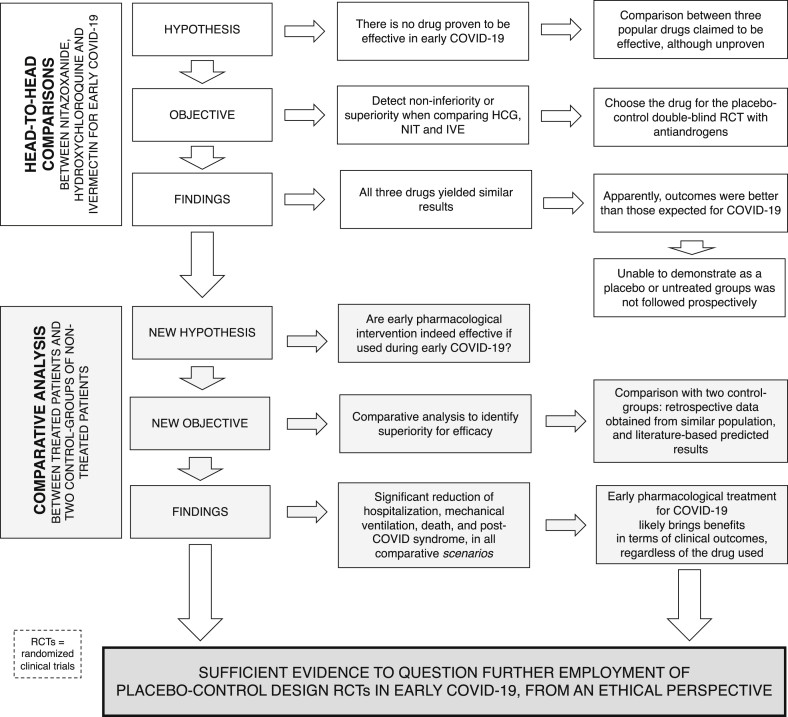
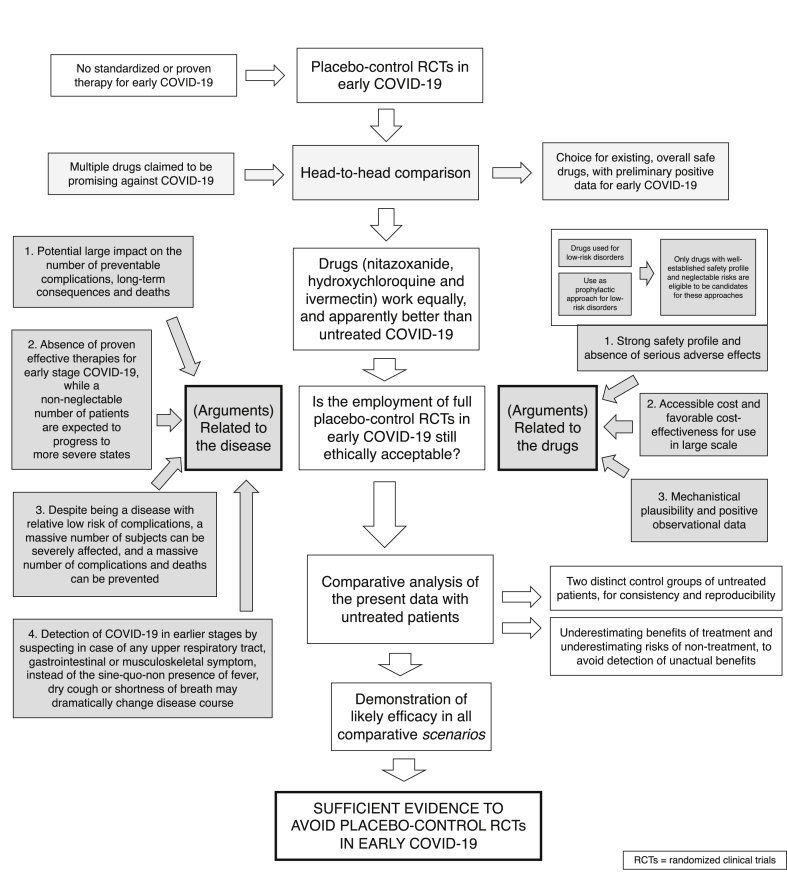
In a prospective observational study (pre-AndroCoV Trial), the use of nitazoxanide, ivermectin and hydroxychloroquine demonstrated unexpected improvements in COVID-19 outcomes when compared to untreated patients. The apparent yet likely positive results raised ethical concerns on the employment of further full placebo controlled studies in early-stage COVID-19. The present analysis aimed to elucidate, through a comparative analysis with two control groups, whether full placebo-control randomized clinical trials (RCTs) on early-stage COVID-19 are still ethically acceptable. The Active group (AG) consisted of patients enrolled in the Pre-AndroCoV-Trial (n = 585). Control Group 1 (CG1) consisted of a retrospectively obtained group of untreated patients of the same population (n = 137), and Control Group 2 (CG2) resulted from a precise prediction of clinical outcomes based on a thorough and structured review of indexed articles and official statements. Patients were matched for sex, age, comorbidities and disease severity at baseline. Compared to CG1 and CG2, AG showed reduction of 31.5-36.5% in viral shedding (p < 0.0001), 70-85% in disease duration (p < 0.0001), and 100% in respiratory complications, hospitalization, mechanical ventilation, deaths and post-COVID manifestations (p < 0.0001 for all). For every 1000 confirmed cases for COVID-19, at least 70 hospitalizations, 50 mechanical ventilations and five deaths were prevented. Benefits from the combination of early COVID-19 detection and early pharmacological approaches were consistent and overwhelming when compared to untreated groups, which, together with the well-established safety profile of the drug combinations tested in the Pre-AndroCoV Trial, precluded our study from continuing employing full placebo in early COVID-19.
在一项前瞻性观察性研究(前安多罗科夫试验)中,与未治疗的患者相比,硝唑尼特、伊维菌素和羟氯喹的使用在新冠病毒病(COVID-19)的治疗结果方面显示出意外的改善。这些明显且可能为阳性的结果引发了对于在早期COVID-19中开展进一步完全安慰剂对照研究的伦理担忧。本分析旨在通过与两个对照组进行比较分析,阐明在早期COVID-19中开展完全安慰剂对照随机临床试验(RCT)在伦理上是否仍然可接受。活性组(AG)由纳入前安多罗科夫试验的患者组成(n = 585)。对照组1(CG1)由一组回顾性获取的同人群未治疗患者组成(n = 137),对照组2(CG2)是基于对索引文章和官方声明的全面且结构化审查对临床结果进行精确预测得出的。患者在基线时按性别、年龄、合并症和疾病严重程度进行匹配。与CG1和CG2相比,AG的病毒载量降低了31.5%至36.5%(p < 0.0001),病程缩短了70%至85%(p < 0.0001),呼吸并发症、住院、机械通气、死亡和COVID-19后表现的发生率降低了100%(所有p值均< 0.0001)。对于每1000例确诊的COVID-19病例,至少可避免70例住院、50例机械通气和5例死亡。与未治疗组相比,早期COVID-19检测与早期药物治疗方法相结合的益处是一致且显著的,再加上前安多罗科夫试验中测试的药物组合已确立的安全性,使得我们的研究无法继续在早期COVID-19中使用完全安慰剂。