Almubark Rasha A, Memish Ziad A, Tamim Hani, Alenazi Thamer H, Alabdulla Mohammed, Sanai Faisal M, BinDhim Nasser F, Alfaraj Sarah, Alqahtani Saleh A
Scientific Affairs Department, Sharik Association for Health Research, Riyadh, Saudi Arabia.
Research and Innovation Center, King Saud Medical City, Ministry of Health, Riyadh, Saudi Arabia.
Saudi J Med Med Sci. 2021 May-Aug;9(2):118-124. doi: 10.4103/sjmms.sjmms_853_20. Epub 2021 Apr 29.
To analyze symptomatic and asymptomatic COVID-19 patients in Saudi Arabia in terms of initial presentation, risk factors, laboratory findings, clinical outcomes and healthcare utilization.
All laboratory-confirmed reverse transcription-polymerase chain reaction positive COVID-19 patients who had been tested at three governmental hospitals in Saudi Arabia (two in Riyadh and one in Makkah) between March 8 and May 18, 2020 were included. Demographics, COVID-19 variables, clinical characteristics and healthcare utilization variables were extracted and combined, and a descriptive analysis was conducted. Symptomatic and asymptomatic (on presentation) patients' data were compared.
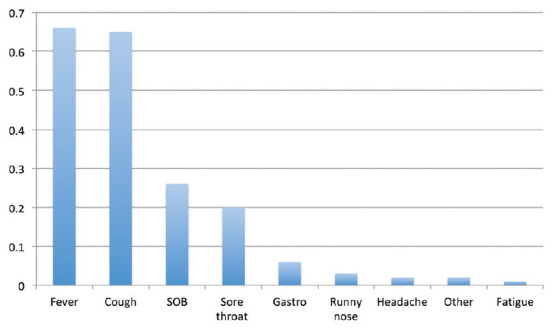
Eighty percent of the patients were males (81.4% of symptomatic and 73.2% of asymptomatic patients, = 0.02). Moreover, 47.6% and 38.4% of symptomatic and asymptomatic patients were aged 40-64 years, respectively. Fever, cough and breathing difficulties were frequent presenting symptoms. Overall, diabetes (16.4%), hypertension (11.7%), chronic respiratory disease (7.1%) were the most frequent comorbidities, with no differences between the two groups. Symptomatic patients had higher C-reactive protein levels (3.55 vs. 0.30 mg/L; < 0.0001) and lower total lymphocytes (1.41 vs. 1.70; = 0.02). ICU admission and mortality were 12.1% and 4.1% in symptomatic, compared to 6.0% and 2.9% in asymptomatic patients, respectively.
In the studied COVID-19 cohort, symptomatic patients tended to be older, had higher C-reactive protein and more lymphopenia with worse outcome than asymptomatic patients. This granular analysis of COVID-19 cohorts enables identification of at-risk cohorts in future waves, optimizing development of patient pathways and public health interventions.
从初始表现、危险因素、实验室检查结果、临床结局及医疗资源利用方面,对沙特阿拉伯有症状和无症状的新型冠状病毒肺炎(COVID-19)患者进行分析。
纳入2020年3月8日至5月18日期间在沙特阿拉伯三家政府医院(利雅得两家、麦加一家)接受检测且实验室确诊为逆转录聚合酶链反应阳性的COVID-19患者。提取并合并人口统计学、COVID-19变量、临床特征及医疗资源利用变量,进行描述性分析。比较有症状和无症状(就诊时)患者的数据。
80%的患者为男性(有症状患者中占81.4%,无症状患者中占73.2%,P = 0.02)。此外,有症状和无症状患者中分别有47.6%和38.4%的患者年龄在40 - 64岁之间。发热、咳嗽和呼吸困难是常见的首发症状。总体而言,糖尿病(16.4%)、高血压(11.7%)、慢性呼吸道疾病(7.1%)是最常见的合并症,两组之间无差异。有症状患者的C反应蛋白水平较高(3.55 vs. 0.30 mg/L;P < 0.0001),总淋巴细胞较低(1.41 vs. 1.70;P = 0.02)。有症状患者的重症监护病房(ICU)入住率和死亡率分别为12.1%和4.1%,无症状患者分别为6.0%和2.9%。
在所研究的COVID-19队列中,有症状患者往往年龄较大,C反应蛋白水平较高,淋巴细胞减少更明显,结局比无症状患者更差。这种对COVID-19队列的细致分析有助于在未来疫情中识别高危人群,优化患者诊疗路径及公共卫生干预措施的制定。