Badros Ashraf Z, Meddeb Mariam, Weikel Dianna, Philip Sunita, Milliron Todd, Lapidus Rena, Hester Lisa, Goloubeva Olga, Meiller Timothy F, Mongodin Emmanuel F
Greenebaum Cancer Center University of Maryland School of Medicine, Baltimore, MD, United States.
University of Maryland Dental School, Baltimore, MD, United States.
Front Oncol. 2021 Jun 24;11:704722. doi: 10.3389/fonc.2021.704722. eCollection 2021.
Define incidence and risk factors of osteonecrosis of the jaw (ONJ) and explore oral microbial signatures and host immune response as reflected by cytokine changes in saliva and serum in multiple myeloma (MM) patients on bisphosphate (BP) therapy.
A single center observational prospective study of MM patients (n = 110) on >2 years of BP, none had ONJ at enrollment. Patients were followed every 3 months for 18 months with clinical/dental examination and serial measurements of inflammatory cytokines, bone turnover markers, and angiogenic growth factors. Oral microbiota was characterized by sequencing of 16S rRNA gene from saliva.
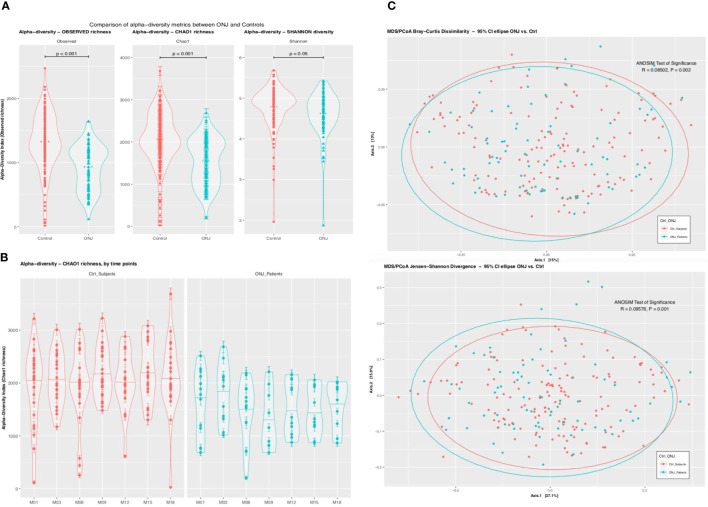
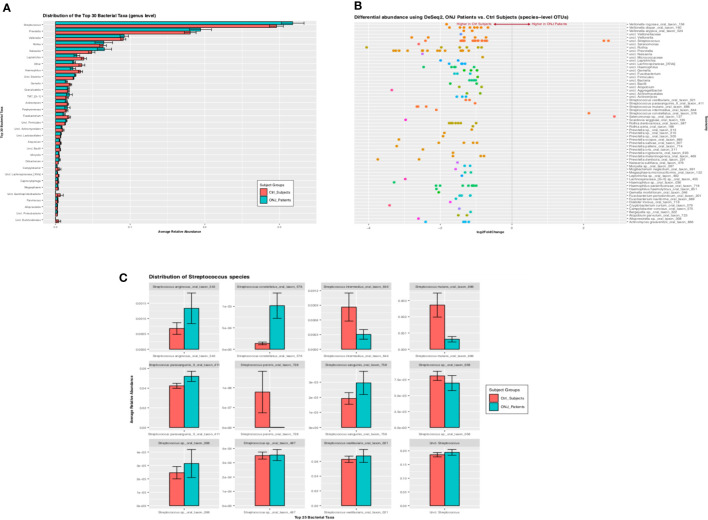
Over the study period 14 patients (13%) developed BRONJ, at a median of 5.7 years (95% CI: 1.9-12.0) from MM diagnosis. Chronic periodontal disease was the main clinically observed risk factor. Oral microbial profiling revealed lower bacterial richness/diversity in BRONJ. , , and were abundant in controls; and were prevalent in BRONJ. In the saliva, at baseline patients who developed BRONJ had higher levels of MIP-1β; TNF-α and IL-6 compared to those without BRONJ, cytokine profile consistent with M-1 macrophage activation. In the serum, patients with BRONJ have significantly lower levels of TGF beta and VEGF over the study period.
Periodontal disease associated with low microbial diversity and predominance of invasive species with a proinflammatory cytokine profile leading to tissue damage and alteration of immunity seems to be the main culprit in pathogenesis of BRONJ.
确定颌骨坏死(ONJ)的发病率和危险因素,并探索在接受双膦酸盐(BP)治疗的多发性骨髓瘤(MM)患者中,唾液和血清中细胞因子变化所反映的口腔微生物特征和宿主免疫反应。
对110例接受BP治疗超过2年的MM患者进行单中心观察性前瞻性研究,入组时均无ONJ。每3个月对患者进行随访,为期18个月,进行临床/牙科检查,并连续测量炎性细胞因子、骨转换标志物和血管生成生长因子。通过对唾液中16S rRNA基因进行测序来表征口腔微生物群。
在研究期间,14例患者(13%)发生了BRONJ,从MM诊断起的中位时间为5.7年(95%CI:1.9 - 12.0)。慢性牙周病是主要的临床观察到的危险因素。口腔微生物谱分析显示BRONJ中的细菌丰富度/多样性较低。对照组中 、 和 丰富;BRONJ中 和 普遍存在。在唾液中,基线时发生BRONJ的患者与未发生BRONJ的患者相比,MIP - 1β、TNF - α和IL - 6水平更高,细胞因子谱与M - 1巨噬细胞活化一致。在血清中,BRONJ患者在研究期间TGFβ和VEGF水平显著降低。
牙周病与微生物多样性低以及具有促炎细胞因子谱的侵袭性物种占主导有关,导致组织损伤和免疫改变,这似乎是BRONJ发病机制中的主要罪魁祸首。