Department of Operative Dentistry and Periodontology, Medical Center-University of Freiburg, Faculty of Medicine, University of Freiburg, Freiburg, Germany.
Division for Cariology, Department of Operative Dentistry and Periodontology, Medical Center- University of Freiburg, Faculty of Medicine, University of Freiburg, Freiburg, Germany.
Sci Rep. 2020 Jun 12;10(1):9546. doi: 10.1038/s41598-020-66412-z.
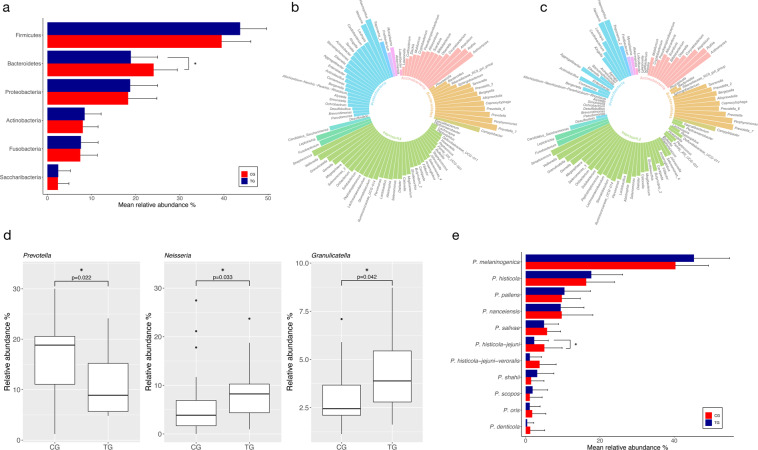
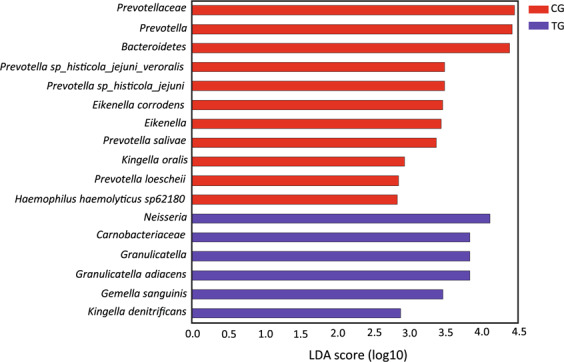
Oral hygiene products containing tin are suitable to prevent erosive tooth wear, yet effects on the oral microbiota are not known yet. Therefore, this study determined the salivary microbiome of 16 participants using products with stannous ions for three years (TG) compared with a control group (CG) to assess their influence on the microbiota. Participants were included in a randomized controlled clinical trial (RCT) with biannual visits. Illumina Miseq sequencing revealed as most abundant genera: Streptococcus (TG 14.3%; CG 13.0%), Veillonella (TG 11.3%; CG 10.9%), Prevotella (TG 7.0%; CG 9.8%), Haemophilus (TG 6.6%; CG 7.2%), Porphyromonas (TG 5.9%, CG 5.1%), Leptotrichia (TG 5.8%; CG 4.9%), Actinomyces (TG 4.0%; CG 4.6%) and Neisseria (TG 5.4%; CG 4.2%). Beta-Diversity was not significantly different between groups at both time points, although significant differences between groups were found for certain taxa after three years. The genus Prevotella was found in higher abundance in CG whereas Neisseria and Granulicatella, health-associated taxa, were found more abundantly in TG. Salivary microbiota after three years reflected a composition associated with oral health, hence continual use as a preventive measure for dental erosion can be considered safe and benefitting oral health for patients with a high risk of erosion.
含锡的口腔卫生产品适合预防侵蚀性牙齿磨损,但对口腔微生物群的影响尚不清楚。因此,本研究使用含有亚锡离子的产品对 16 名参与者的唾液微生物组进行了三年的研究(TG),并与对照组(CG)进行了比较,以评估它们对微生物群的影响。参与者被纳入一项为期三年的随机对照临床试验(RCT),每半年进行一次随访。Illumina Miseq 测序显示最丰富的属为:链球菌(TG 14.3%;CG 13.0%)、韦荣球菌(TG 11.3%;CG 10.9%)、普雷沃菌(TG 7.0%;CG 9.8%)、嗜血杆菌(TG 6.6%;CG 7.2%)、卟啉单胞菌(TG 5.9%,CG 5.1%)、勒克氏菌(TG 5.8%;CG 4.9%)、放线菌(TG 4.0%;CG 4.6%)和奈瑟菌(TG 5.4%;CG 4.2%)。在两个时间点,两组之间的β多样性没有显著差异,尽管三年后两组之间的某些分类群存在显著差异。CG 中发现普雷沃菌属的丰度较高,而奈瑟菌属和颗粒亚种属,与健康相关的分类群,在 TG 中发现的丰度较高。三年后的唾液微生物组反映了与口腔健康相关的组成,因此,作为预防牙酸蚀症的一种预防措施,持续使用可以被认为是安全的,并有益于高酸蚀风险患者的口腔健康。