Chen Dongying, Schwartz Martin A, Simons Michael
Yale Cardiovascular Research Center, Departments of Internal Medicine, Yale University School of Medicine, New Haven, CT, United States.
Department of Cell Biology, Yale University School of Medicine, New Haven, CT, United States.
Front Cell Dev Biol. 2021 Jun 25;9:691335. doi: 10.3389/fcell.2021.691335. eCollection 2021.
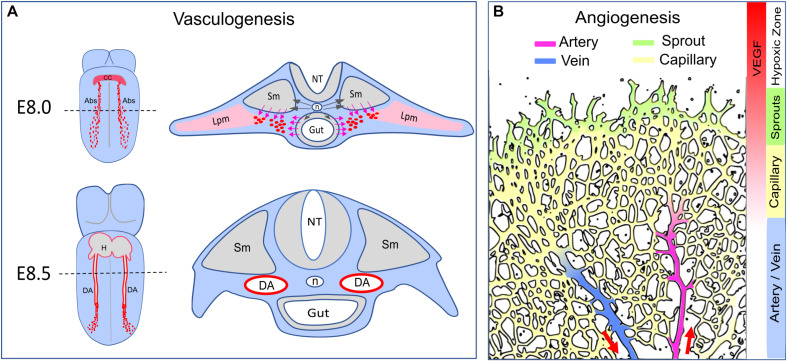
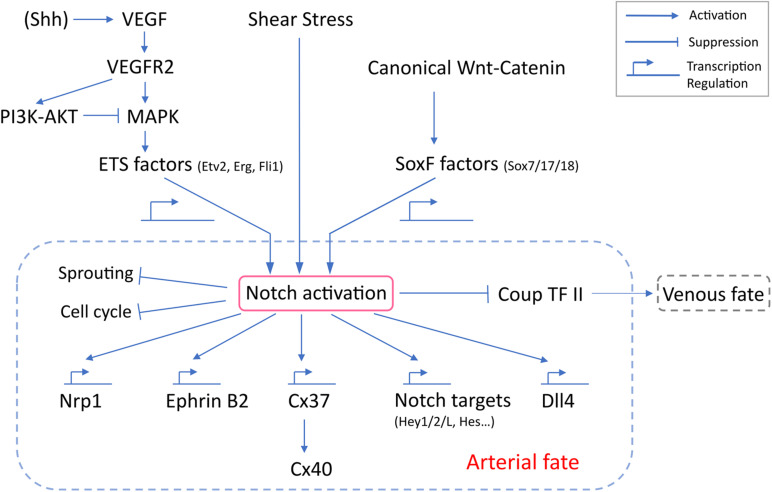
Blood vessel acquisition of arterial or venous fate is an adaptive phenomenon in response to increasing blood circulation during vascular morphogenesis. The past two decades of effort in this field led to development of a widely accepted paradigm of molecular regulators centering on VEGF and Notch signaling. More recent findings focused on shear stress-induced cell cycle arrest as a prerequisite for arterial specification substantially modify this traditional understanding. This review aims to summarize key molecular mechanisms that work in concert to drive the acquisition of arterial fate in two distinct developmental settings of vascular morphogenesis: vasculogenesis of the dorsal aorta and postnatal retinal angiogenesis. We will also discuss the questions and conceptual controversies that potentially point to novel directions of investigation and possible clinical relevance.
血管获得动脉或静脉命运是血管形态发生过程中对血液循环增加的一种适应性现象。过去二十年在该领域的努力促成了一种广泛接受的分子调节因子范式的发展,该范式以血管内皮生长因子(VEGF)和Notch信号为核心。最近的研究发现,剪切应力诱导的细胞周期停滞是动脉特化的先决条件,这极大地改变了这种传统认识。本综述旨在总结在血管形态发生的两种不同发育背景下协同作用以驱动动脉命运获得的关键分子机制:背主动脉的血管发生和出生后视网膜血管生成。我们还将讨论可能指向新研究方向和潜在临床相关性的问题及概念性争议。