Madan Jagmeet, Desai Sharvari, Moitra Panchali, Salis Sheryl, Agashe Shubhada, Battalwar Rekha, Mehta Anushree, Kamble Rachana, Kalita Soumik, Phatak Ajay Gajanan, Udipi Shobha A, Vaidya Rama A, Vaidya Ashok B
Sir Vithaldas Thackersey College of Home Science (Autonomous), Shreemati Nathibai Damodar Thackersey (SNDT) Women's University, Mumbai, India.
Nurture Health Solutions, Mumbai, India.
Front Nutr. 2021 Jun 24;8:668622. doi: 10.3389/fnut.2021.668622. eCollection 2021.
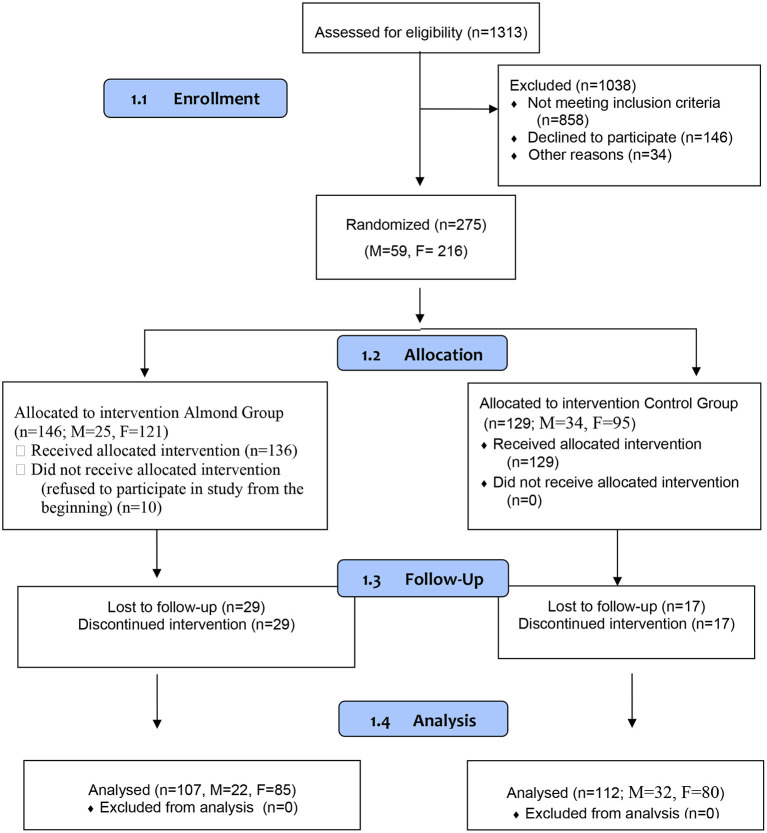
A large percentage of the Indian population has diabetes or is at risk of pre-diabetes. Almond consumption has shown benefits on cardiometabolic risk factors in adults. This study explored the effect of almond consumption on determinants of metabolic dysfunction-blood glucose, lipids, insulin and selected inflammatory markers in adolescents and young adults aged 16-25 years from Mumbai city. This randomized controlled trial was conducted for a period of 90 days on individuals with impaired levels of fasting glucose levels between 100-125 mg/dL (5.6-6.9 mmol/L) and 2-h post-glucose value 140-199 mg/dL (7.8-11.0 mmol/L) and/or fasting insulin (≥15 mIU/ml)/stimulated insulin (≥80 mIU/ml). Of 1,313 individuals screened, 421 met the inclusion criteria, of which 275 consented to participate and 219 completed the trial. The trial was registered with Clinical Trials Registry India (CTRI) CTRI/2018/02/011927. The almonds group ( = 107) consumed 56 g almonds daily, the control group ( = 112) was provided an iso-caloric cereal-pulse based snack. At baseline and endline, blood glucose, insulin, HbAc, LDL-c, HDL-c, total and ox-cholesterol, triglycerides, hs-CRP, IL-6, TNF-α, adiponectin, leptin were measured and HOMA-IR and FG:FI ratios were calculated. Dietary intakes were assessed. The anthropometric measurements, biochemical markers as well as macronutrient intakes did not differ significantly between the two groups at baseline. Almond consumption significantly decreased HbAc, total cholesterol and LDL-c. Stimulated insulin decreased post-intervention in both groups, but the decrease was greater in the almonds group. Fasting glucose was reduced post intervention in the controls with no change in the almonds group. FG:FI ratio decreased in the almonds group. TNF-α and IL-6 decreased in the almonds group, while it increased in the control group. Our results showed that almonds reduced HbA1c, LDL-c and total cholesterol levels in just 12 weeks of consumption in these adolescents and young adults who were at risk for developing diabetes. Almonds can be considered as part of food-based strategies for preventing pre-diabetes. ClinicalTrials.gov, identifier: CTRI/2018/02/011927.
很大比例的印度人口患有糖尿病或处于糖尿病前期风险。食用杏仁已显示出对成年人心脏代谢风险因素有益。本研究探讨了食用杏仁对孟买市16至25岁青少年和年轻人代谢功能障碍的决定因素——血糖、血脂、胰岛素和选定的炎症标志物的影响。这项随机对照试验对空腹血糖水平在100 - 125毫克/分升(5.6 - 6.9毫摩尔/升)之间、葡萄糖后2小时值在140 - 199毫克/分升(7.8 - 11.0毫摩尔/升)和/或空腹胰岛素(≥15毫国际单位/毫升)/刺激后胰岛素(≥80毫国际单位/毫升)水平受损的个体进行了为期90天的试验。在筛查的1313名个体中,421人符合纳入标准,其中275人同意参与,219人完成了试验。该试验已在印度临床试验注册中心(CTRI)注册,注册号为CTRI/2018/02/011927。杏仁组(n = 107)每天食用56克杏仁,对照组(n = 112)食用等热量的基于谷物 - 豆类的零食。在基线和试验结束时,测量了血糖、胰岛素、糖化血红蛋白、低密度脂蛋白胆固醇、高密度脂蛋白胆固醇、总胆固醇和氧化胆固醇、甘油三酯、高敏C反应蛋白、白细胞介素 - 6、肿瘤坏死因子 - α、脂联素、瘦素,并计算了胰岛素抵抗指数(HOMA - IR)和空腹血糖:空腹胰岛素比值(FG:FI)。评估了饮食摄入量。两组在基线时人体测量指标、生化标志物以及常量营养素摄入量无显著差异。食用杏仁显著降低了糖化血红蛋白、总胆固醇和低密度脂蛋白胆固醇。两组干预后刺激后胰岛素均下降,但杏仁组下降幅度更大。对照组干预后空腹血糖降低,杏仁组无变化。杏仁组的FG:FI比值下降。杏仁组肿瘤坏死因子 - α和白细胞介素 - 6下降,而对照组升高。我们的结果表明,在这些有患糖尿病风险的青少年和年轻人中,食用杏仁仅12周就降低了糖化血红蛋白、低密度脂蛋白胆固醇和总胆固醇水平。杏仁可被视为预防糖尿病前期基于食物的策略的一部分。ClinicalTrials.gov标识符:CTRI/2018/02/011927。